

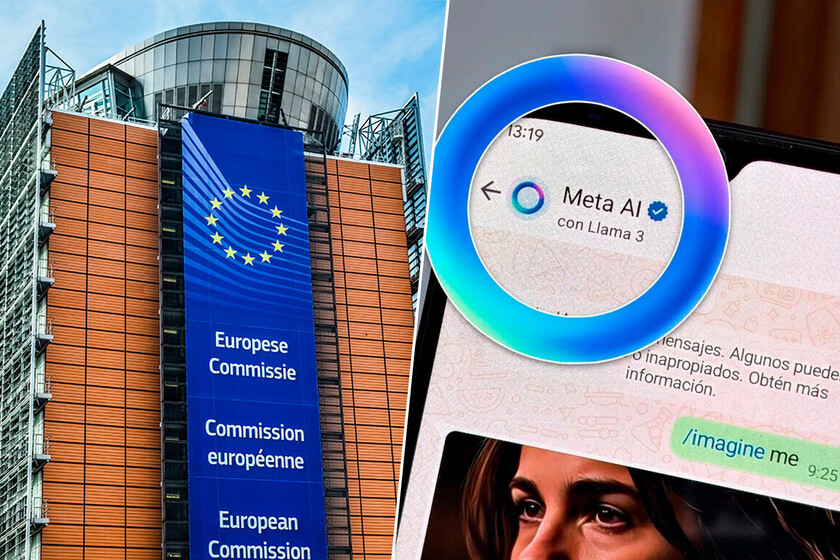
The European Commission has been fiercely fighting against monopolies in the technology sector for years. The pursuit of Microsoft in the early 2000s was just the beginning. In 2018 the EU imposed a historic fine on Google for abuse of a dominant position with Android and last year they fined Facebook for the same reason. According to the Financial Times, Meta is going to once again sit in the dock accused of monopoly, this time for the forced integration of Meta AI into WhatsApp.
In the spotlight. The European Commission has not commented on the matter, but according to sources consulted by the Financial Times, Brussels is already investigating Meta for the integration of Meta AI into WhatsApp and the announcement will take place imminently. The case will be conducted under traditional monopoly laws and not under the Digital Markets Act or DMA.
The accusation. The investigation has not yet been confirmed by the European Commission, but internal sources have revealed that the main reason is the deployment of Meta AI within WhatsApp, its AI chatbot. As we already saw, there is no way to prevent it from being activated and there is no option to hide it either. Let us remember that WhatsApp is the most used messaging app in the world, with 3 billion active users.
Meta is already being investigated for this reason by the competition authority in Italy, which considers that the integration of Meta AI “could limit production, market access or technical development” in the AI chatbot sector.
Goal returns to the bench. Just a year ago, Meta entered the select club of companies fined by the European Commission for violating the antitrust rules of the European Union. On that occasion, the product that was the object of the accusation was Facebook, more specifically for forcing the use of Facebook Marketplace, which, like Meta AI in WhatsApp, was activated without users’ permission. After several years of investigation, the Commission concluded that the company had broken the law and made them pay a fine of 800 million euros. In April of this year they also had to pay 200 million for the case that forced them to consent to the transfer of data.
Historic fines. It has been cheap for Facebook if we compare it with other sanctions, such as the more than 4.3 billion that Google had to pay for abuse of a dominant position with Android, and it has not been the only one that Mountain View has had to pay. In September of this year the EU fined Google €2.95 billion for abusing its position in the digital advertising market and Brussels is currently preparing another case for how it classifies media results in its search results.
USA against. The Trump administration has attacked the DMA and the EU fines, which it described as unfair and discriminatory, threatening to start a tariff war. Europe’s response was forceful: technological regulation “is a sovereign right of the EU.” Obviously the heads of the technology companies have also positioned themselves against it and earlier this year, Mark Zuckerberg called on the US government to protect the technology companies from “European censorship”, so we can assume that this new investigation will not have been very amusing.
Judges in the US also see monopolies. At the same time as the criticism is occurring, in the United States there are also antitrust cases against large technology companies, such as the one that Google lost in 2024 and that threatened to force them to sell Chrome, although in the end they dodged the bullet. Meta also starred in a similar case recently in which they were accused of monopoly over WhatsApp and Instagram, but in this case they won. We will see what happens if Europe makes its case against WhatsApp official.
Images | European Commission, WorldOfSoftware Android
In WorldOfSoftware | The United States seems determined to break its monopolies. And it has an obvious victim between its eyebrows: Google
![5 Threats That Reshaped Web Security This Year [2025]](https://blogger.googleusercontent.com/img/b/R29vZ2xl/AVvXsEjQ51hMVtHfFQ2O7pCZYfK5WkypXg1Qury_AA_VudY5f_n7u8S8M4UJAy76w7DM1aBq1faDyuaOO4VJP7bIj1L1-AgNzZjQf0-kZlhU6kH-G4qDMkZFF_7YsL3v5R6d9PkpJcTegD7H01BySWNNs-m5toA_DTqVSVs-sCeLm5n1zJuLzs1_erWdl8asq4k/s790-rw-e365/reflectiz.jpg "5 Threats That Reshaped Web Security This Year [2025]")


