Almost 60 years after America won the first space race, the moon is once again the focus of a competition between superpowers: Who’ll be the first to put a nuclear-powered base on the lunar surface?
And just as President John F. Kennedy set a goal of landing astronauts on the moon and bringing them back safely “before the decade is out,” NASA and the Department of Energy have set another end-of-decade deadline for developing a nuclear reactor for use on the moon. The current plan calls for demonstrating a 40-kilowatt power plant by 2030.
Why 2030?
Roger Myers, an aerospace consultant who has been in the business of developing in-space power and propulsion systems for decades at NASA and Aerojet Rocketdyne, says the timing is tied to China’s ambition to set up its own moon base by 2035.
“China has announced many times in the last few years that they plan to land their astronauts, their taikonauts, on the surface of the moon by 2030, and they want to have a sustained presence on the surface of the moon by 2035,” he says in the latest episode of the Fiction Science podcast. “The United States has a decision to make: Do we want every human on the planet to look up every night and see just a Chinese flag? Or do we want them to see a Chinese and an American flag?”
Myers says there are economic reasons as well as geopolitical reasons for establishing a sustainable lunar base on the moon.
“As we think forward 10 years, 20 years, and ask ourselves what future we want for our economy, one of the big questions is, ‘How do we grow the space economy beyond low Earth orbit?’ And to do that, we need resources,” he says. “If we want ready access to resources, we’ve got to go to the moon.”
Those resources could include helium-3, which is more abundant on the moon than it is on Earth. Seattle-based Interlune is already working on a plan to extract helium-3 from lunar soil and ship it out for use in quantum computers, neutron detectors, medical scanning systems and future-generation fusion reactors. The price for helium-3 is said to range as high as $20 million per kilogram.
Why nuclear?
The way Myers sees it, nuclear power is the energy source most suited for supporting long-term, continuous operations at a moon base. “Nuclear power is important because the lunar night is two weeks long,” Myers says. “There are a few places where you could use solar with power towers. … The challenge that we have is that to scale that to where we can use the power for resource exploitation to grow the economy, we need a lot of power. We need 100 kilowatts and up, and solar doesn’t scale well for that application.”
NASA Administrator Jared Isaacman agreed with that assessment last month during his second Senate confirmation hearing.
“I think NASA should be evolving to work on grand, almost mini-Manhattan Project nuclear programs that have the benefit for surface power applications, especially when you’re out of sunlight or you’re undertaking discovery missions — let’s say past Mars, for example, or even actually on the surface of Mars for manufacturing propellant.”

The federal government’s to-do list for space nuclear power draws upon recommendations that were detailed in an 84-page report Myers wrote up last year in collaboration with tech policy analyst Bhavya Lal.
“My co-author and I spent a lot of time in Washington briefing a lot of agencies and Capitol Hill, and so we see this continuing, mainly because of the geopolitical competition aspects of it,” Myers says. “Our government does not want our nation to be second. We want to lead. And if we’re going to lead, that means we need to establish a sustained presence on the surface of the moon, and we need to do that in the early 2030s.”
Myers notes that Congress appropriated $250 million for the current fiscal year to support the development of a nuclear reactor for the moon — “which is, in fact, pretty much what we recommended.”
NASA and the Department of Energy are expected to enlist commercial partners that could include General Atomics and Westinghouse Electric, the heavy-hitters of the nuclear power industry; aerospace powerhouses such as Lockheed Martin and L3Harris Technologies; and startups such as Radiant, a nuclear technology venture that was founded by SpaceX veterans.
Myers says the nuclear power plants that go to the moon are likely to be small modular reactors, or SMRs, which are also attracting interest for power generation here on Earth. TerraPower, a Seattle-area venture co-founded by Bill Gates, and Oregon-based NuScale Power are among the many companies working on SMR technology.
What could go wrong?
The potential perils of space nuclear power have been the stuff of science fiction since the dawn of the Atomic Age and the Space Age.
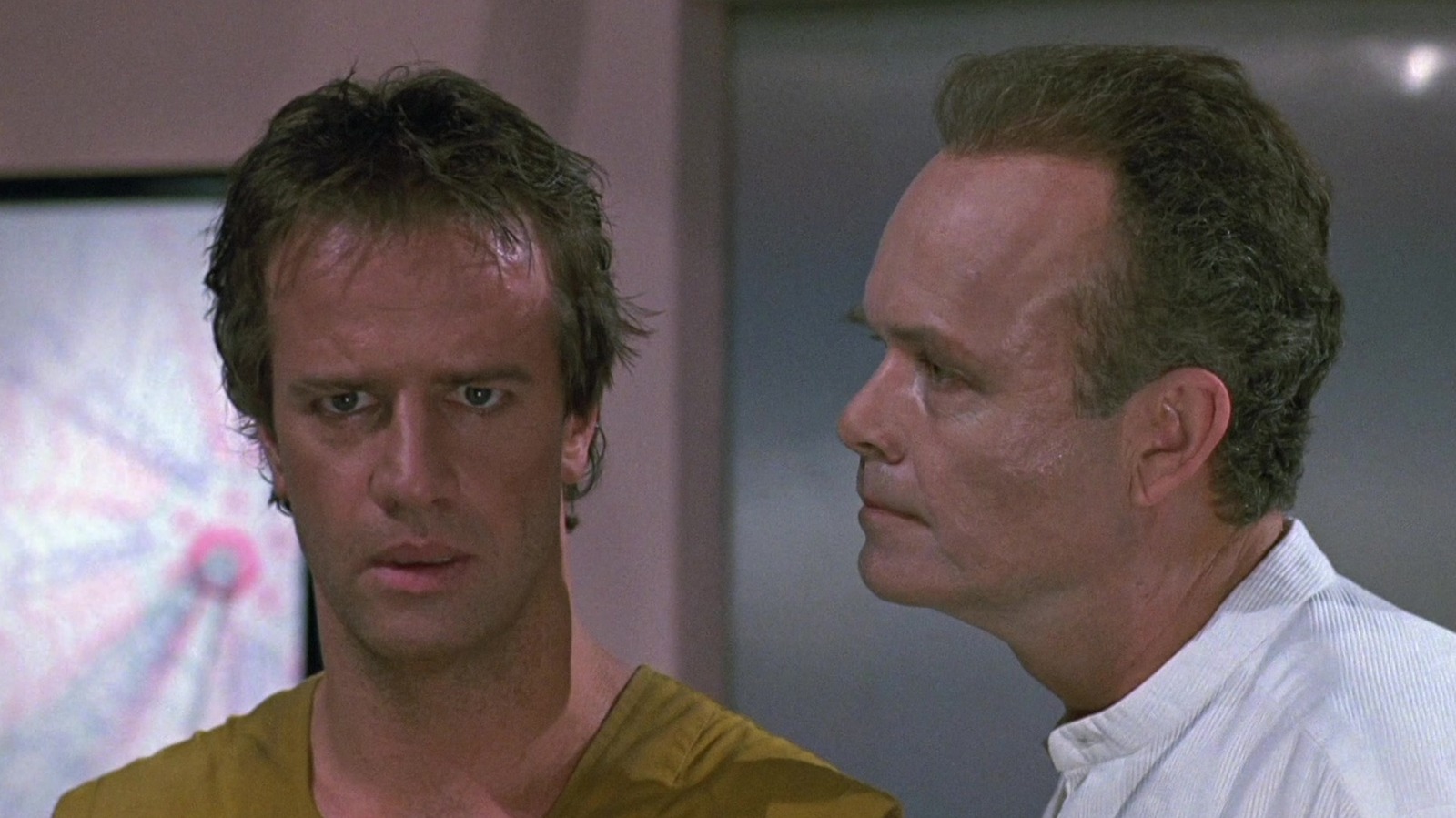
In the 1950 movie “Destination Moon,” astronauts have to cope with the legal and technical problems associated with their rocket’s nuclear propulsion system. A nuclear waste explosion knocks the moon out of its orbit around Earth in “Space 1999,” a TV show that aired in the 1970s. And in the second season of Apple TV’s “For All Mankind,” astronauts narrowly avert a nuclear reactor meltdown on the moon.
Myers says the scale of the nuclear reactors that are being designed for in-space operation makes such sci-fi nightmares far less likely. “The nice thing about these small reactors is, they don’t melt down,” he says. “There’s not enough thermal energy in them to result in a meltdown.”
What about the nuclear waste issue? “We’re only talking about a few of these [reactors] on the surface of the moon, even to get to megawatts. … And so you’d probably just bury them once you have run them for 10 or 15 years, or however long,” Myers says. “By that time, we’ll have bulldozers on the surface of the moon, and you would dig a hole, and you’d put the thing in there and bury it. So that’s how you would dispose of the waste.”
A company called Deep Isolation is already working on this deep-borehole strategy for next-generation nuclear waste disposal on Earth. Deep Isolation has its headquarters in California, but it also has an office in Richland, Wash., a global hot spot for nuclear engineering.
Although Myers thinks nuclear power is the best energy source for a moon base, he acknowledges that other energy technologies also have their roles to play on the final frontier. Several Seattle-area companies are working on their own space power initiatives:
- Zeno Power is developing a new kind of nuclear battery for rovers on the moon and Mars.
- Jeff Bezos’ Blue Origin space venture has a project called Blue Alchemist that aims to manufacture solar cells from lunar materials.
- PowerLight Technologies partnered with Blue Origin to design a system that would use laser beams to transmit power on the moon.
- WiBotic’s wireless charging technology is being put to use in a system that Astrobotic is developing to charge up moon rovers.
“Rovers might use an orbiting network of solar power satellites that are beaming power down to the surface, or they might use a power tower, depending on the range of transmission,” Myers says. “My point in the report was that if we want multiple astronauts on the surface of the moon through a night, that’s probably a minimum of 20 to 40 kilowatts of power. And that’s where you really start to need nuclear.”
Roger Myers is due to discuss space nuclear power and the role it will play in future deep-space missions at 2 p.m. Saturday, Jan. 31, at Seattle’s Museum of Flight. The event is free for museum members and included with museum admission. Check out the museum’s website for further information about Myers’ talk, and check out “Weighing the Future: Strategic Options for U.S. Space Nuclear Leadership” for the detailed road map drawn up by Myers and Bhavya Lal.
The original version of this post was published on Cosmic Log. Fiction Science is included in FeedSpot’s 100 Best Sci-Fi Podcasts. Stay tuned for future episodes of the Fiction Science podcast via Apple, Spotify, Player.fm, Pocket Casts and Podchaser. If you like Fiction Science, please rate the podcast and subscribe to get alerts for future episodes.