For the fourth consecutive month, the prices of photovoltaic modules increased further in April 2026. Despite contradictory signals from the production side, the upward trend shows no sign of slowing down.
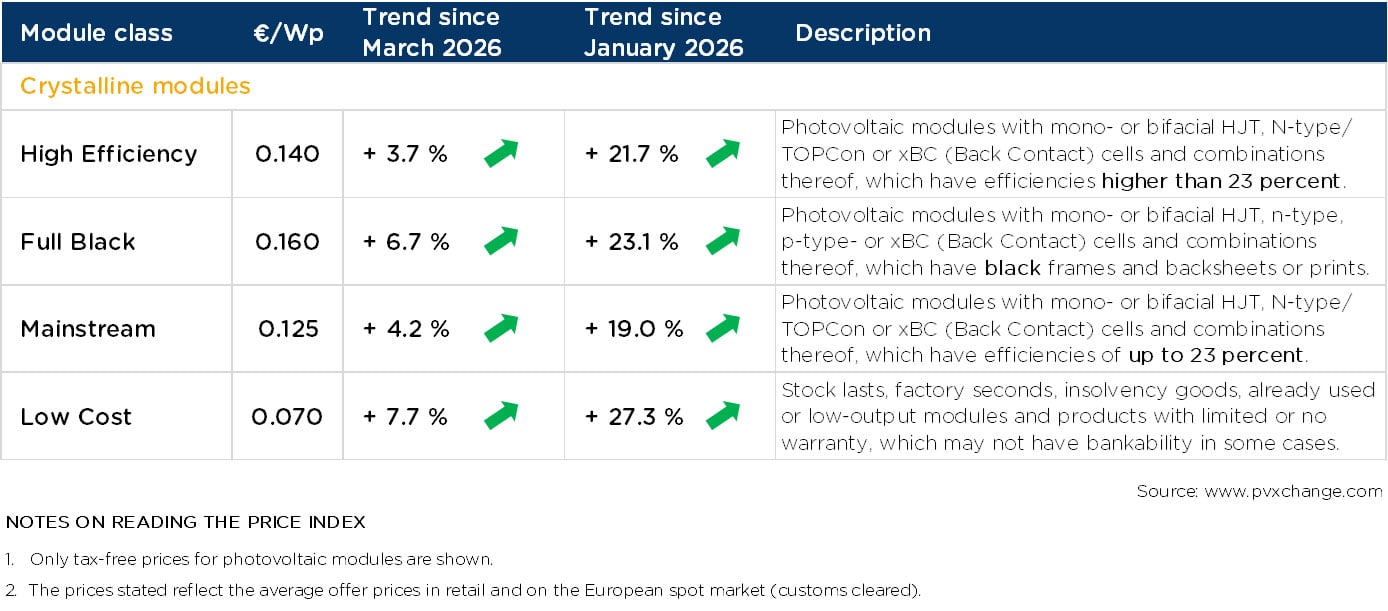
Prices of photovoltaic modules increased further in April 2026, for the fourth consecutive month. Between March and April, they increased by 5.5% on average, all categories combined, even though certain upstream costs, such as polysilicon, have been declining for several weeks. The end of export tax reimbursement by China, which came into force on April 1, should also have weighed on prices, but for the moment, nothing is happening.
Since January, all segments have been on an upward trend. Standard modules took 19%, high-efficiency models 21.7%, all-black modules 23.1% and low-cost models 27.3%.
Demand still strong
This movement is part of a context of continued sustained demand. Economic uncertainty and tensions in the Middle East continue to fuel interest in energy independence, as installers post full order books and developers press ahead with projects even without subsidies. The residential market remains particularly dynamic, with a marked attraction for entirely black modules, highly sought after for their discreet aesthetic, but also more exposed to supply tensions. Over one month, this category also shows the most marked increase with +6.7% since March, ahead of low cost models at +7.7%.
A tighter offer
The real driving force behind this surge, however, lies on the supply side. At the start of the year, several Chinese manufacturers reduced their production rates to avoid a new price war, which tightened availability. Modules now only arrive in Europe on order, or in the volumes stipulated by contract, with longer lead times and sometimes increases accepted on orders already signed. As Martin Schachinger, co-founder and managing director of pvXchange, summarizes, the days when panels were shipped to Europe by the container load, purely on speculation, seem to be over.
Also read: Balcony solar kits: what are the real benefits?
Bad timing
This price increase comes at the worst time for French individuals. While the cost of installations is rising again on the global market, the government is preparing to significantly reduce support for small solar power, with the announced elimination of the self-consumption bonus and a further reduction in the surplus feed-in tariff. The double effect risks lastingly slowing down the growth of residential solar power in France.
👉🏻 Follow tech news in real time: add 01net to your sources on Google, and subscribe to our WhatsApp channel.
Source :
pvXchange