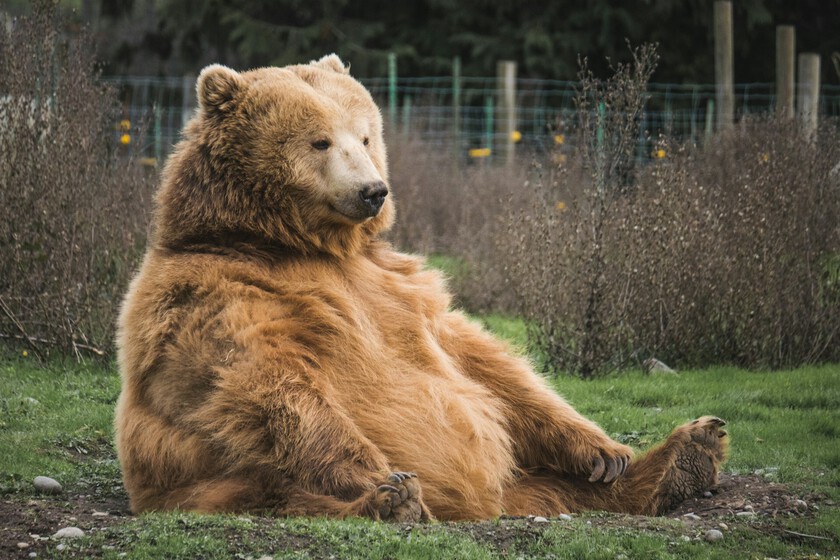
In recent decades, the image of the unchanging bear of the wild has given way to a different reality. Science is now seeing how bears are changing their physiognomy, their DNA and their way of interacting with the world in order to survive two great pressures: persecution by humans and climate change.
The Italian experiment. The most surprising case is that of the Apennine brown bear in Italy. For centuries, this animal has lived on a biological island surrounded by civilization that has managed to change the animal both physically and genetically. This is something that science itself has collected and that has been seen in the weight of the animal, since this animal weighs an average of between 140 and 210 kilos, while its closest relatives usually weigh 350 kilos.
And this was not a conscious selection, because for generations humans systematically eliminated the largest, boldest and most conflictive specimens. Those that remained in the ecosystem were the smallest and also the most docile specimens that began to reproduce.
Selection of the shy ones. This reality connects with Alejandro Martínez-Abraín’s theories about “shy-selected” populations or selected for their shyness. According to this concept, historical hunting not only reduced the number of predators, but acted as a psychological filter. We have pruned the personality of the species, eliminating the brave and leaving behind a lineage of animals whose main characteristic is the extreme avoidance of human beings. with the aim of not giving us problems.
Also in the Cantabrian Sea. While the character of the bear changes in Italy, if we come to Spain it is easy to see how we are breaking the calendar of our own species. In the north of the peninsula, climate change has begun to dismantle hibernation, one of the most sacred biological processes of the species.
Data collected since the mid-1990s shows a clear trend: females are leaving their nests earlier and earlier due to rising spring temperatures. In this way, what once represented an awakening regulated by biology and food availability at the end of April or May, is now an uncertain exit conditioned by shorter winters.
The hidden biological cost. By leaving the burrow early, mothers with babies face a mountain that has not yet fully awakened because spring has not arrived. In this way, the bear cubs, vulnerable and with a developing immune system, are exposed to pathogens and also to the attack of adult males that also activate early.
In this way, climate change is not only warming the air, it is forcing the bear to live in a time lag with its own ecosystem. Something that also adds to the scarcity of resources that can compromise their survival.
In the Arctic. Here the situation has reached an almost science-fiction level of genomic complexity, since the subpopulation of polar bears in southeastern Greenland has become the living laboratory of adaptation to global warming.
These animals live in an environment that no longer has the sea ice necessary to hunt seals for much of the year, but they have found an emergency solution: using the glacial ice that breaks off from the fjords.
Inside. The most profound adaptation they are undergoing is within their cells, since researchers point out that they have identified more than 1,500 specific fragments that are active specifically in this population. These elements seem to be altering fat metabolism, since they cannot depend on seal fat as they have until now. That is why they have to look for other sources of fat such as eggs, poultry or reindeer.
To do this, their genetic profile is changing to allow them to process terrestrial energy sources, a metabolic transformation that could be the species’ last line of defense against an ice-free Arctic. Which is what is being achieved with the increase in the Earth’s temperature.
A new coexistence. This global metamorphosis poses a management dilemma for the 21st century, since with the abandonment of rural areas and the rise of nature tourism, encounters between humans and bears are more frequent than ever. But this is a problem, since although the ‘shy’ ones have remained in nature, the lack of fear they have can reverse the trend of security that we have before them.
That is why the key to the future is not only in protecting the animal, but in managing its behavior. The goal is to achieve what they call “zero habituated bears,” which implies the use of more aggressive measures: from the use of firecrackers and rubber bullets to reinforce fear of humans, to surgical waste management to prevent bears from seeing towns as easy food.
Great plasticity. This is a great characteristic of bears as we have seen, since they have reduced their size in Italy, they come out of hibernation earlier in Spain and they are more omnivorous in the Arctic. But this “redesign” is also a reminder of our omnipotence: even when we try to save species, we end up altering their very essence so that they can survive on a planet we have made in our image.
Images | Mark Basarab
In WorldOfSoftware | Faced with the largest flood of wild bears in memory, Japan has taken a measure: emergency hunts