
Every marketer knows the first sentence can make or break a reader’s attention. What’s new is that it now decides how AI engines interpret your content, too.
When Google’s AI Overviews, ChatGPT, or Perplexity scan a page, they start by reading your opening paragraph. That section tells them what your content is about, who wrote it, and whether you’re credible enough to summarize.
If your intro is vague or stuffed with fluff, AI can misread your intent, strip out your expertise, or even prioritize someone else’s answer. But when your opening 200 words are structured with clarity, context, and authority, you increase the chance of being cited or summarized accurately.
This guide breaks down how AI engines process intros, what they look for, and how to rewrite your first 200 words so your content is easy to interpret and hard to ignore.
(If you’re counting, this intro was 142 words.)
Contents
The hidden ranking signals in your first 200 words
AI engines extract meaning from the top down. Unlike humans, who skim, AI systems classify information.
Your intro influences:
- How your topic is interpreted.
- Whether your content meets the “credibility threshold.”
- How your article is summarized.
- If you get cited or ignored in AI results.
This is backed by data:
- A study from Authoritas found a 38% higher likelihood of appearing in AI Overviews when entity signals appear in the opening paragraph.
- Search Engine Land’s research claims that the most cited sources in AI Overviews include a clear scope and expertise markers within the first 150 words.
When an intro lacks these signals, your page becomes “floating text.” AI can read it, but it cannot confidently classify or reuse it.
For SMBs, this is a strategic gap that can be filled immediately, without technical SEO or large budgets.
🔎 Need help understanding the modern rules for SEO? Download our free guide >> How to Do SEO Right—Right Now!
How AI engines parse intros
AI engines follow a predictable parsing pattern. Understanding it helps you design intros that get cited more often.
1. They identify entities and relationships
AI extracts the foundational nouns that define the content. These include:
- The business or author
- The audience
- The topic
- The platform being discussed
- Any supporting references
This helps the model map your content to the Knowledge Graph or internal embeddings. Without clear entities, your content becomes floating text with no anchor.
Example: Bill’s Plumbing’s Plumbing Services page starts by identifying the business, the service area, and the audience before describing any service details:
“When it comes to plumbing needs in the Greater Colorado Springs area, Bill’s Plumbing and Drains is the trusted, reliable company to call!
Bill’s Plumbing and Drains currently has 11 service technicians to meet your needs. These typically fall into a few categories, and every technician can help.”
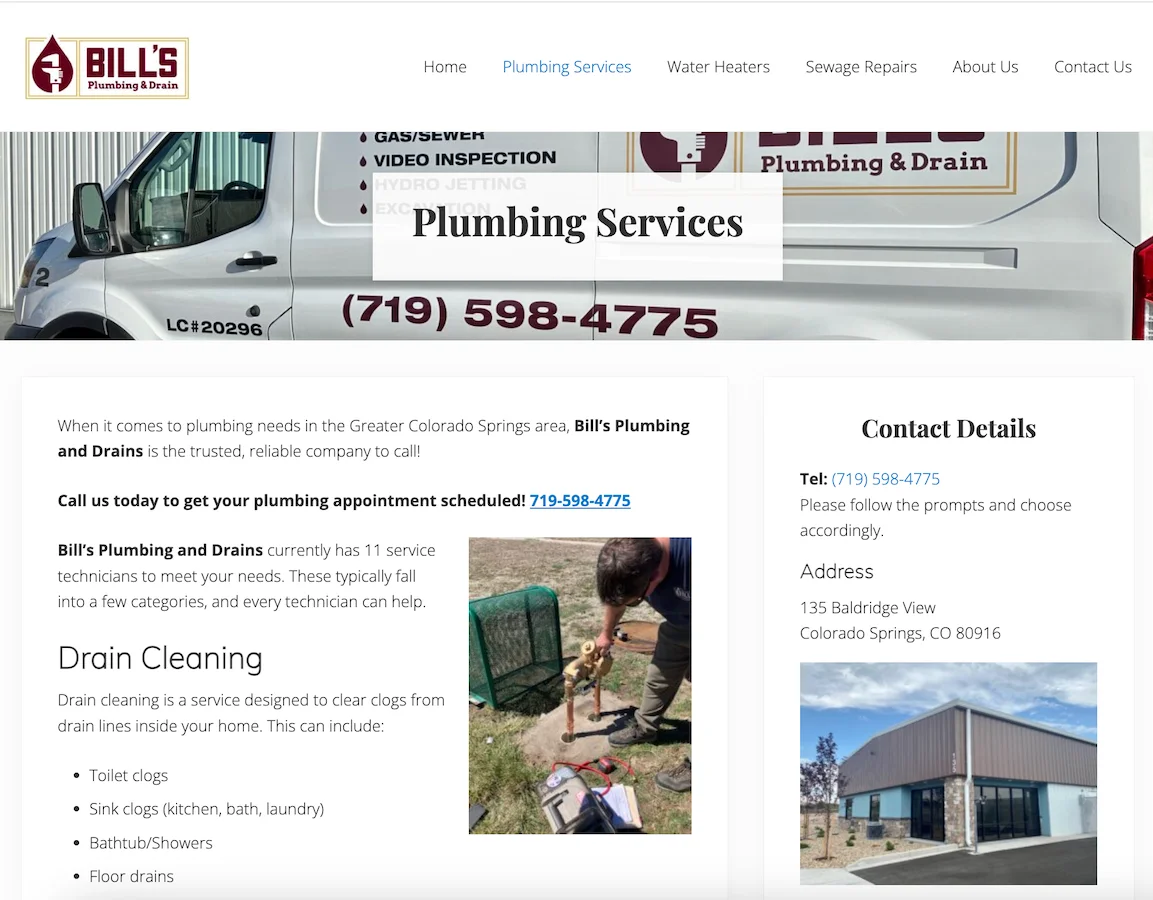
This gives AI:
- Entity: Bill’s Plumbing & Drain Service
- Topic: Plumbing repair
- Audience: Local homeowners
- Region: Greater Colorado Springs area
- Expertise: 11 service technicians
The intro is short, factual, and structured in a way that AI can reuse confidently. It tells exactly who is speaking, who the content helps, and which domain of expertise the page belongs to. These early signals increase the likelihood of being interpreted correctly and cited in generative answers.
2. They weigh author and source credibility
AI checks who wrote the content. It uses:
- Names
- Titles
- Roles
- Business types
- Years of experience
- Certifications
- Context from previous pages on the same domain
When an intro skips identity, trust signals never appear.
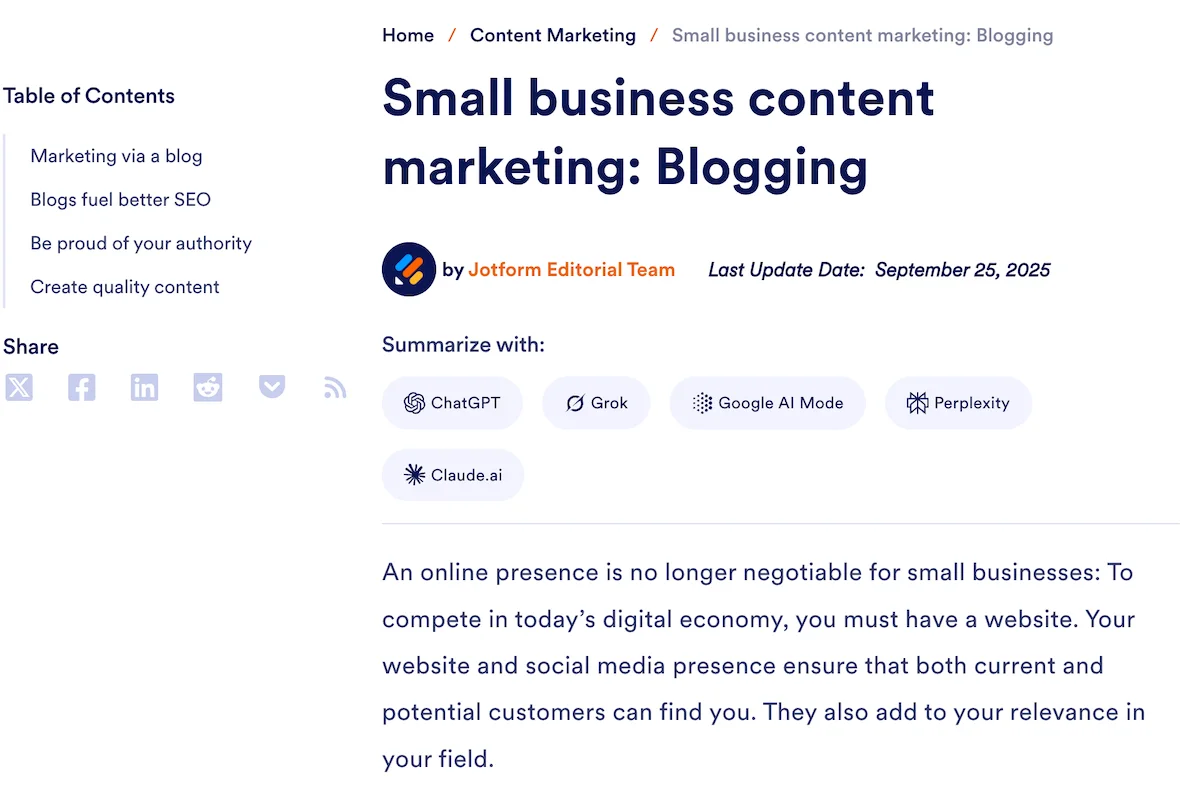
Weak: “This article explains how to do content marketing for your small business.”
Strong: “This guide from Jotform, written by the Jotform Editorial Team, provides small business owners with clear steps to build an effective content marketing engine.”
3. They detect intent and format
Before AI attempts to summarize you, it wants to know what you are trying to do. Clear format signals help it avoid misclassification.
Examples of intent phrases:
- “This guide explains…”
- “This tutorial walks through…”
- “This checklist helps you…”
- “This review compares…”
When the intent is clear, AI categorizes the page as instructional, transactional, comparative, or educational.
Example: Gusto primarily writes for small and mid-size businesses and makes intent explicit in the opening sentence of many guides. When they have content that doesn’t match the SMB audience fully, they add a disclaimer.
At the very beginning of this article, What is a Capital Account and How Does It Work?, you can see this: NOTE: This post is relevant to disregarded entities, partnerships, and S corps. It is not applicable to C corp owners.

This does two important things:
- It clearly defines the audience for readers.
- It gives AI an unambiguous scope and context for the content.
That kind of upfront clarification helps AI avoid pulling the page into the wrong summaries and improves how accurately the content is represented.
4. They map topical hierarchies
AI engines need to understand the scope early. They want to know what the page covers and what boundaries it stays within.
Example: Jobber’s HVAC dispatching guide opens with a clear description of what readers can expect within the post.
“In this post, you’ll find practical tips for productive dispatching—and how to win your time back with convenient HVAC dispatching tools.”
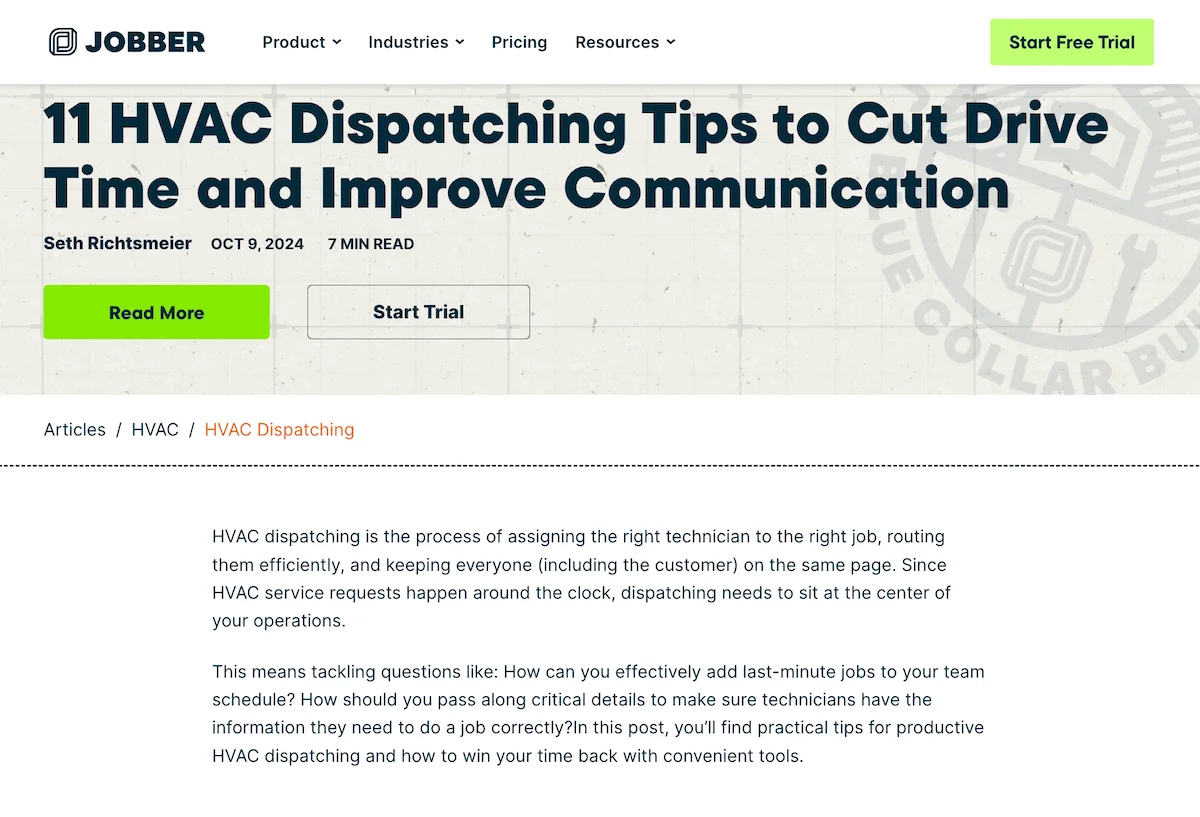
Three topics, stated clearly, which help AI build a hierarchical map:
- Audience: HVAC businesses
- Topic: HVAC
- Subtopics: HVAC dispatching
That clarity leads to more accurate summaries.
🚨 Get ready-to-use AI prompts for email marketing, social media, content creation, and more >> 200+ Best AI Prompts Any Business Can Use
The 3 core signals you need in your first 200 words
These signals determine if your page is trusted, cite-worthy, and easy for AI to interpret.
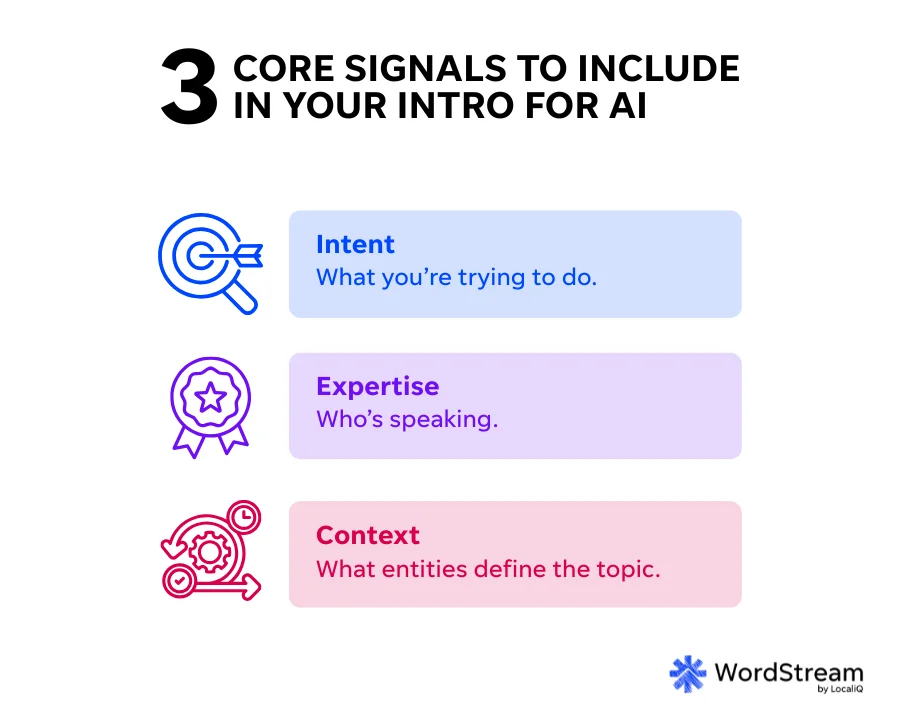
1. Intent signal: What you’re trying to do
Your intro should state the page’s purpose in the first two sentences.
Good example: “This guide explains how small businesses can structure their blog intros so AI Overviews interpret them correctly.”
No fluff. No buildup. Clear purpose.
2. Expertise signal: Who’s speaking
Introduce the author, business, or data source early.
Example: “Written by the content team at LocaliQ, a digital-marketing platform that helps SMBs attract and convert customers via paid search, display, SEO, social, email, and AI-powered lead management.”
Expertise signals reduce ambiguity. They differentiate your content from generic AI-generated text.
3. Context signal: What entities define the topic
This is where you name the concepts AI needs to understand.
Examples:
- Google AI Overviews
- Local SEO for service businesses
- Facebook Ads for small retailers
Clear context equals better classification.
Examples of good (and not-so-good) intros for AI visibility
Here are some practical examples that show how framing, intent, and context affect how AI interprets a page.
Example 1: Clear framing (Positive example)
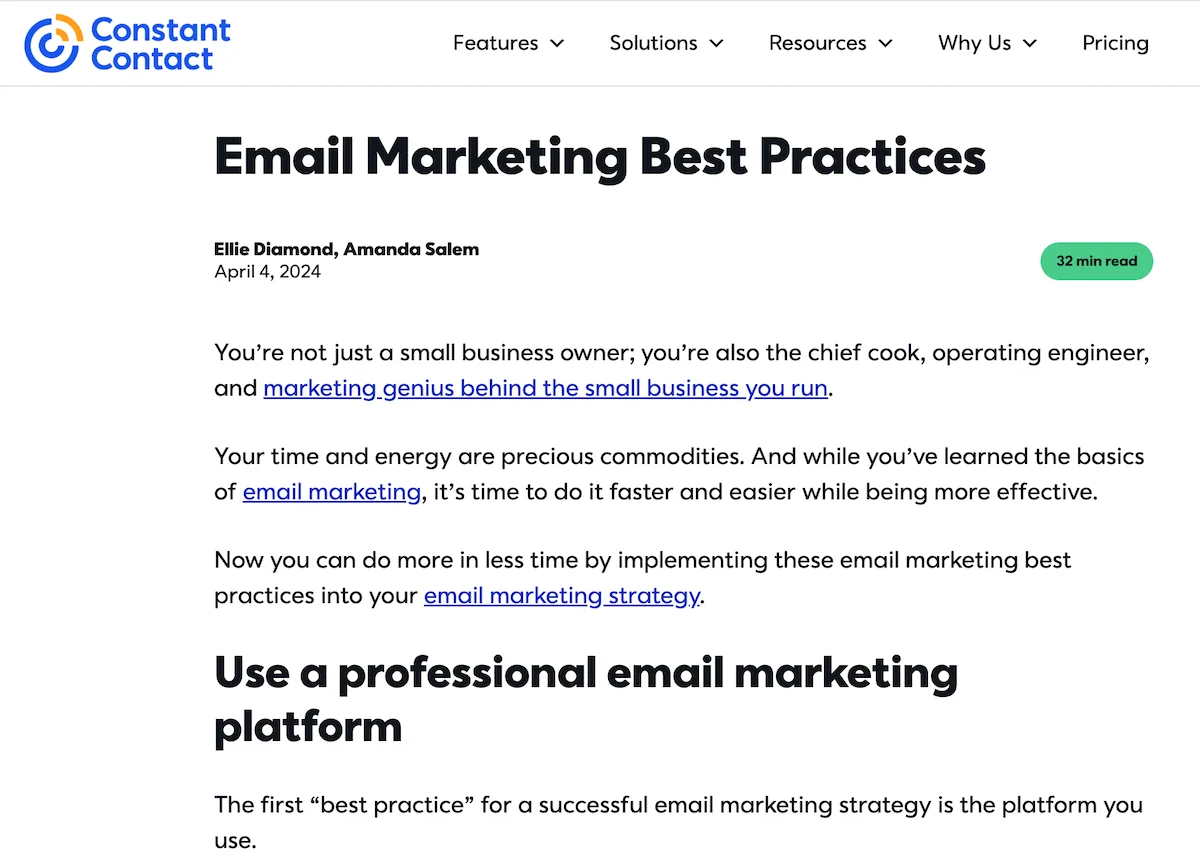
Page: Constant Contact – Email Marketing Best Practices
Why it works:
- Opens with a problem that affects small businesses.
- Defines the audience immediately.
- Uses direct language.
- Context appears early (“email marketing,” “small businesses,” “engagement”).
Example 2: Weak framing (Negative example)
Page: Generic small-business blog with “The digital world is evolving quickly” in the intro.
Why it fails:
- No entity.
- No topic.
- No audience.
- No intent.
AI has no starting point, so it ignores the page.
Example 3: Strong EEAT intro
Page: LawnStarter – How Much Does Lawn Care Cost in 2025?
Why it works:
- States the exact topic in the headline and first paragraph.
- Establishes LawnStarter’s role in the lawn-care industry early.
- Frames the content around a real decision lawn care customers and providers make.
- Includes pricing context, location variables, and service scope.
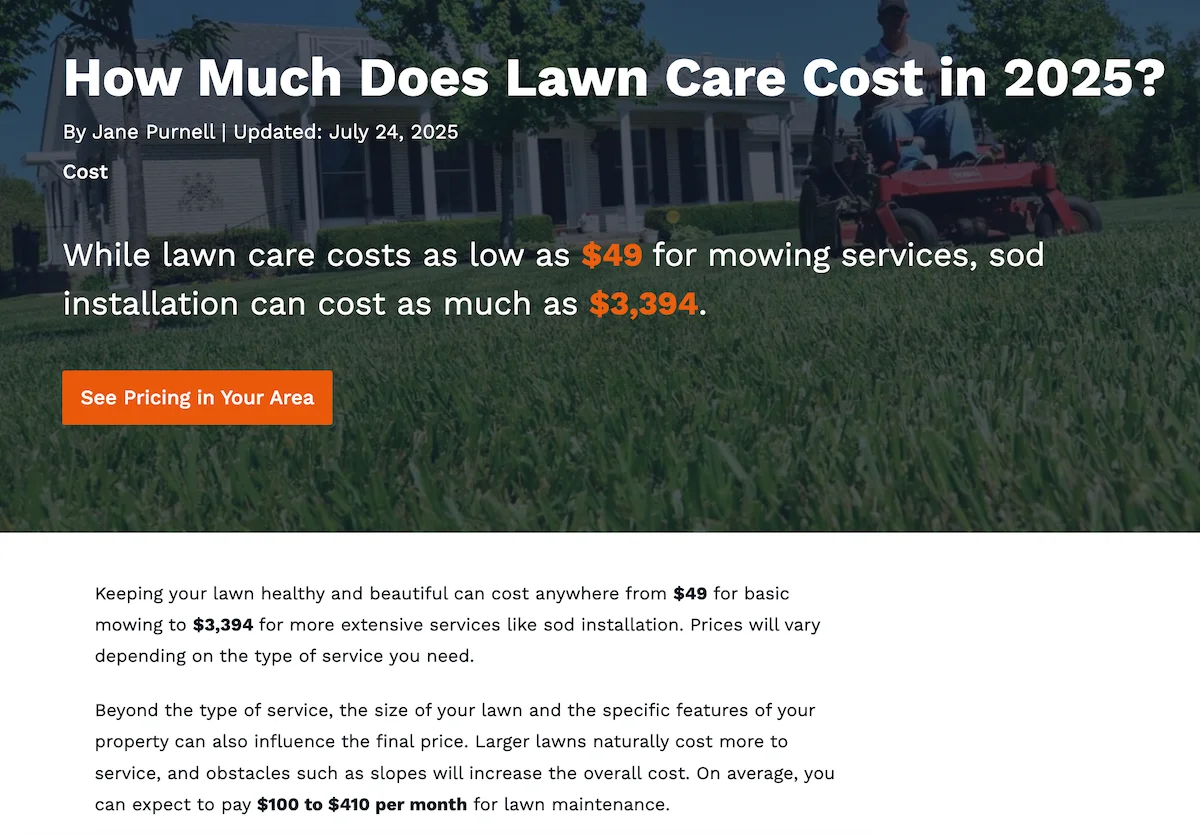
This makes it easy for AI to reuse the content in cost-related and local service queries.
Example 4: SMB context
Page: Autoflow – How to Get More Google Reviews for Your Auto Repair Shop
Why it works:
- Speaks directly to auto repair shop owners, not drivers.
- Defines the task immediately: getting more reviews for an auto repair shop.
- Uses explicit, operational language from the opening paragraph.
- Establishes Autoflow early as a relevant platform for auto repair businesses.
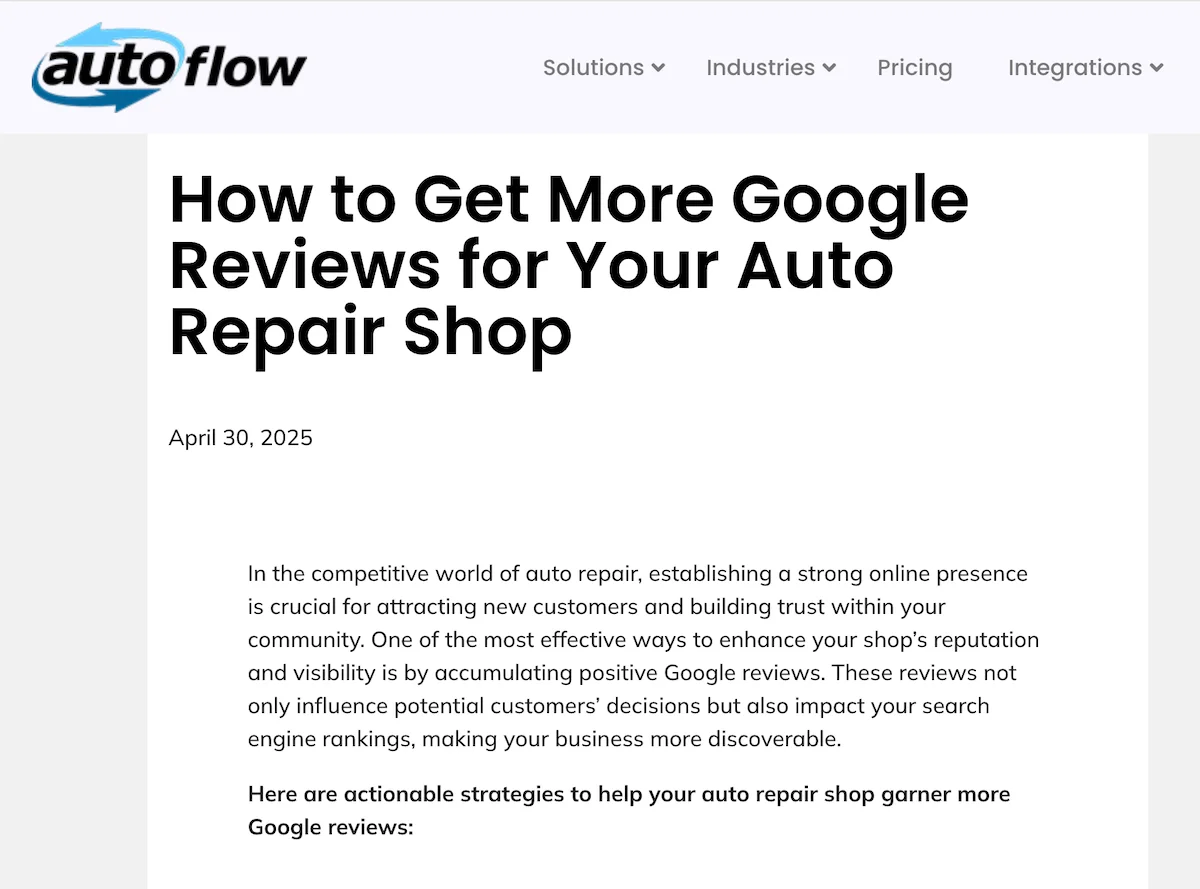
That gives AI a clean classification signal: instructional SMB content focused on local service reputation.
❌ Want to avoid catastrophic website mistakes? Download our free guide >> The 10 Most Common Website Mistakes (& How to Fix Them!)
How to rewrite your intros for AI visibility
This framework makes intros readable for humans and interpretable for AI.
Step 1: Front-load meaning
Put your primary keyword, the topic, and the audience in the first sentence.
Weak: “Today, we are going to talk about something many businesses struggle with.”
Strong: “This guide explains how small service businesses can ask for Google reviews in a way customers respond to.”
Step 2: Introduce expertise within 100 words
Mention your brand, your author, your customer base, or your original data.
Example: “This guide was created by the team at XY, a field service platform used by HVAC, plumbing, and electrical businesses.”
This tells AI the page is reliable.
Step 3: Clarify intent and format
AI engines look for signals like:
- Guide
- Tutorial
- Checklist
- Review
- Comparison
These markers reduce ambiguity.
Step 4: Add a mini summary sentence
AI needs a clean line it can extract.
Example: “By structuring your first 200 words to include clear entities, expertise, and intent, you make your page easier for AI to classify and feature.”
How to test and measure the impact of your AI-optimized intros
Updating your intros is just the first step. To see real benefits, you need to track how AI engines respond and refine based on what you learn.
What to monitor
- Google Search Console impressions: After updating your intro, watch for an increase in impressions (even if clicks stay flat). A rise often means better classification by AI.
- AI overview presence: Check whether your pages appear as cited sources in features like Authoritas’ new AI Overview tracker.
- LLM paraphrase analysis: Ask systems like ChatGPT or Perplexity specific questions that your page should answer. Does your intro show up in their responses?
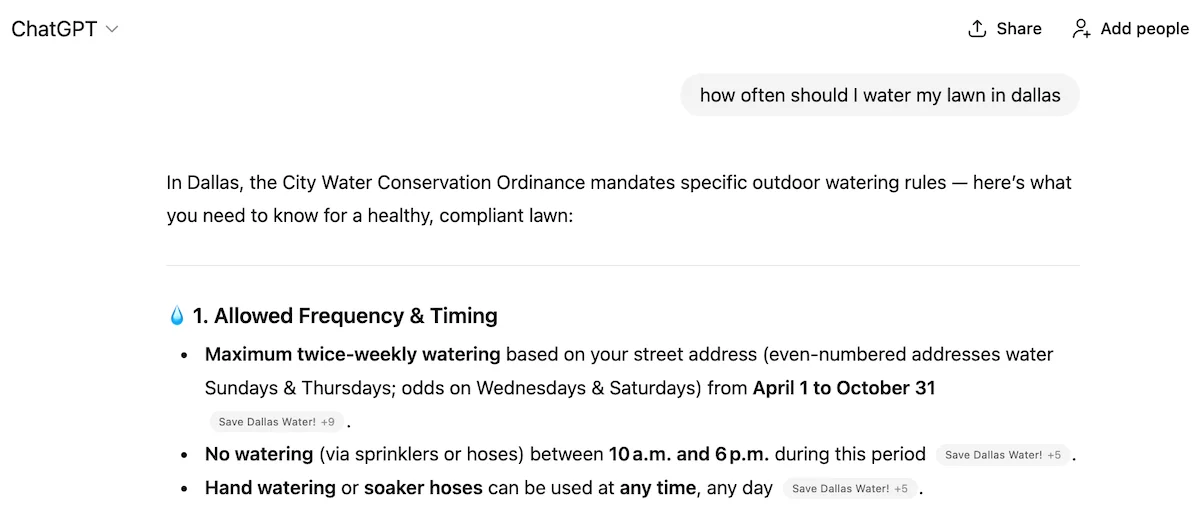
ChatGPT is citing Save Dallas Water! in its responses to this question.
- Entity-match frequency: Are your brand name, author, or topic entities showing up when others discuss this page?
- Citation clarity: When your page is referenced, is it attributed clearly (brand + topic) or generically? Clean attribution signals better trust.
What improvement looks like
- Your page is cited more often in AI-generated answers on your topic.
- Summaries from AI show your phrasing, insert your intro text, or quote you directly.
- Competitors appear less frequently for the same keywords.
- Your Google Search Console impressions climb—even in cases where click-through doesn’t increase.
- Your page begins to serve as a source in generative answers rather than only ranking in organic results.
Tool and data setup
- Use an SEO tool like Authoritas to track which of your keywords trigger AI Overviews and who is being cited.
- Combine that with Google Search Console and your analytics stack to build a “before vs. after” snapshot of intro updates.
- Run spot-checks every 4-8 weeks. Ask: Did impressions go up? Was our intro reused? Did competitors get replaced?
- If results aren’t improving, re-examine the intro: Are entities missing? Is the author unclear? Is the audience too vague?
A simple method:
If you don’t have a budget for SEO tool, here’s a DYI solution: Create a list of 25 prompts in ChatGPT and Perplexity that relate to your niche. Test them monthly. Document whether your brand appears.
Quick checklist for AI-readable intros
Use this handy checklist to ensure your intros are AI-optimized.
| Element | What to include |
| Topic & Entity | Name the product, platform, or subject |
| Author/Brand | Identify who is speaking |
| Audience | Define who the content helps |
| Intent | Clarify what the content delivers |
| Context | Mention credible references or related concepts |
Get your intro seen by AI platforms
AI Overviews reward clarity. Your intro now plays the role that keywords and backlinks once played. When it communicates your expertise, your entities, your audience, and your intent early, AI systems classify your content faster and reuse it more accurately.
This shift benefits SMBs. You do not need domain authority to win. You need clarity. You need attribution. You need a well-structured meaning at the top of the page.
Your next step is simple: Rewrite your top 10 URLs. Tighten the first 200 words. Add entity clarity. Add expertise signals. Resubmit them for indexing. Track improvement over the next month.
If AI can read you clearly, it can rank you confidently.