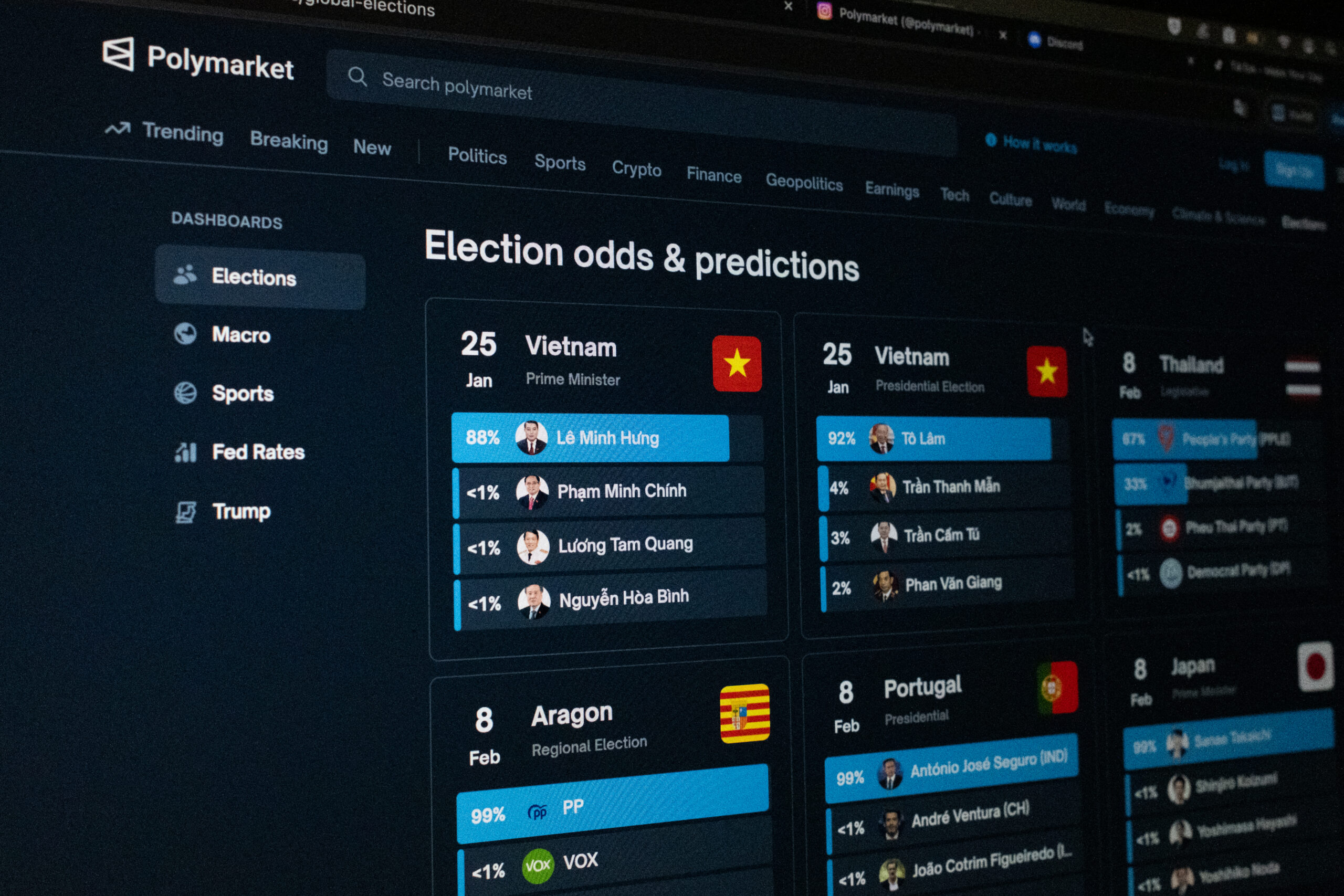
WASHINGTON—Prediction market platforms are rapidly moving from niche curiosities to fixtures of mainstream media coverage, yet their implications for information security and democratic resilience remain underexamined. As mainstream news organizations begin to integrate prediction market data into their reporting as quasi-authoritative “signals,” they risk opening a new vector for influence operations by foreign adversaries. This emerging ecosystem blurs the line between genuine probabilistic forecasts and engineered narratives, creating a fertile environment for the manipulation of public opinion, markets, and trust in core institutions.
From odds to “truth”
How might this risk play out? To begin with, prediction markets present themselves as neutral aggregators of dispersed information, implying that prices reflect the collective best guess about future events rather than the preferences of a narrow set of participants with varied motivations. When media outlets adopt this framing by pointing to market prices on issues ranging from elections and recessions to wars and major sporting events, they elevate those prices and the associated narratives from mere data points to perceived arbiters of reality.
In practice, however, these markets are often thin, sometimes dominated by a relatively small pool of sophisticated bettors, enthusiasts, and speculators. Treating their movements as transparent reflections of public belief risks granting disproportionate narrative power to actors with both the capital and the incentive to shape prices for reasons that may have little to do with forecasting accuracy. This dynamic is particularly concerning when the topics at stake intersect with homeland security, national security, or cybersecurity.
A widening attack surface
The logic of narrative manipulation via markets is already visible in benign commercial contexts. Consider a prediction market on whether a blockbuster film will exceed a $100 million opening weekend. A studio could rationally allocate a portion of its marketing budget to buy the “yes” side to move the price upward, and then cite that movement to entertainment reporters as evidence of strong anticipated performance. The market becomes both a promotional tool and a self-referential signal that justifies its own engineered optimism.
In sports, similar dynamics apply. If newsrooms begin to lean on prediction markets the way they rely on performance analytics, then those markets become attractive tools for agents or teams seeking to influence awards or contract-linked incentives. A concentrated position in a market related to a “most valuable player” award, paired with a coordinated media push, could subtly shape perceptions among voters and fans. While such behavior may resemble traditional public relations and be within the bounds of the law, it expands the surface area on which questions of fairness, integrity, and legitimacy can be raised.
From sports integrity to national security
These seemingly narrow examples matter because they help normalize skepticism about the fairness of outcomes in domains that have historically served as relatively apolitical spaces of shared experience. If fans repeatedly encounter allegations—substantiated or not—that betting lines, awards, or game outcomes are being manipulated, their baseline trust in the integrity of sport erodes. That erosion is not easily contained. It can spill over into attitudes toward other large-scale events and institutions, including elections, financial markets, and government processes or geopolitical maneuvering. You don’t have to look any further than the recent case in the Israeli military. In February 2026, at least two people were indicted on charges of using classified national security intelligence to place wagers on Polymarket to reap as much as $100,000 in profits. To its credit, the Israeli security forces acted swiftly with a first-of-its-kind legal action to maintain civic trust in the military.
Foreign adversaries have already demonstrated the capacity to pair cyber intrusions with information operations, exploiting stolen data to shape narratives for strategic effect. In a world where liquid prediction markets exist on sensitive geopolitical topics—such as regime stability, military escalation, or sanctions decisions—access to privileged information and the ability to move markets provide powerful tools. For example, an intelligence service that has compromised a Fortune 500 firm’s email system or a government agency’s internal communications could simultaneously profit from and weaponize that information by taking positions in relevant markets and then amplifying the resulting price movements as “evidence” of impending events.
Cyber-enabled financial and narrative operations
Even in the absence of cyber espionage, adversaries can use capital and content to similar effect. For example, a thinly traded market on whether a particular regime will fall by a given date could be meaningfully shifted by a single six-figure trade. Once the price moves, coordinated networks of accounts and media proxies might then point to the market as an apparently neutral indicator that the regime’s stability is in serious peril. This approach turns a small financial outlay into a lever for shaping news coverage, investor sentiment, and public expectations.
The same model applies domestically. Markets tied to divisive social or political issues could be used to amplify polarization, with foreign actors selectively moving prices and then framing those moves as proof that “everyone knows” a certain controversial outcome is likely or inevitable. When combined with cheap artificial intelligence–generated content—audio, video, or text—these efforts could be supplemented by fabricated “evidence,” such as manipulated footage further undermining confidence in institutional neutrality.
Policy, governance, and security responses
The goal is not to abolish prediction markets (or sports wagering), which can offer genuine informational and economic value, but rather to recognize and mitigate the security risks they introduce. As these markets proliferate and integrate more deeply into the information environment, policymakers, regulators, and industry leaders should treat them as dual-use infrastructures that require deliberate guardrails.
Several lines of effort merit consideration:
First, media organizations should adopt transparent standards for when and how prediction market data are cited, emphasizing that prices reflect the beliefs and incentives of a limited set of participants rather than objective truths. CNBC, for example, has added a disclosure of its investment in Kalshi when it reports on the platform both on its website and on air.
Second, regulators and platforms should develop disclosure requirements for large or coordinated positions in markets linked to elections, major national security events, or systemically important firms, along with enhanced scrutiny of foreign participation in such markets.
Third, prediction platforms should invest in robust market integrity monitoring, including mechanisms to detect anomalous trading patterns that coincide with coordinated information campaigns.