By using this site, you agree to the Privacy Policy and Terms of Use.
Accept
World of SoftwareWorld of SoftwareWorld of Software
  • News
  • Software
  • Mobile
  • Computing
  • Gaming
  • Videos
  • More
    • Gadget
    • Web Stories
    • Trending
    • Press Release
Search
  • Privacy
  • Terms
  • Advertise
  • Contact
Copyright © All Rights Reserved. World of Software.
Reading: God, Aliens, and Infinite Loops: Pushing Google Antigravity to the Breaking Point | HackerNoon
Share
Sign In
Notification Show More
Font ResizerAa
World of SoftwareWorld of Software
Font ResizerAa
  • Software
  • Mobile
  • Computing
  • Gadget
  • Gaming
  • Videos
Search
  • News
  • Software
  • Mobile
  • Computing
  • Gaming
  • Videos
  • More
    • Gadget
    • Web Stories
    • Trending
    • Press Release
Have an existing account? Sign In
Follow US
  • Privacy
  • Terms
  • Advertise
  • Contact
Copyright © All Rights Reserved. World of Software.
World of Software > Computing > God, Aliens, and Infinite Loops: Pushing Google Antigravity to the Breaking Point | HackerNoon
Computing

God, Aliens, and Infinite Loops: Pushing Google Antigravity to the Breaking Point | HackerNoon

News Room
Last updated: 2026/02/23 at 9:30 AM
News Room Published 23 February 2026
Share
God, Aliens, and Infinite Loops: Pushing Google Antigravity to the Breaking Point | HackerNoon
SHARE

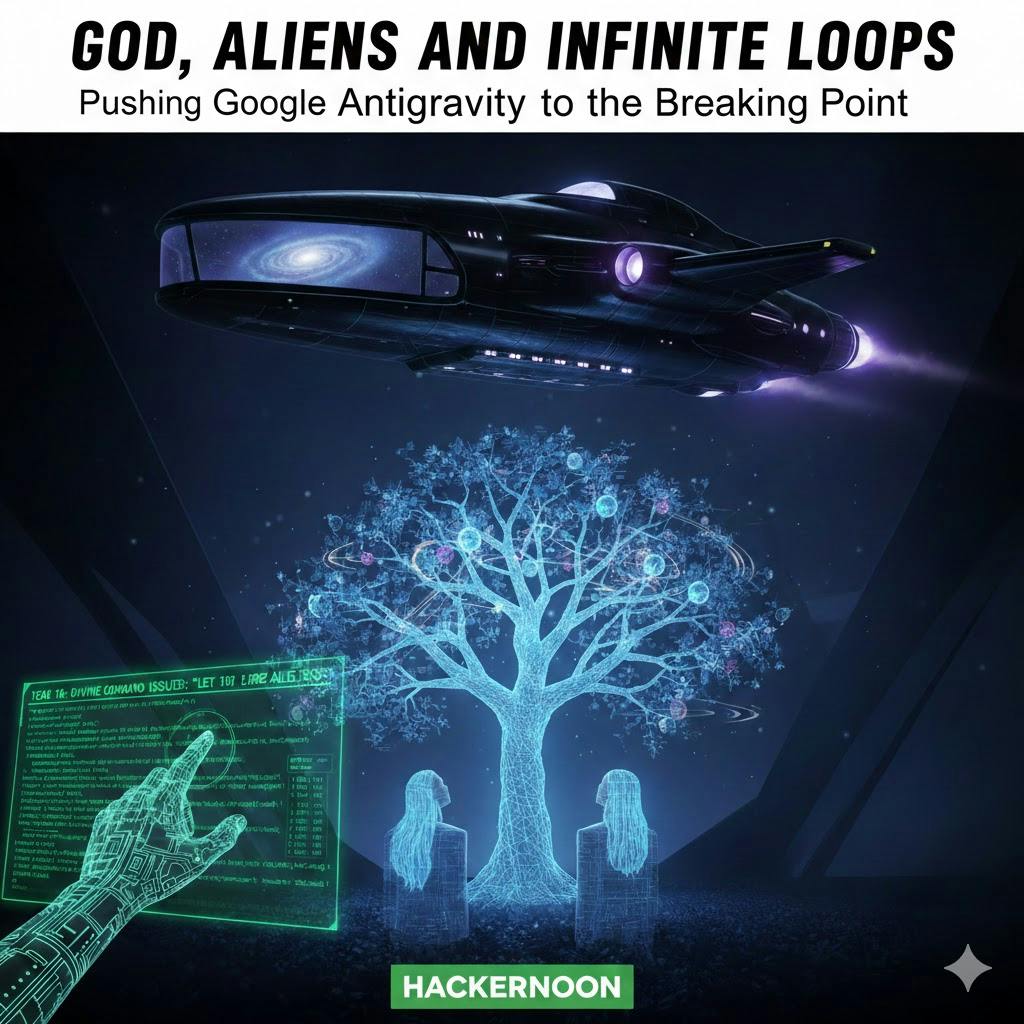
Google Antigravity is a powerhouse. As an agentic development platform, it’s remarkably capable of remembering context and executing complex instructions. But after using it to build a turn-based algorithmic simulation of Genesis, I realized something critical: The platform is only as smart as the architect directing it. If you aren’t a developer, you’ll find yourself staring at a “perfect” piece of software that doesn’t actually work. Here is how I used my engineering intuition to bridge the gap between Antigravity’s potential and a finished, accessible game.

1. The Monitoring Gap: Building My Own “Eyes.”

Antigravity itself is built on a VS Code-style architecture. For a screen-reader user, the IDE itself isn’t fully accessible yet. I didn’t let that stop me. I didn’t need to “read” the platform’s internal logs because I could intuitively visualize where the logic was tripping up.

However, I needed a way to verify the simulation’s state independently. I prompted the agents to install a custom log-viewer directly into the webpage of the game. I engineered a window into the machine’s soul so I could monitor the simulation in an environment I could actually navigate.

2. The “Stateless” Trap

Antigravity remembers everything you tell it, but the agents it deploys don’t instinctively build software with its own “memory.” Initially, the simulation was stateless. The agents would generate a brilliant turn of scripture and then immediately “forget” the genealogical data or world-state for the next turn.

A non-developer would have been baffled as to why the AI was “losing its mind.” I knew the problem was architectural. I had to instruct the agents to design a system where the event logs were fed back into the AI’s prompt as a persistent state-bridge. The platform was capable, but it took a human to tell the agents to build a nervous system for the software.

3. Theology Meets Sci-Fi: “Let There Be Aliens.”

The simulation took a wild turn when I issued the command: “Let there be aliens.” Suddenly, the theology shifted. The agents interpreted the “Sons of God” as “Star-Beings.” In my logs, Cain wasn’t just jealous of Abel—he was envious of the aliens’ freedom.

But then, the loop happened. From Year 121 down to Year 9, the narrator got caught in a recursive trap, repeating the same “Star-Being” revelations over and over. I didn’t need a visual debugger to tell me the context window was being flooded by its own previous outputs. I knew exactly how to restructure the prompt to flush the buffer and force the simulation to progress.

4. The API Key Swapper

To keep the project within Google’s free tier while using the high-performance Gemini 2.5 Flash model, I had to be smart about infrastructure. I had the agents build a hot-swappable API key uploader with a built-in test feature. It’s the kind of practical “dev-ops” move that a casual user would never think to ask for, but it’s what kept the project alive and cost-effective.

The Verdict

Google Antigravity is excellent. It is a robust, memory-capable platform that can spin up code at a staggering pace. But it isn’t a “replacement” for a developer.

A normal person without development experience would have hit a wall the moment the simulation became stateless or the IDE became inaccessible. They wouldn’t have known how to “see” the errors or how to give the software a memory. Antigravity provides the muscle, but the Senior Engineer provides the intuition. I could visualize how the system should work and knew exactly why it wasn’t—and that’s something no agent can replicate.


Sign Up For Daily Newsletter

Be keep up! Get the latest breaking news delivered straight to your inbox.
By signing up, you agree to our Terms of Use and acknowledge the data practices in our Privacy Policy. You may unsubscribe at any time.
Share This Article
Facebook Twitter Email Print
Share
What do you think?
Love0
Sad0
Happy0
Sleepy0
Angry0
Dead0
Wink0
Previous Article Fastest machine ever built to be fired around the sun to chase ‘UFO’ comet Fastest machine ever built to be fired around the sun to chase ‘UFO’ comet
Next Article The Moto G Power (2026) is the cheapest Motorola phone you might actually like The Moto G Power (2026) is the cheapest Motorola phone you might actually like
Leave a comment

Leave a Reply Cancel reply

Your email address will not be published. Required fields are marked *

Stay Connected

248.1k Like
69.1k Follow
134k Pin
54.3k Follow

Latest News

Affinity Review: Free and Powerful, But Still Not Adobe
News
Can scientists really resurrect the dodo? Inside the company that says it can
News
Go 1.21: An Inside Look at Forward Compatibility and Toolchain Management | HackerNoon
Computing
New Investigation Reveals Smart Glasses Are Recording Your Most Private Moments – BGR
News

You Might also Like

Go 1.21: An Inside Look at Forward Compatibility and Toolchain Management | HackerNoon
Computing

Go 1.21: An Inside Look at Forward Compatibility and Toolchain Management | HackerNoon

8 Min Read
The HackerNoon Newsletter: Its Not Kubernetes. It Never Was. (3/15/2026) | HackerNoon
Computing

The HackerNoon Newsletter: Its Not Kubernetes. It Never Was. (3/15/2026) | HackerNoon

4 Min Read
Linux 7.0-rc4 Released With Hang Fixes, Resolves At Least One Performance Regression
Computing

Linux 7.0-rc4 Released With Hang Fixes, Resolves At Least One Performance Regression

3 Min Read
Bcachefs 1.37 Released With Linux 7.0 Support, Erasure Coding Stable & New Sub-Commands
Computing

Bcachefs 1.37 Released With Linux 7.0 Support, Erasure Coding Stable & New Sub-Commands

2 Min Read
//

World of Software is your one-stop website for the latest tech news and updates, follow us now to get the news that matters to you.

Quick Link

  • Privacy Policy
  • Terms of use
  • Advertise
  • Contact

Topics

  • Computing
  • Software
  • Press Release
  • Trending

Sign Up for Our Newsletter

Subscribe to our newsletter to get our newest articles instantly!

World of SoftwareWorld of Software
Follow US
Copyright © All Rights Reserved. World of Software.
Welcome Back!

Sign in to your account

Lost your password?