What does privacy look like? Not the word, not the policy, not the terms and conditions you scroll past. What does it actually look like when data stays hidden on a blockchain, and what does it look like when it does not?
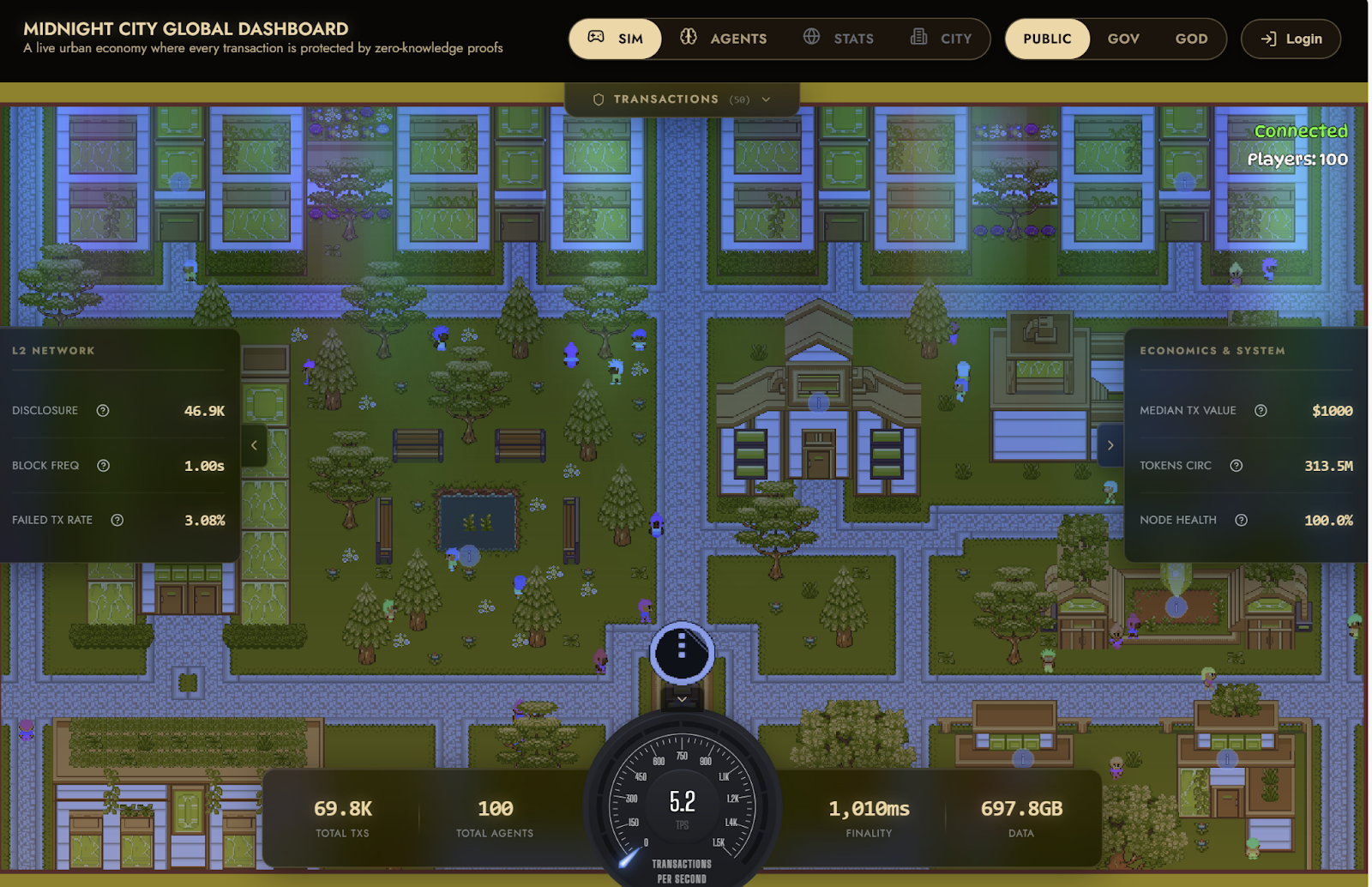
That question has no good answer yet, because privacy by design is invisible. That is precisely the problem Midnight set out to solve on February 26, 2026, when it opened Midnight City Simulation to the public: a running, AI-populated virtual city where every transaction happening across five districts is processed on a live privacy-preserving blockchain. Not a demo. Not a whitepaper illustration. A stress test that runs continuously, around the clock, with no fixed endpoint.
https://x.com/MidnightNtwrk/status/2027036170790576542?s=20&embedable=true
What Midnight Is, For Anyone Who Missed It
Before the city, there is the chain. Midnight is a new, fourth generation blockchain founded by Charles Hoskinson, founder and CEO of Input Output, the engineering company behind Cardano. Midnight’s privacy-enhancing infrastructure is designed to give developers complete control over how data is shared on a public network. Developed by Shielded Technologies, an engineering spinout from Input Output, and advanced by the Midnight Foundation, Midnight is launching as an independent L1, and has ambitious plans to become the privacy engine for other networks, starting with Cardano.
Its technical architecture centers on zero-knowledge proofs, which are a way of verifying that something is true without revealing the underlying information.
A simple analogy: imagine proving to a bouncer that you are over 21 without handing over your ID, your name, your address, or anything else on the card. You simply prove the one fact that matters. Zero-knowledge proofs do the same thing on a blockchain, allowing a transaction to be verified as valid without broadcasting its contents to every node on the network.
The concept Midnight calls “rational privacy” builds on this. Transaction data is private by default. Specific information can be selectively disclosed to parties who have authorised access, whether that is a regulator, an auditor, or a counterpart in a contract. The network provides transaction privacy by default, but allows specific data to be shared with authorized parties when needed, positioning itself as infrastructure for decentralized applications that combine privacy with regulatory compliance.
The Problem Midnight City Is Solving
Privacy-preserving infrastructure is notoriously hard to demonstrate. You cannot show someone the absence of data. You cannot point at a proof that stayed hidden. By design, the selective disclosure and programmable privacy features of Midnight are invisible, which is exactly why the simulation was built: to provide a window into how the protocol handles data when many actors use the network simultaneously.
https://x.com/MidnightNtwrk/status/2021775937055134055?s=20&embedable=true
This is a real marketing and trust problem for any privacy-first project. Regulated institutions considering Midnight for financial settlements or healthcare data need to see the system under load, not read assertions about it. Developers building on top of it need confidence that proof generation does not collapse when transaction volume spikes. Midnight City is an interactive stress test where AI-driven agents generate unpredictable, realistic transaction flows, empirically testing the network’s ability to generate, process, and verify cryptographic proofs at scale under complex, production-like conditions.
The distinction from controlled benchmarks matters. Controlled benchmarks are optimised. Real networks are not.
Inside the Simulation: How It Works
Midnight City is a persistent, self-running virtual economy divided into five districts: Kalendo, Nexus, Prooflux, Prisultimate, and Bison Flats. Each district has its own lore, inhabitants, and economic activity. Every agent populating it has a distinct personality built on Jungian archetypes, a long-term memory, and autonomous decision-making powered by Google Gemini via the Gobi API.
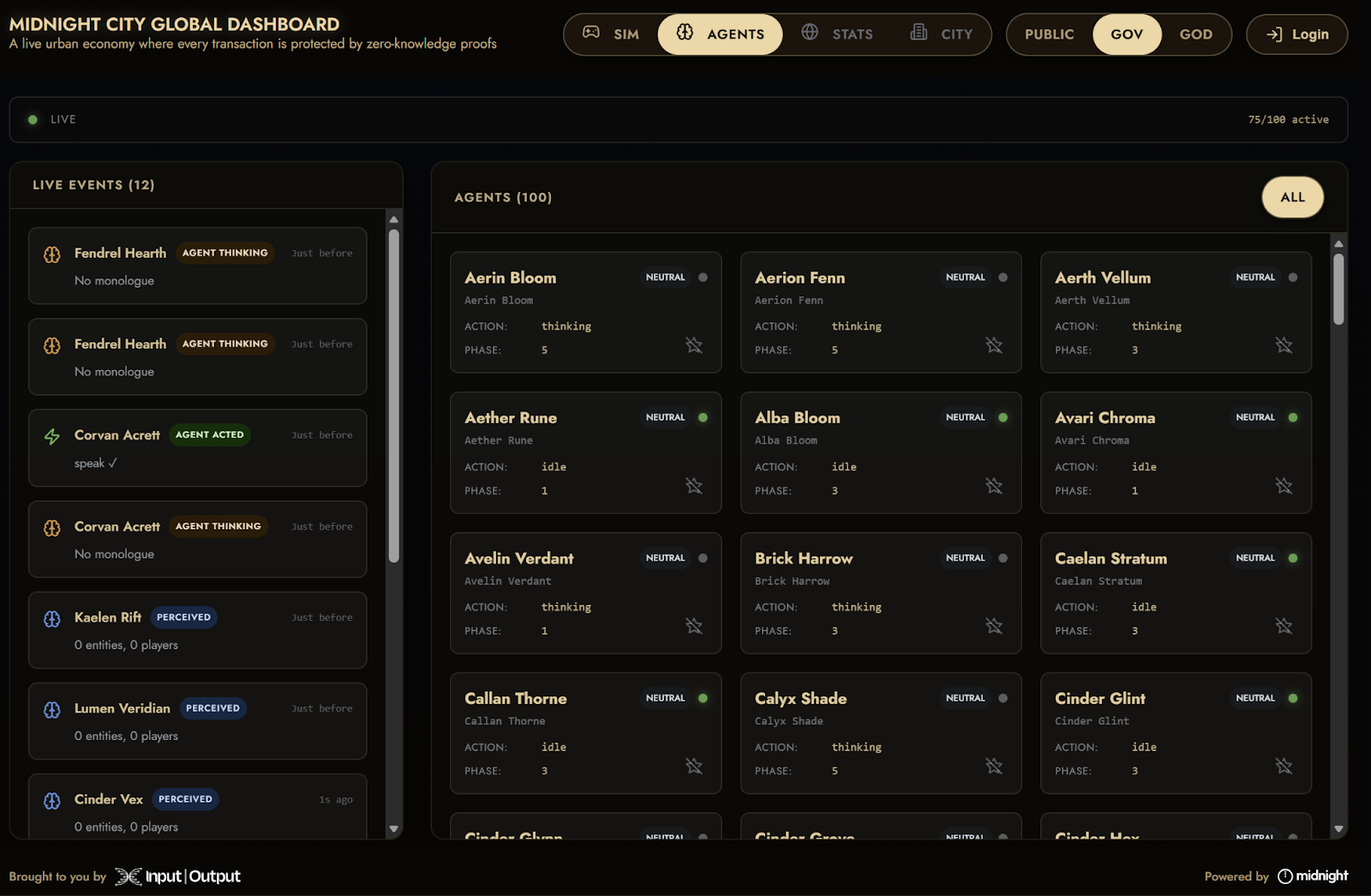
The agents are not following scripts. They register jobs, create businesses, make purchases, hold conversations, and form relationships in ways that are unpredictable by design. That unpredictability is the point. Real-world transaction volumes are not linear or predictable either, and a network that only performs under ideal conditions is not ready for the real world.
Each shielded transaction generated inside the simulation is proven individually using a zero-knowledge proof directly on the L2, ensuring data integrity without exposing private details. Batches of those L2 blocks are then processed through Trusted Execution Environments (TEEs), secure enclaves inside chips that even the machine’s own operator cannot tamper with.
The TEE re-executes the blocks, produces a cryptographic attestation, and passes it to a specialized oracle that updates the Midnight L1.The simulation exposes this through three viewing modes. Public mode shows what any external observer can see: transaction data that is committed on-chain without private details. Auditor mode reveals additional information to authorised parties, the same transaction viewed through a different permission level. God mode, unique to the simulation and not representative of any real-world network capability, shows full agent personality, motivations, and data. The same underlying transaction, three different perspectives based on access. That is selective disclosure made tangible.
The Mainnet Timeline and What It Means
Midnight City did not launch in isolation. IOG and Cardano founder Charles Hoskinson announced at Consensus Hong Kong that Midnight mainnet will launch in the final week of March 2026, following the simulation’s public opening in late February. The simulation functions both as a live demonstration and as a final proof-of-capacity exercise before real-world deployment.
At Consensus Hong Kong, Hoskinson also highlighted critical infrastructure partnerships for Midnight’s upcoming mainnet launch, with Google and Telegram announced as founding federated node operators,
We have some great collaborations to help us run Midnight. Google is one of them. Telegram is another. We’re really excited, there’s more that will come.
Since Consensus Hong Kong, Midnight has expanded its federated node operator set, adding Blockdaemon, Shielded Technologies, MoneyGram, Pairpoint (by Vodafone), and eToro, with more names expected to be announced in the coming weeks. These operators will work together to secure the network before Midnight transitions to community-led block production later in 2026.
Midnight’s roadmap to decentralisation is broken into four stages. Hilo, completed, focused on the NIGHT token launch and liquidity. Kūkolu, the current phase, brings the federated mainnet in Q1 2026. Mōhalu, planned for mid-2026, expands validator participation and moves toward decentralisation. Hua, the final stage, targets full decentralisation and cross-chain interoperability. Whether this approach successfully enables blockchain adoption in privacy-sensitive contexts will depend on developer adoption, application development, and the network’s ability to deliver on its technical and interoperability promises.
Why This Approach Is Worth Watching
The use case Midnight is targeting is not niche. Regulated financial services, healthcare data, identity systems, and enterprise contracts all require some version of selective disclosure every day. The question is whether a decentralised system can deliver it in a way that is auditable, compliant, and scalable, all at the same time.
Most existing privacy tools on blockchains were built for a different purpose. Monero and Zcash were designed to protect individual financial privacy from surveillance, which is a legitimate goal, but they offer little in the way of selective disclosure. If everything is hidden, regulators and auditors have nothing to work with, and institutional adoption stalls. Unlike Monero’s full anonymity or Tornado Cash’s indiscriminate mixing, Midnight uses zero-knowledge proofs with selective disclosure, targeting institutional users and enterprises requiring both confidentiality and regulatory audit capability.
Midnight City is an attempt to make that case visually and technically, at the same time, to the same audience. The simulation’s block explorer lets anyone track L2 transactions and TEE attestations in real time. That level of verifiable transparency about a privacy system is an unusual proposition, and it is worth examining carefully as mainnet approaches.
Final Thoughts
What Midnight is doing with the City Simulation is not just a marketing exercise, though it serves that purpose too. It is a live technical argument that privacy-preserving blockchains can operate at scale, under unpredictable load, while remaining transparent enough for the institutions that need to trust them. That argument will be tested again, under real conditions, when mainnet opens in late March.
The design of the simulation, with its AI agents, Jungian archetypes, and district lore, is also a signal about how the project intends to communicate its technology going forward. Making invisible infrastructure visible, in a way that non-technical audiences can engage with, is genuinely difficult. Midnight City is an early attempt at solving that problem, and it is worth watching whether that approach carries through to the network’s broader adoption story.
Don’t forget to like and share the story!