By using this site, you agree to the Privacy Policy and Terms of Use.
Accept
World of SoftwareWorld of SoftwareWorld of Software
  • News
  • Software
  • Mobile
  • Computing
  • Gaming
  • Videos
  • More
    • Gadget
    • Web Stories
    • Trending
    • Press Release
Search
  • Privacy
  • Terms
  • Advertise
  • Contact
Copyright © All Rights Reserved. World of Software.
Reading: AI Coding Assistants Haven’t Sped up Delivery Because Coding Was Never the Bottleneck
Share
Sign In
Notification Show More
Font ResizerAa
World of SoftwareWorld of Software
Font ResizerAa
  • Software
  • Mobile
  • Computing
  • Gadget
  • Gaming
  • Videos
Search
  • News
  • Software
  • Mobile
  • Computing
  • Gaming
  • Videos
  • More
    • Gadget
    • Web Stories
    • Trending
    • Press Release
Have an existing account? Sign In
Follow US
  • Privacy
  • Terms
  • Advertise
  • Contact
Copyright © All Rights Reserved. World of Software.
World of Software > News > AI Coding Assistants Haven’t Sped up Delivery Because Coding Was Never the Bottleneck
News

AI Coding Assistants Haven’t Sped up Delivery Because Coding Was Never the Bottleneck

News Room
Last updated: 2026/03/24 at 10:14 AM
News Room Published 24 March 2026
Share
AI Coding Assistants Haven’t Sped up Delivery Because Coding Was Never the Bottleneck
SHARE

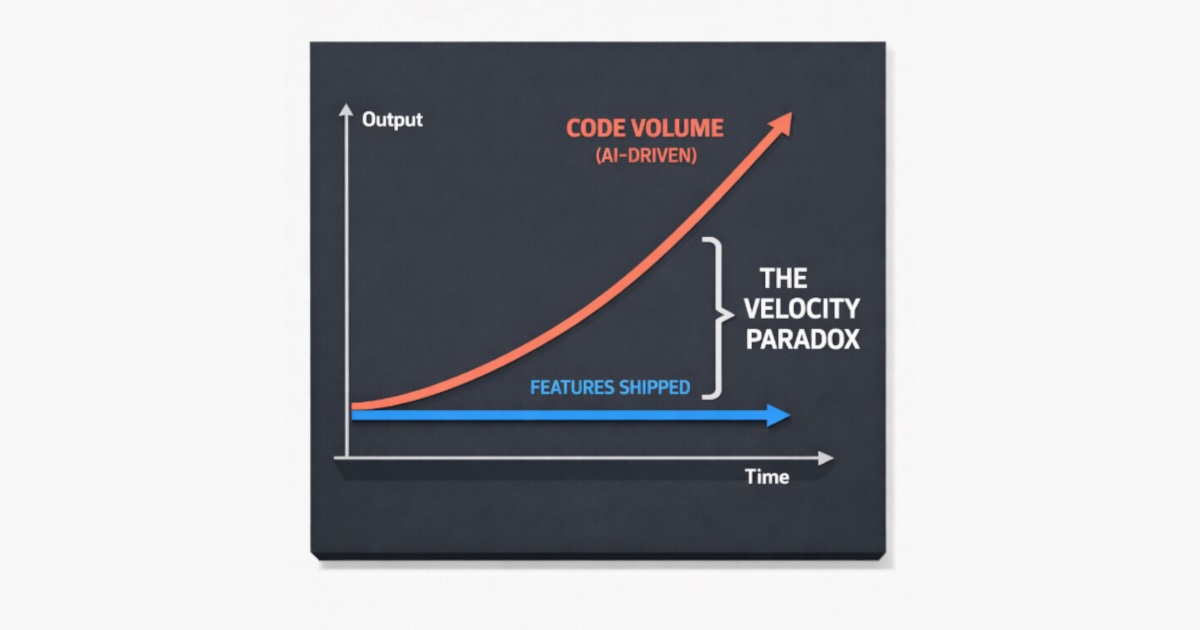
Agoda recently published an observation arguing that while AI coding tools have measurably raised individual developer output, the resulting velocity gains at the project level have been surprisingly modest, because coding was never the real bottleneck. The post claims that the bottleneck has shifted upstream to specification and verification because these areas require human judgment. This shift carries significant implications for how engineering teams should be structured.

Leonardo Stern, a software engineer at Agoda, frames this as a rediscovery of Fred Brooks’ decades-old argument in “No Silver Bullet” that improvements in speed to only one part of the development lifecycle produce diminishing returns for overall delivery.

The observation aligns with industry-wide data: research by Faros AI analyzing telemetry from over 10,000 developers across 1,255 teams found that teams with high AI adoption completed 21% more tasks and merged 98% more pull requests, yet PR review time increased by 91%. This metric is consistent with the diagnosis that acceleration at the coding stage relocates pressure elsewhere.

For Stern, the more important implication is what this shift means for team structure. The traditional rationale for small, focused engineering teams was partly built on the assumption that coding was the most significant value-creating activity and that communication was overhead that impeded it.

If the highest-value work becomes collaborative specification and architectural alignment, that logic inverts: communication is no longer the cost to minimize, it is the work itself. Smaller teams win not because they reduce coordination but because they achieve shared understanding faster. Five people can genuinely align around intent and corner cases in ways that fifteen typically cannot.


The shift in software engineering key deliverables from coding to specification and verification (source)

Stern introduces a three-stance taxonomy for how engineers can relate to AI-generated code. The “white box” model, where humans read and review every line, does not scale when agents can produce thousands of lines per hour. “Black box” or “vibe coding”, shipping whatever the AI generates with minimal verification, is fast but brittle for production systems serving large user bases.

Stern’s preferred middle path, which he calls “grey box,” keeps humans accountable at the two points that matter: writing specifications precise enough for the agent to execute correctly, and verifying results against evidence rather than inspecting the implementation line by line. Crucially, he is explicit that accountability does not shift to the AI: the engineer who guides the agent and approves the merge request remains fully responsible for what ships.

This reframing of the review from code inspection to evidence evaluation echoes the architectural formalism in Leigh Griffin and Ray Carroll’s recent InfoQ article on Spec-Driven Development. In this article, they argue that specifications should become the executable source of truth for a system, with generated code treated as a downstream, regenerable artifact.


Human authority is migrating from writing code to defining and governing intent (source)

Stern arrives at a compatible conclusion from a workflow perspective: a high-fidelity specification with testable acceptance criteria, explicit corner cases, and captured architectural decisions becomes the primary engineering deliverable, with implementation increasingly delegated. Both pieces converge on the observation that human authority is migrating upward in the abstraction stack — from writing code to defining and governing intent.

Sign Up For Daily Newsletter

Be keep up! Get the latest breaking news delivered straight to your inbox.
By signing up, you agree to our Terms of Use and acknowledge the data practices in our Privacy Policy. You may unsubscribe at any time.
Share This Article
Facebook Twitter Email Print
Share
What do you think?
Love0
Sad0
Happy0
Sleepy0
Angry0
Dead0
Wink0
Previous Article In the cemeteries of Galicia, the Christs have begun to disappear from the tombstones. There is a suspect: “red gold” In the cemeteries of Galicia, the Christs have begun to disappear from the tombstones. There is a suspect: “red gold”
Next Article For All Mankind will end with season 6 For All Mankind will end with season 6
Leave a comment

Leave a Reply Cancel reply

Your email address will not be published. Required fields are marked *

Stay Connected

248.1k Like
69.1k Follow
134k Pin
54.3k Follow

Latest News

Apple Maps could get ads as soon as this summer
News
The Power of Visual Content: Engaging Audiences Through Infographics and Videos |
Computing
Kleiner Perkins Raises .5B For AI-Focused Funds
Kleiner Perkins Raises $3.5B For AI-Focused Funds
News
Comprehensive Evaluation and Platform Profile of SKHTU Exchange
Gadget

You Might also Like

Apple Maps could get ads as soon as this summer
News

Apple Maps could get ads as soon as this summer

3 Min Read
Kleiner Perkins Raises .5B For AI-Focused Funds
News

Kleiner Perkins Raises $3.5B For AI-Focused Funds

4 Min Read
Flighty launches new ‘Airport Intelligence’ feature, here’s how it works – 9to5Mac
News

Flighty launches new ‘Airport Intelligence’ feature, here’s how it works – 9to5Mac

3 Min Read
New Apple Maps Feature Already Has Users Frustrated (And It Isn’t Even Out Yet) – BGR
News

New Apple Maps Feature Already Has Users Frustrated (And It Isn’t Even Out Yet) – BGR

5 Min Read
//

World of Software is your one-stop website for the latest tech news and updates, follow us now to get the news that matters to you.

Quick Link

  • Privacy Policy
  • Terms of use
  • Advertise
  • Contact

Topics

  • Computing
  • Software
  • Press Release
  • Trending

Sign Up for Our Newsletter

Subscribe to our newsletter to get our newest articles instantly!

World of SoftwareWorld of Software
Follow US
Copyright © All Rights Reserved. World of Software.
Welcome Back!

Sign in to your account

Lost your password?