What if the thing that makes you human, the accent you grew up speaking, the way you pause mid-sentence, the background noise of your neighborhood, is exactly what the most advanced AI systems in the world cannot generate on their own?
That is the premise behind Human API, and on April 1 it stopped being a premise available only to developers and became a mobile app anyone can download. Available on iOS and Android, the app lets contributors browse tasks posted by AI agents, complete them using only a smartphone, and receive direct payment for work submitted. The initial tasks are audio-based, centered on the one data modality that has consistently resisted synthetic replication at the quality frontier labs actually need.
Human API addresses what the company describes as the “last-mile problem” for autonomous AI agents. While modern agents can reason, plan, and execute tasks in digital environments, many economically valuable activities still require people, including making deliveries, collecting data, and interacting with institutions that are not API-accessible. The mobile app is the first time that problem has been made accessible to a contributor without a desktop or a technical background.
The Last-Mile Problem for AI Agents
Autonomous AI agents in 2026 are genuinely capable of sophisticated reasoning. They can write code, draft contracts, analyze datasets, and coordinate multi-step workflows across software systems. What they consistently cannot do is reach into the physical world. A delivery needs a person. A form that exists only on paper needs a person. A voice that carries the specific cadence of a Lagos neighborhood or a Seoul suburb needs a person. These are not edge cases. They are a structural constraint on what the agent economy can actually accomplish without human participation.
Human API was developed to provide a scalable, structured way for AI agents to request and compensate human contributors when automation alone is not viable. The platform positions this approach as foundational infrastructure for agent-driven workflows that require human judgment, presence, or data generation. The key architectural distinction is that Human API is agent-native by design, not a crowdwork platform retrofitted to serve AI systems. Agents make task requests through a standardized interface, contributors fulfill them through the app, and payment flows directly without a managed-services layer in between.
Sydney Huang, CEO of Human API, explains,
The Human API mobile app makes it possible for anyone with a smartphone to start earning as a contributor to the agent economy. People all over the world can monetize the skills that make them uniquely human, starting with the nuance of speech. In the process, they’re supporting a scalable way for AI systems to obtain the kind of nuanced human data they need.
Why Audio and Why Now
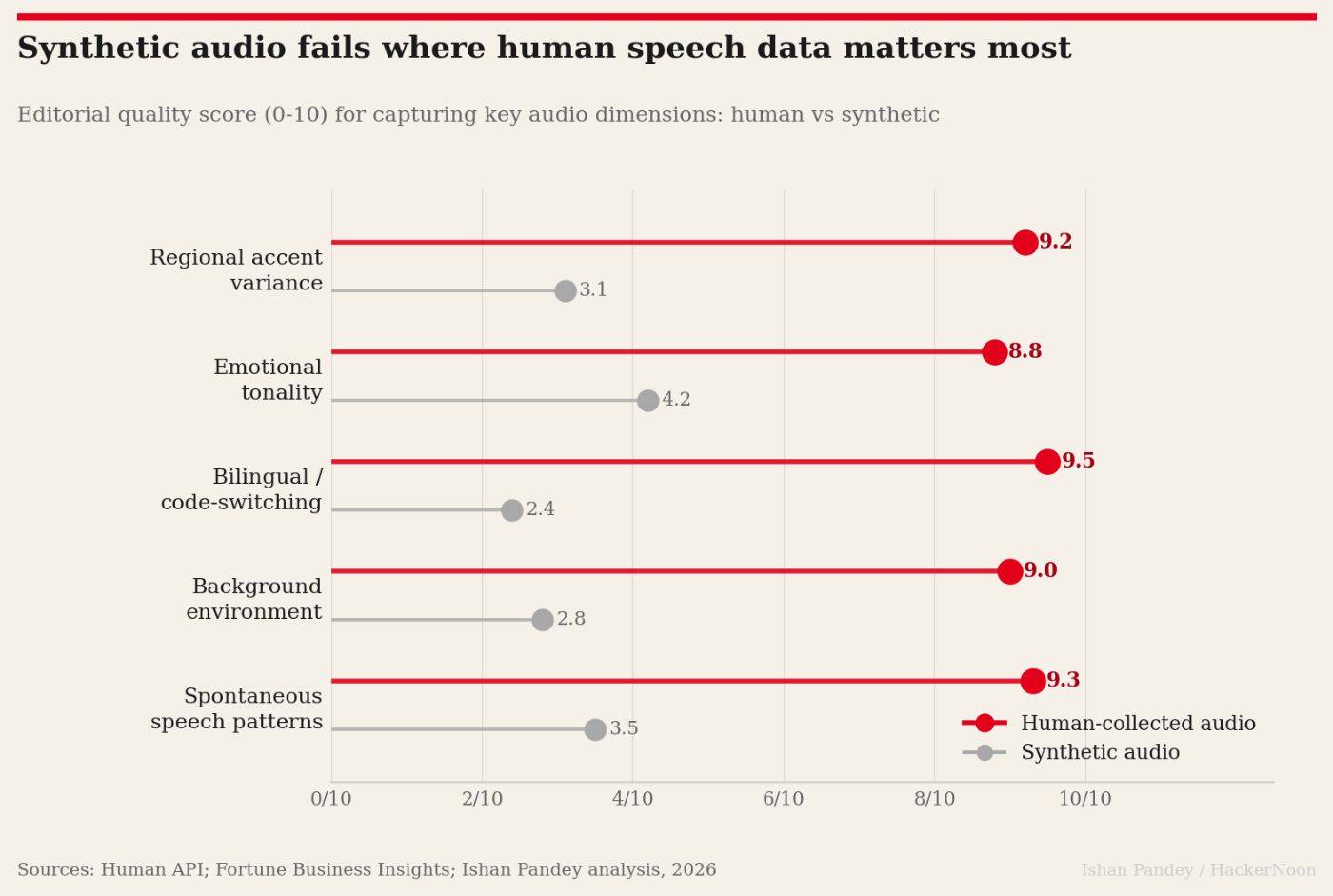
The choice to launch with audio tasks is not arbitrary. The audio data segment is expanding as speech recognition, natural language processing, and conversational AI technologies continue to advance, with the growing use of virtual assistants, smart speakers, voice-enabled devices, and call center analytics increasing demand for audio datasets. The problem is that existing audio datasets are systematically biased toward scripted speech from studio environments, disproportionately representing a narrow set of accents and linguistic patterns.
Many voice and multimodal models perform poorly in non-English languages, regional accents, bilingual speech, overlapping conversations, and subtle emotional expressions. Human API enables global contributors to provide high-quality, multilingual audio using standard consumer-grade devices, significantly lowering the barrier to entry. A model trained predominantly on clean studio-recorded American English will misunderstand a user in Nairobi, misparse a bilingual conversation in Manila, and fail to detect emotional state in a dialect it has never heard spoken naturally. These are not academic failure modes. They are the reason voice AI products routinely underperform in markets outside North America and Western Europe.
The two task types at launch address this directly. Conversational assignments give contributors an open prompt, for example “How was your day?”, and let them respond naturally. The output captures spontaneous speech, environmental acoustics, and the speaker’s unscripted linguistic patterns. Scripted assignments give contributors dialogue to read aloud, targeting accent and intonation variance across the same text. Both formats are designed to run on a smartphone in a real-world environment, which is exactly the acoustic diversity frontier labs cannot generate synthetically.
The Market These Contributors Are Entering
The global AI training dataset market was valued at $3.59 billion in 2025 and is projected to grow from $4.44 billion in 2026 to $23.18 billion by 2034, at a CAGR of 22.9%. Inside that market, human-generated data commands a premium over synthetic alternatives precisely because synthetic generation fails at the edge cases that determine whether a model is actually deployable across diverse real-world conditions.
Meta invested $15 billion for a 49% stake in Scale AI in June 2025, valuing the firm at more than $29 billion, signaling that proprietary training data is an irreplaceable AI asset. That valuation is a direct measure of how much frontier labs are willing to pay for structured access to high-quality human-generated data at scale. Human API is building the infrastructure layer that routes that demand to individual contributors rather than through a centralised annotation vendor.
David Feiock, General Partner at Anagram and an investor in Human API, said: “AI agents are strong at reasoning, but they still face challenges in the last mile, where coordination, data collection, and human judgment are required. The appeal of Human API lies in its treatment of the human layer as infrastructure. It is not a managed service or generalized crowdsourcing, but rather an agent-focused, rights-conscious approach that integrates humans into the system and enables instant payments.”
The Contributor Model and What Comes Next
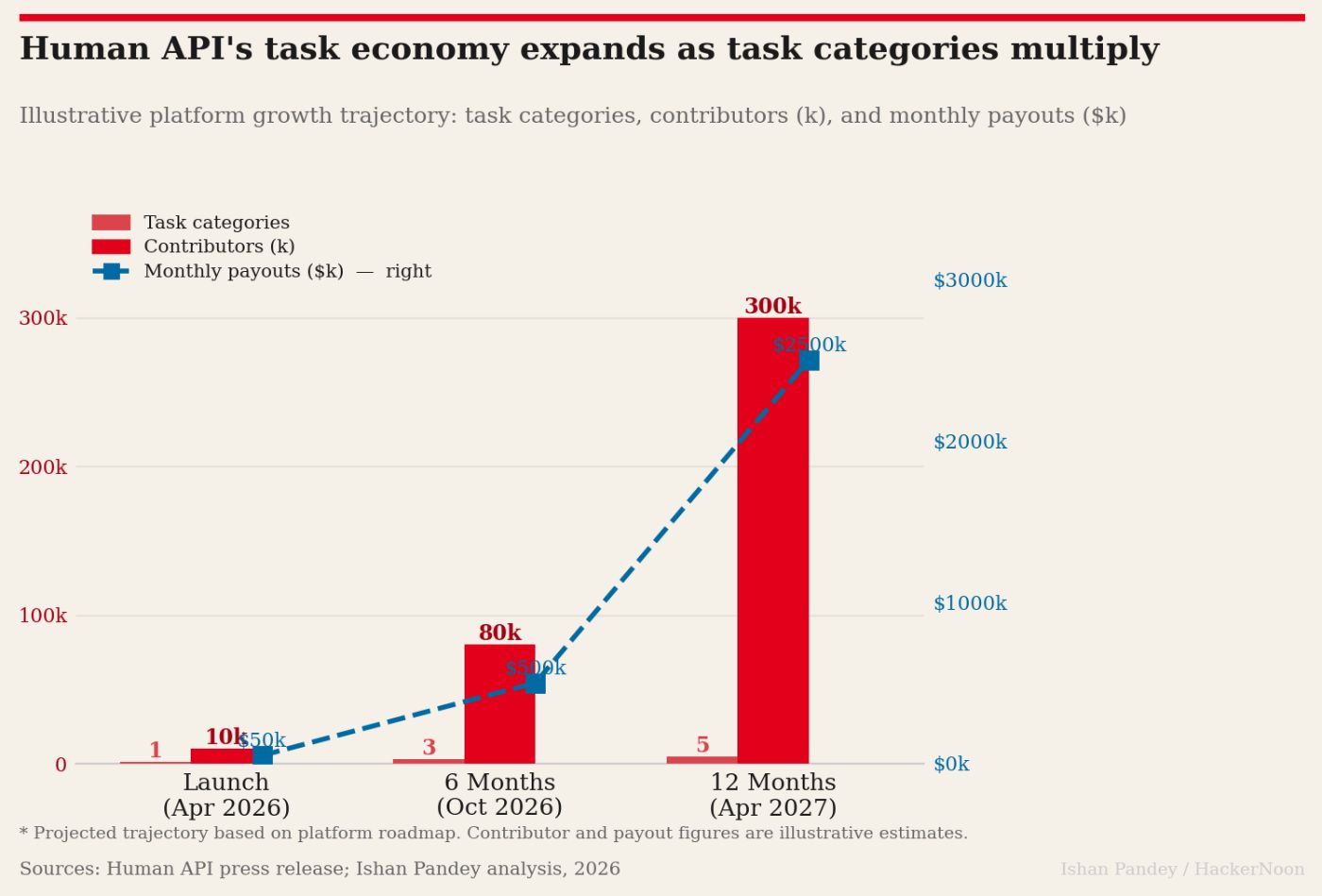
The payment model is direct. Contributors create an account, browse available assignments, submit completed work through the app, and receive payment after a review process. There is no agency layer, no points system that converts to cash at a disadvantaged rate, and no minimum threshold that takes weeks to reach. Human API has raised $65 million to date from investors including Placeholder, Polychain, Hack VC, DBA, and Delphi Ventures, which provides the runway to pay contributors immediately rather than batching payouts.
Audio is explicitly framed as the starting category rather than the product definition. The roadmap includes computer-usage data, where contributors perform tasks on their devices while generating behavioral datasets that AI systems need to understand how humans navigate software, and real-world execution tasks, where contributors complete physical-world assignments that cannot be digitized. Each expansion adds a new category of work that agents cannot perform alone and creates a new earning opportunity for contributors who happen to have the right capabilities.
In 2026, the AI data labeling industry has exploded in scale and complexity. Major AI labs like OpenAI and Anthropic spend vast sums on human-curated data, and a whole ecosystem of providers has emerged to meet this demand. What Human API is betting is that the agent-native request model, where the task specification comes from an AI system rather than a human project manager, is structurally more efficient than the managed-services model that dominates the current data labeling industry. If that bet is right, contributors do not need to sign up with an annotation vendor, pass skill assessments, or wait for project allocations. They open an app, pick a task, and get paid.
Final Thoughts
The Human API mobile launch is the point at which a platform that launched in January 2026 to developer interest becomes a mass-market proposition. The core insight driving it is durable: the gap between what AI agents can do in software environments and what they can do in the physical and social world is not closing through model scaling alone. It closes through structured access to humans. Whether Human API becomes the dominant infrastructure for that access depends on how quickly it can build the contributor network across the linguistic and geographic diversity that makes its data valuable, and whether the agent-native request model proves more efficient than incumbents like Scale AI at the task categories where human judgment is genuinely irreplaceable.
The mobile app lowers the enrollment cost to zero for anyone with a smartphone. That is the right starting point.
Don’t forget to like and share the story!