Key takeaways
- Social media in healthcare builds patient trust, supports recruitment, and raises public health awareness, but compliance with HIPAA, FDA, and FTC regulations is non-negotiable.
- A documented healthcare social media policy with approval workflows protects your organization from violations that can carry fines of more than $2.1 million per violation category per year.
- Healthcare organizations that focus on educational, entertaining content on one or two priority platforms outperform those spreading resources thin across every network.
- AI tools can save healthcare social teams significant time on content creation, but every post needs human review and compliance approval before publishing.
An active social media presence can help healthcare organizations do everything from attracting new patients to recruiting top talent. Here’s a closer look at the most impactful benefits.
How does social media build patient trust and brand recognition?
Social media builds patient trust and brand recognition by creating a consistent, values-driven presence that signals credibility before someone ever walks through your doors. Healthcare organizations aren’t usually what most people associate with brands, like remembering a Coca-Cola commercial from their childhood. But brand recognition and perception is even more important for healthcare organizations because a provider-patient relationship centers around patient trust.
When prospective patients research providers online, a consistent, values-driven social presence signals credibility. Posts demonstrating your values go a long way toward building trust with both prospective patients and employees, like this Reel from St. Jude’s:
Source: @stjude
How can social media raise public health awareness?
For public health bodies like health authorities or government offices, social media is a powerful tool to reach the majority of your region’s population relatively inexpensively. 53% of U.S. adults at least sometimes get news from social media. During the COVID-19 pandemic, for example, public health agencies that had established social media followings were able to distribute vaccine information and counter misinformation far more quickly than through traditional channels alone.
For those in the B2B health space, social media is both a way to promote your products to healthcare organizations and help contribute to public health literacy with educational content.
How does social listening help healthcare organizations stay informed?
Besides sharing your own news, social media keeps you informed about what your competitors and industry as a whole are up to.
For healthcare organizations specifically, social listening can help you track emerging health trends, monitor misinformation about treatments or conditions, and benchmark your presence against other health systems in your region.
With a social listening tool like Hootsuite Listening, you can search for keywords across billions of online sources in seconds. More than search results, Hootsuite Listening shows you relevant conversations in context, including measuring positive vs. negative brand sentiment and the most popular content for your keywords.
Hootsuite Listening helps healthcare organizations track trending health topics across social media.

#1 Easy Social Listening
Brand mentions, trending topics, and sentiment at your fingertips. Enhance your social strategy with the insights that matter.
Start your free trial
How does social media support healthcare recruitment and employer branding?
Healthcare faces ongoing staffing challenges, and social media has become one of the most effective channels for reaching potential hires where they already spend time.
Hospitals and health systems that showcase workplace culture, share employee testimonials, and highlight professional development opportunities on platforms like LinkedIn and Instagram can differentiate themselves in a competitive labor market.
This goes beyond posting job listings. Behind-the-scenes content, “day in the life” videos from nurses or technicians, and posts celebrating team milestones all help prospective employees picture themselves at your organization.
For large health systems managing recruitment across multiple locations, a consistent employer brand built through employee advocacy can reduce cost-per-hire and shorten time-to-fill for critical roles.
How can social media improve patient engagement and communication?
Social media gives healthcare organizations a direct line to patients outside of clinical settings. Organizations use it to share appointment reminders, post-care instructions, answers to common health questions, and updates about new services or locations.
This kind of ongoing communication builds a sense of community. Patient-facing Facebook groups, Q&A sessions on Instagram Stories, and educational YouTube series all create touchpoints that keep your organization top of mind between visits. The result is stronger patient loyalty and a more informed patient population.
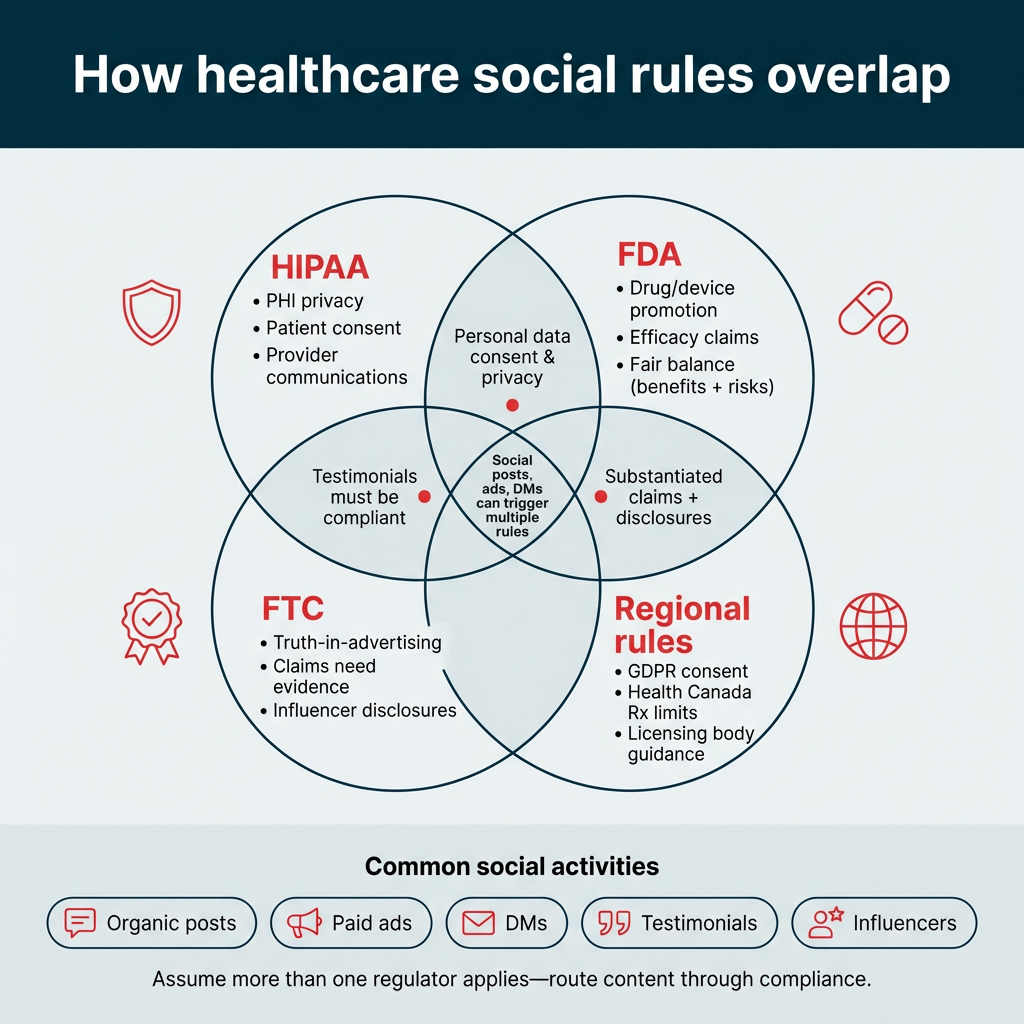
Healthcare social media is governed by a patchwork of federal, regional, and industry-specific regulations. Compliance in regulated industries isn’t optional. Violations can result in significant financial penalties, loss of licensure, and lasting damage to your organization’s reputation. Here’s what you need to know.
What does HIPAA mean for social media?
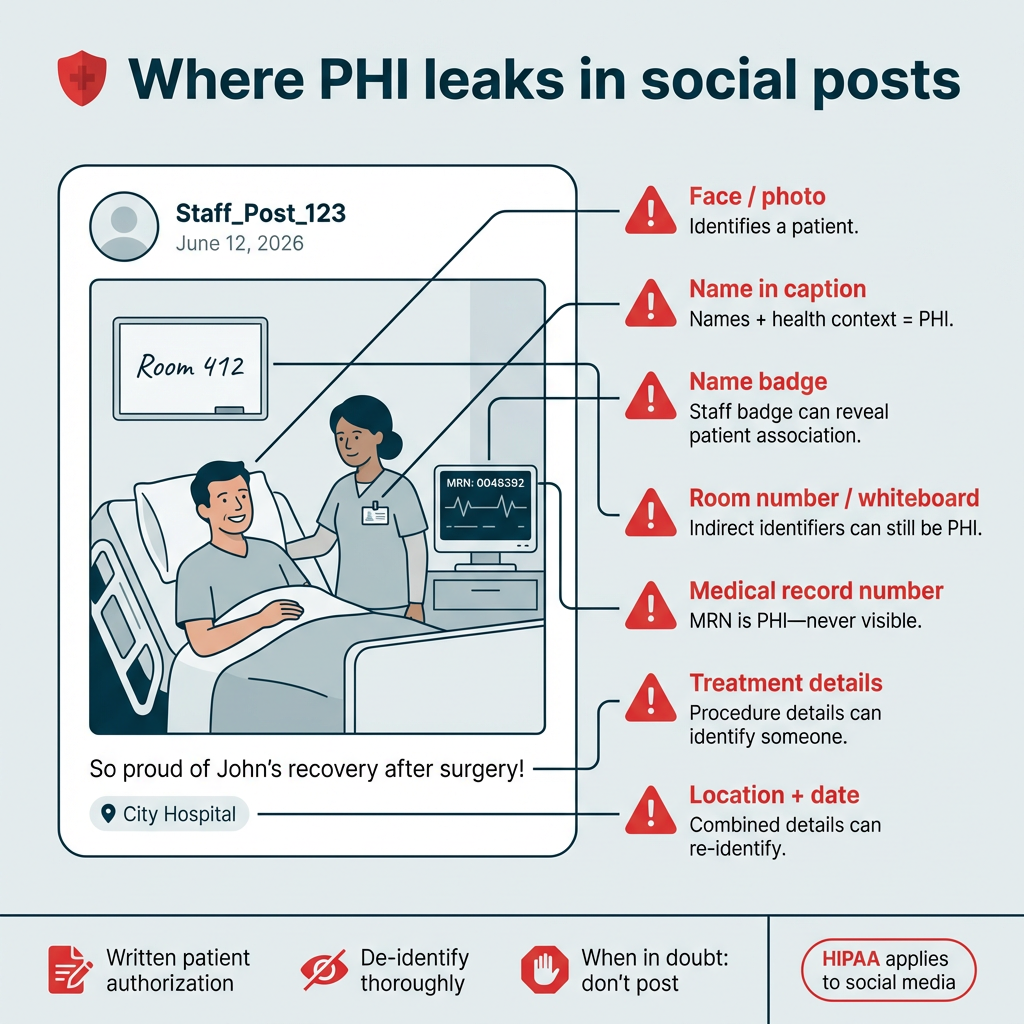
HIPAA’s Privacy Rule applies to any communication channel, including social media. It prohibits the disclosure of protected health information (PHI) without explicit written patient consent. To date, HHS OCR has settled or imposed penalties in 152 cases totaling $144.9 million, spanning national pharmacy chains, major medical centers, and small provider offices alike.
PHI includes any individually identifiable health information: names, photos, medical record numbers, treatment details, and even information that could allow someone to identify a patient indirectly.
The consequences of a HIPAA violation on social media are serious. The U.S. Department of Health and Human Services can impose fines exceeding $2.1 million per violation category per year. Even well-intentioned posts, like celebrating a patient’s recovery, can constitute a violation if proper written authorization wasn’t obtained first.
What FDA and FTC rules apply to healthcare social media?
The FDA regulates how drugs, medical devices, and health products are promoted, including on social media. Any efficacy claims must be substantiated, and posts about prescription products must include fair balance (mentioning both benefits and risks).
The FTC, meanwhile, enforces truth-in-advertising standards and requires that any health-related claims be backed by competent and reliable scientific evidence.
Even saying something like, “XYZ Product works for most people,” without citing your source can land you in trouble with the FTC. What counts as most: 90%, 75%, 51%? Which study verified that claim? While you don’t need footnotes in a social media post, be prepared to back up any claims with evidence if asked.
A few resources to keep bookmarked:
What regional and professional body regulations should you know?
Beyond U.S. federal law, healthcare organizations need to be aware of regional regulations and professional body guidelines that may apply to their social media activity.
In Canada, Health Canada restricts direct-to-consumer advertising for prescription drugs, and the Canadian Code of Advertising Standards applies to health claims made on social media. In the EU, GDPR requires explicit consent before using any patient data, including in social media content.
Professional licensing bodies may also set their own social media guidelines. For example, the British Columbia College of Physicians and Surgeons explicitly lists what doctors can and cannot do when advertising or communicating with the public, including on social media. Failure to follow these guidelines may jeopardize your ability to practice in your region.
Make sure you’re aware of any social media-specific guidance from your regulatory body before you begin posting.
|
Regulation |
Jurisdiction |
What it covers |
Key social media implication |
|---|---|---|---|
|
HIPAA |
United States |
Patient health information privacy |
Never post PHI without written consent; fines exceeding $2.1M per violation category |
|
FDA |
United States |
Drug/device advertising claims |
All efficacy claims must be substantiated; fair balance required |
|
FTC |
United States |
Truth in advertising |
No misleading health claims; influencer disclosures required |
|
Health Canada |
Canada |
Health product advertising |
Restrictions on direct-to-consumer Rx advertising |
|
GDPR |
European Union |
Personal data protection |
Patient data requires explicit consent for any use |
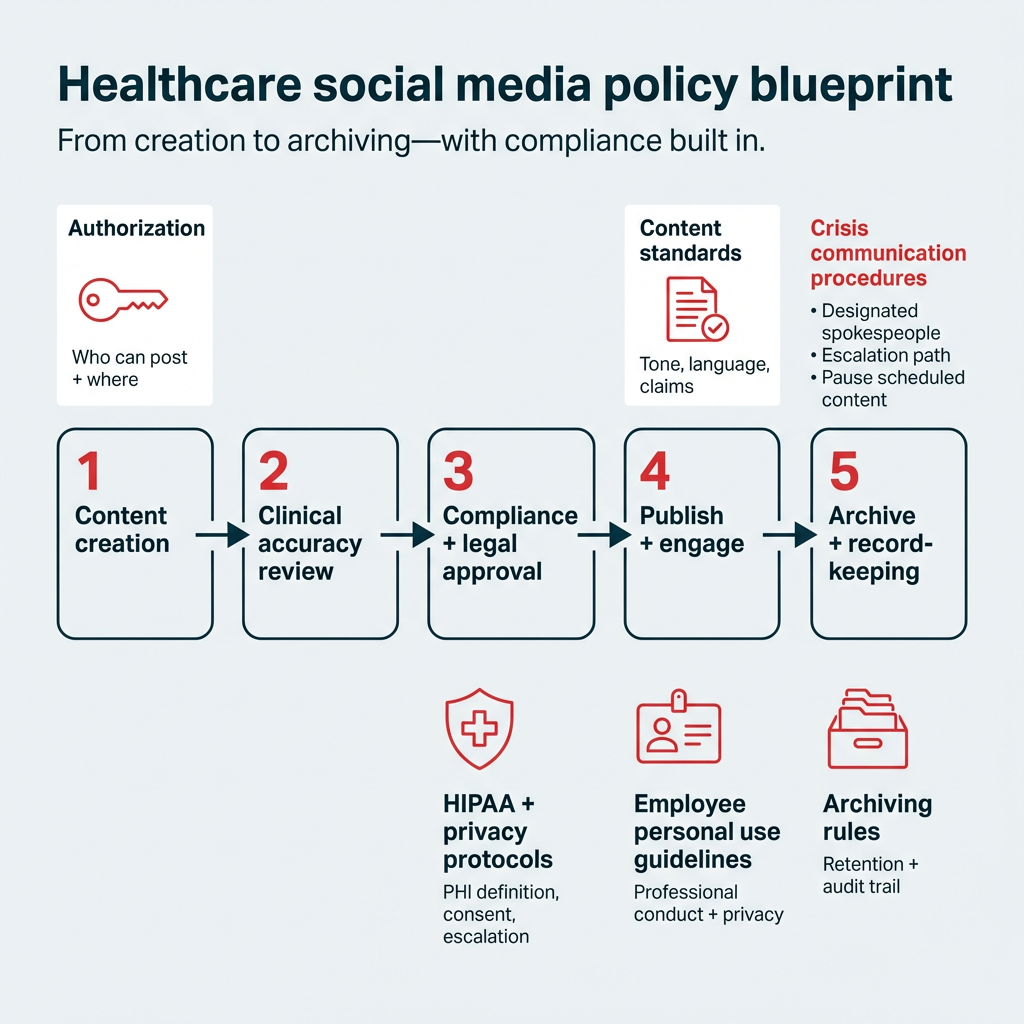
A healthcare social media policy is a core component of your social media governance framework: a documented set of guidelines that defines how your organization and its employees should use social media. Without one, you’re relying on individual judgment to navigate a landscape where a single misstep can result in regulatory penalties or reputational harm.
Here are the core components your policy should cover:
- Authorization: Define who is allowed to post on behalf of the organization and on which platforms.
- Approval workflows: Establish a review and sign-off process for all content before it goes live, including who reviews for clinical accuracy and regulatory compliance.
- HIPAA and privacy protocols: Spell out what constitutes PHI, how to obtain patient consent for social content, and what to do if a potential violation is identified.
- Content standards: Set guidelines for tone, language, and the types of claims that can and cannot be made on social media.
- Crisis communication procedures: Outline how the team should respond to negative press, misinformation, or a data breach on social channels, including designated spokespeople and escalation paths.
- Employee personal use guidelines: Clarify expectations for employees’ personal social media activity as it relates to the organization, patient privacy, and professional conduct.
- Archiving and record-keeping: Define how social media content and interactions are archived for compliance and legal purposes.
Starting from a healthcare policy template can accelerate the drafting process. Once finalized, make it accessible to every employee, not just the social media team. Regular training sessions help ensure the guidelines stay top of mind, especially as regulations and platforms evolve.
Even well-meaning healthcare organizations can stumble on social media. A proactive approach to social media risk management starts with understanding the most common mistakes. Here are a few examples of what to steer clear of.
Sharing patient information without consent
Sharing patient information without written consent is not just a reputational risk. It is a violation of HIPAA that can result in fines exceeding $2.1 million per violation category per year and potential criminal charges.
While no medical professional has likely done this with ill intent, it does happen. Healthcare organizations should err on the side of caution and avoid potentially sensitive information altogether if there’s any question about whether content is anonymous enough.
Using stigmatizing or outdated medical language
Not using the most current medical language may imply a bias or judgment, even if you didn’t mean to come across as judgmental at all.
An example could be referring to substance use disorder issues with (unintentionally) stigmatizing language which may alienate potential patients. The National Institute of Health has some great advice on science-based language relating to this example, though there are parallels for many other health topics.
Making unsubstantiated health claims
Healthcare organizations are unlikely to make claims on social media without clinical evidence. But vague language can still trigger regulatory scrutiny. Phrases like “clinically proven” or “doctor recommended” require specific sourcing, and the FTC has made it clear that the burden of proof falls on the advertiser.
Be prepared to back up any claims with evidence if asked, and have your compliance team review content that references product efficacy or health outcomes before it goes live.
Running misleading healthcare ads
Healthcare ads need to follow much stricter rules than regular consumer ads. The main key is ensuring they are clear, accurate, and not misleading in any way, even by way of omission.
Misleading by omission is particularly common on social media, where character limits and short-form formats make it tempting to highlight benefits without mentioning risks. For example, promoting a weight-loss medication without disclosing common side effects, or advertising a procedure’s success rate without noting the criteria that defined “success” in the study. Both could draw FDA or FTC scrutiny.
In addition to being governed by privacy laws like HIPAA, healthcare ads are also regulated by the FDA and FTC in the United States and other government bodies worldwide.
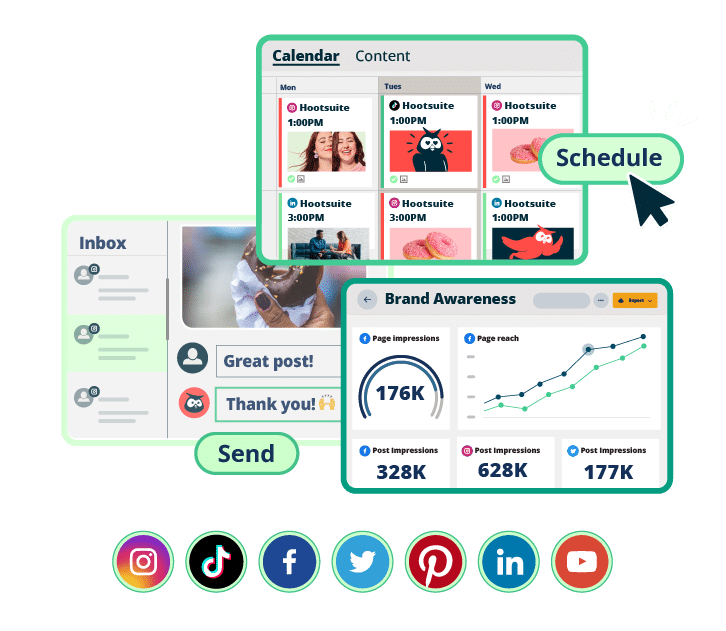
The Most Trusted Social Media Tool for Healthcare
Create and publish posts. Talk to patients and prospects. Measure ROI. Save time and grow faster.
Book a demo
A strong healthcare social media content strategy combines education and entertainment (sometimes called “edutaining” content) to drive engagement without sacrificing credibility. That combination is what sets successful healthcare brands apart.
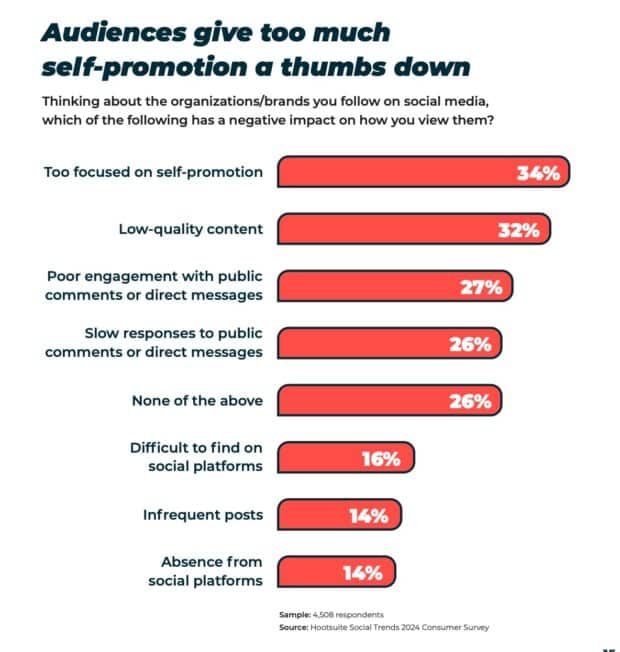
People say the top reason they use social media is to be entertained, and 53% wish brands were more relatable. Across all industries, people dislike brands who are too self-promotional, post low-quality content, or don’t engage with their followers.
What types of content perform best for healthcare brands?
Healthcare organizations that consistently grow their social presence tend to mix several content types rather than relying on one format. Based on current healthcare social media trends, here are the types that tend to perform well:
- Educational Reels and short-form videos: Quick health tips, myth-busting, and explainers. The Mayo Clinic Minute series is a great example of fast-paced, informative Reels.
- Provider spotlights: Introduce your doctors, nurses, and specialists to humanize your organization and build trust.
- Patient testimonials (with consent): Real stories from patients who’ve had positive experiences, shared with proper written authorization.
- Behind-the-scenes content: Tours of new facilities, day-in-the-life posts from staff, or prep for community health events.
- Myth-busting and FAQ posts: Address common health misconceptions directly. These tend to earn high engagement and shares.
- Community health events: Promote free screenings, vaccination drives, or wellness workshops to drive both online engagement and in-person attendance.
This Reel from Cleveland Clinic demonstrates how to make educational content engaging:

Source: @clevelandclinic
How often should healthcare organizations post on social media?
There’s no universal posting frequency that works for every healthcare organization. The right cadence depends on your team’s capacity, the platforms you’re on, and your social media goals.
That said, consistency matters more than volume. Posting three times a week on one platform with high-quality, compliant content will outperform daily posts across five platforms that feel rushed or generic. Start with a sustainable schedule, track what resonates, and adjust from there.

You don’t need to be on every social platform out of obligation. 49% of healthcare organizations say their biggest social media challenge is related to the cost or time it takes to maintain their presence on multiple platforms.

Focus your time and budget on the one or two platforms that are driving the most results. According to Pew Research, only three platforms (YouTube, Facebook, and Instagram) are used by at least half of U.S. adults. Here’s a quick breakdown of how each major platform fits into a healthcare social media strategy:
|
Platform |
Best for |
Healthcare use case |
Audience |
|---|---|---|---|
|
|
Community building, events |
Patient community groups, health education, event promotion |
Broad; skews 30-65+ |
|
|
Visual storytelling, Reels |
Provider spotlights, behind-the-scenes, educational Reels |
18-44 |
|
|
Recruitment, thought leadership |
Employer branding, research sharing, B2B health |
Professionals, job seekers |
|
TikTok |
Short-form video, younger audiences |
Myth-busting, quick health tips, humanizing providers |
18-34 |
|
YouTube |
Long-form education |
Procedure explanations, patient stories, provider Q&As |
Broad |
|
X (Twitter) |
Real-time updates, professional discourse |
Public health alerts, conference engagement, policy discussion |
News-focused professionals |
For example, Northwestern Medicine prioritizes video content for TikTok and Instagram rather than trying to “do it all.” Their videos make excellent use of tools to hold the viewer’s attention, like this countdown timer, which increases the likelihood of people watching the entire video.
AI adoption in healthcare social media is accelerating, but trust remains a concern. 62% of people say they’re less likely to engage with or trust AI-generated content, although that varies widely by generation. Gen Z is, predictably, more likely to trust AI content, whereas baby boomers are the least likely.
Even so, AI use is growing rapidly across healthcare organizations, with some planning to increase AI use for patient service by 422% compared to 2023.

The key is using AI to save time without sacrificing trust or regulatory compliance. Here are a few guardrails to keep in mind:
- Never input PHI into AI tools: Most AI platforms are not HIPAA-compliant, and any patient data entered could be stored or used in model training.
- Always have a human review AI-generated content: AI can draft posts, suggest captions, and repurpose content, but a clinician or compliance officer should review anything that touches health claims or patient-facing messaging.
- Build AI into your existing approval workflows: Treat AI-drafted content the same way you’d treat content from a new team member: it needs sign-off before it goes live.
You can use AI content creation tools to save time without sacrificing trust by ensuring you have an approval workflow to fact-check content before publishing.
Hootsuite’s OwlyWriter AI can draft new posts or repurpose existing content into posts tailored for each platform in just a few clicks. Since it’s built into Hootsuite, you can draft and schedule weeks’ worth of content in minutes, then collaborate with your team and assign approvals before going live, all in one place.
Evaluating social media ROI is a challenge for many brands, healthcare organizations included. 69% of those surveyed said they were concerned about their social media ROI.

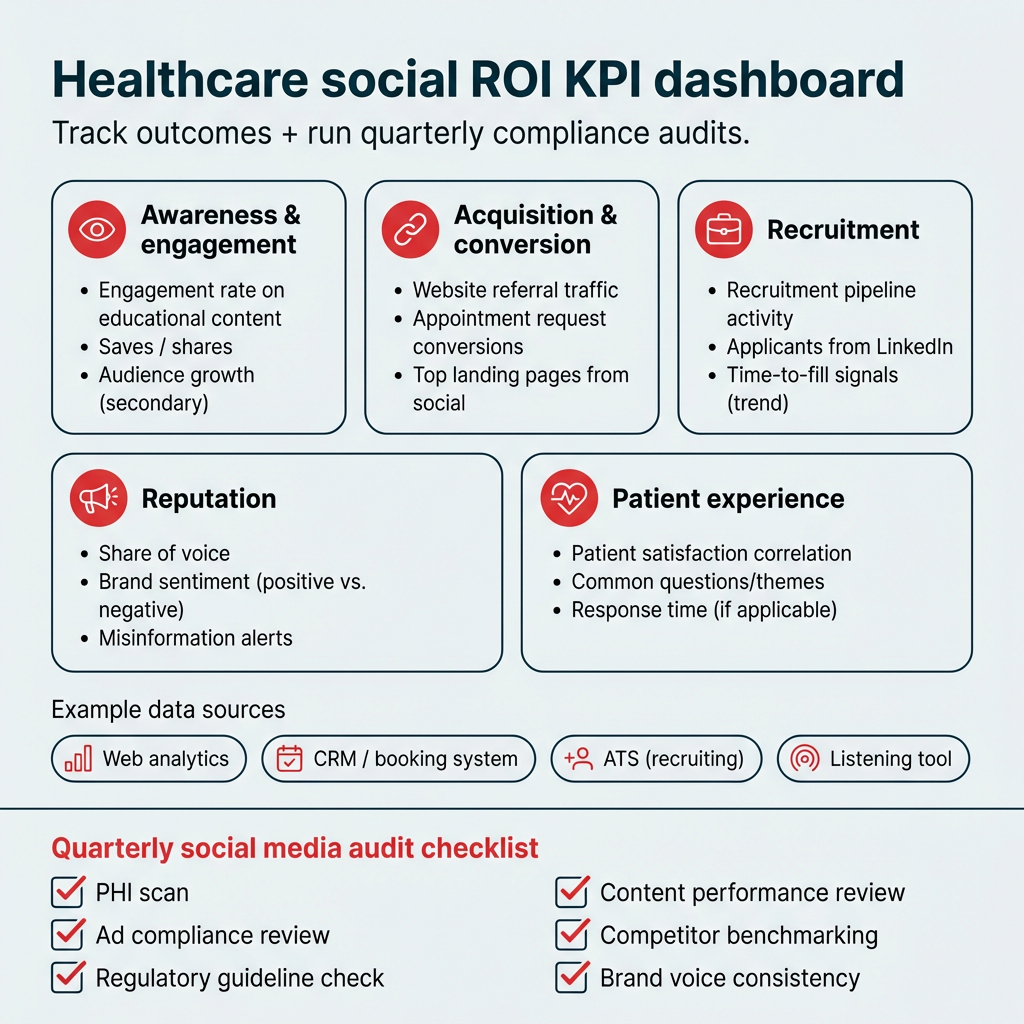
Part of that concern is likely because 64% of organizations say their primary ROI metric is engagement, and 51% say follower count. Those are useful indicators, but they don’t tell the full story. Here are healthcare-specific KPIs worth tracking:
- Website referral traffic: How many visitors come to your site from social media, and which pages do they visit?
- Appointment request conversions: Can you attribute appointment bookings or form fills to social media campaigns?
- Engagement rate on educational content: Are people saving, sharing, and commenting on your health information posts?
- Recruitment pipeline activity: How many job applicants come through social channels like LinkedIn?
- Share of voice: How does your social presence compare to other health systems in your market?
- Patient satisfaction correlation: Do spikes in positive social engagement align with improvements in patient satisfaction scores?
Define your goals for social media, track your return, and above all, post informative, enjoyable content.
How do you run a social media audit for a healthcare organization?
A compliance audit for healthcare social media goes beyond checking your follower count. Besides checking for regulatory and ethical compliance, social media audits uncover:
- PHI scan: Review all published posts for any content that could contain or imply protected health information.
- Ad compliance review: Verify that all promoted content meets FDA, FTC, and platform-specific advertising guidelines.
- Regulatory guideline check: Confirm your content aligns with any updated guidance from your licensing or professional body.
- Content performance review: Identify your top-performing content, audience demographics, and growth by platform.
- Competitor benchmarking: Assess what other health systems in your market are doing and where you can differentiate.
- Brand voice consistency: Ensure tone and messaging are consistent across all accounts and align with your social media policy.
We’ve got a full step-by-step on running a social media audit, complete with a free template. As part of your regular analytics review, aim to run a healthcare-specific compliance audit at least quarterly.
Managing social media in healthcare means juggling content creation, compliance workflows, multi-platform publishing, and ROI reporting, often with a lean team. Hootsuite brings all of that into one place.
Here’s how healthcare organizations use Hootsuite:
- Unified publishing: Schedule and publish content across Facebook, Instagram, LinkedIn, TikTok, X, and YouTube from a single dashboard.
- OwlyWriter AI with approval workflows: Draft posts faster with AI, then route them through your team for clinical accuracy and compliance review before anything goes live.
- Social listening: Monitor conversations about your organization, track health trends, and catch misinformation early with Hootsuite’s listening tools.
- Proofpoint compliance integration: For Enterprise customers, Proofpoint connects to your social accounts through Hootsuite to automatically flag and/or remove posts that may violate policies and laws.
- Analytics and ROI reporting: Track the KPIs that matter to your leadership team, from engagement rates to website referral traffic, with customizable reports.

Proofpoint is available as an integration for Enterprise Hootsuite customers. Learn more about setting it up.
Frequently asked questions
What is social media in healthcare?
Social media in healthcare refers to the use of platforms like Facebook, Instagram, LinkedIn, TikTok, and X by healthcare organizations to communicate with patients, share health information, recruit staff, and build brand awareness.
Is it a HIPAA violation to post on social media?
Posting on social media is not inherently a HIPAA violation, but sharing any protected health information (PHI) without explicit written patient consent violates HIPAA’s Privacy Rule. This can result in fines exceeding $2.1 million per violation category per year.
What should a healthcare social media policy include?
A healthcare social media policy should include guidelines on who is authorized to post, content approval workflows, HIPAA compliance protocols, crisis communication procedures, content standards, and rules for employee personal social media use related to the organization.
Which social media platforms are best for healthcare organizations?
The best social media platforms for healthcare organizations depend on their goals. Facebook and Instagram are widely used for patient engagement and community building. LinkedIn is strong for recruitment and thought leadership. TikTok works well for reaching younger audiences with short-form educational content.
Can healthcare organizations use AI to create social media content?
Yes, healthcare organizations can use AI tools to draft social media content, but every AI-generated post must go through human review and compliance approval before publishing. AI tools should never be used to process protected health information.
How do you measure social media ROI in healthcare?
Measuring social media ROI in healthcare involves tracking metrics tied to business outcomes, such as website referral traffic, appointment request conversions, recruitment pipeline activity, engagement rates on educational content, and share of voice compared to other health systems.
What are examples of HIPAA violations on social media?
Examples of HIPAA violations on social media include posting patient photos without written consent, sharing identifiable patient stories or case details, responding to patient comments with health information, and posting background images that include visible patient records.
How can hospitals use social media for recruitment?
Hospitals can use social media for recruitment by showcasing workplace culture, sharing employee testimonials, promoting open positions on LinkedIn and Facebook, and creating behind-the-scenes content that highlights what it’s like to work at the organization.
What content should healthcare organizations avoid posting on social media?
Healthcare organizations should avoid posting any content that includes protected health information, unsubstantiated medical claims, stigmatizing language, misleading advertising, or anything that could be perceived as providing individual medical advice.
How do you handle a social media crisis in healthcare?
Handling a social media crisis in healthcare starts with activating your pre-established crisis communication plan. This should include designated spokespeople, pre-approved response templates, clear escalation procedures for legal and compliance review, and guidelines for when to pause scheduled content.
Save time managing your social media presence with Hootsuite. Publish and schedule posts, find relevant conversions, engage your audience, measure results, and more — all from one dashboard. Try it free today.