By using this site, you agree to the Privacy Policy and Terms of Use.
Accept
World of SoftwareWorld of SoftwareWorld of Software
  • News
  • Software
  • Mobile
  • Computing
  • Gaming
  • Videos
  • More
    • Gadget
    • Web Stories
    • Trending
    • Press Release
Search
  • Privacy
  • Terms
  • Advertise
  • Contact
Copyright © All Rights Reserved. World of Software.
Reading: Cloudflare and ETH Zurich Outline Approaches for AI-Driven Cache Optimization
Share
Sign In
Notification Show More
Font ResizerAa
World of SoftwareWorld of Software
Font ResizerAa
  • Software
  • Mobile
  • Computing
  • Gadget
  • Gaming
  • Videos
Search
  • News
  • Software
  • Mobile
  • Computing
  • Gaming
  • Videos
  • More
    • Gadget
    • Web Stories
    • Trending
    • Press Release
Have an existing account? Sign In
Follow US
  • Privacy
  • Terms
  • Advertise
  • Contact
Copyright © All Rights Reserved. World of Software.
World of Software > News > Cloudflare and ETH Zurich Outline Approaches for AI-Driven Cache Optimization
News

Cloudflare and ETH Zurich Outline Approaches for AI-Driven Cache Optimization

News Room
Last updated: 2026/04/08 at 10:39 AM
News Room Published 8 April 2026
Share
Cloudflare and ETH Zurich Outline Approaches for AI-Driven Cache Optimization
SHARE

Cloudflare and ETH Zurich have outlined the operational challenges posed by AI-driven crawler traffic and proposed approaches to improve cache efficiency in content delivery networks. Cloudflare engineers report that AI bot traffic now exceeds 10 billion requests per week, creating patterns that differ significantly from human browsing behavior. These patterns affect latency, cache hit rates, and resource utilization across CDN and backend infrastructure.

About a third of Cloudflare’s traffic comes from automated sources, including search engine crawlers, uptime checkers, and AI assistants. AI crawlers are the most active, responsible for roughly 80 percent of self-identified bot requests. These bots issue high-volume parallel requests, often accessing rarely visited pages or scanning sites sequentially to support AI services like retrieval-augmented generation.

AI crawler behavior diverges from human browsing in several ways. Many AI crawlers maintain a high unique URL ratio, access diverse content types, and issue requests that do not effectively reuse cached content. Unlike human users, AI crawlers do not leverage browser caching or session continuity, and multiple independent instances can generate repeated requests for the same content. Cloudflare modeling shows that iterative loops by AI agents create consistently high levels of unique content access, displacing frequently requested human content in edge caches

Erika S, a systems engineer, noted in her X post:

The 70-100 percent unique access ratio in RAG loops explains the cache churn I experienced during recent fine-tuning. LRU failing under AI load makes German hosting unpredictable.

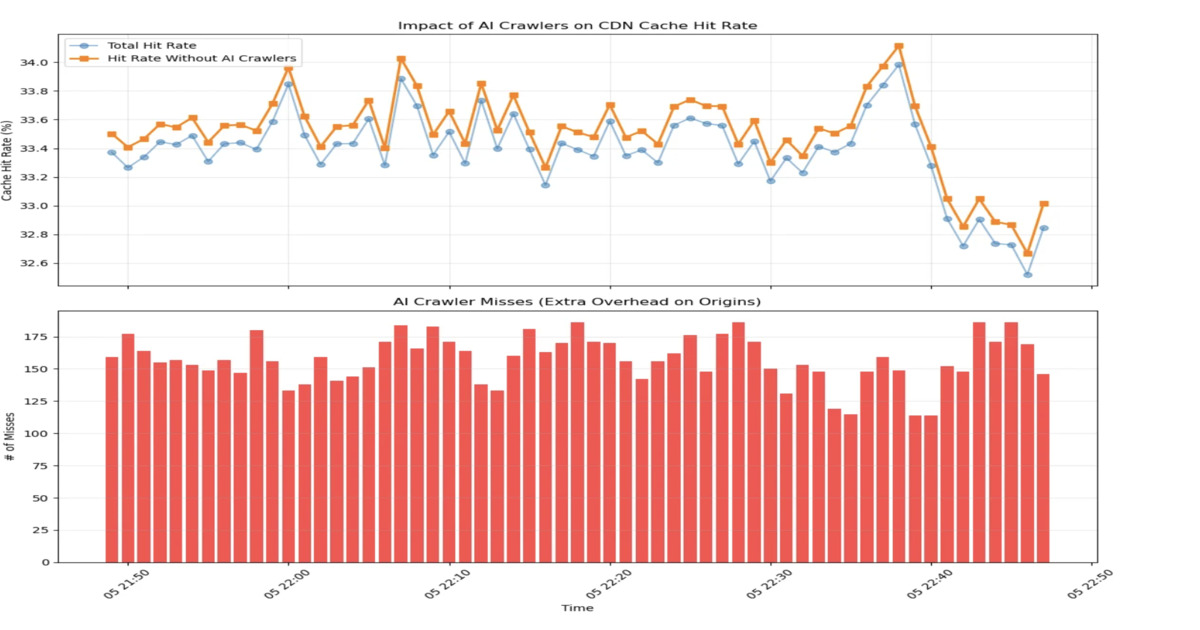
AI traffic increases cache miss rates for CDNs, reducing the effectiveness of strategies such as least recently used cache eviction, cache speculation, and prefetching. Simulated AI crawler traffic caused a measurable drop in cache hit rates for a single CDN node, increasing origin server load and slowing response times.

BeePopCommunity, a technology observer, emphasized the widespread operational impact in X post:

AI traffic breaks assumptions built for humans.

Amy Lee, CFO at Aerospike, described the broader effect on databases in a LinkedIn post:

YES! AI traffic is breaking traditional cache architectures, not just at the CDN layer but all the way to the database. When 70-100 percent of requests are unique, access patterns stop being predictable enough to cache. Most databases perform well when conditions cooperate. AI traffic is systematically eliminating optimized conditions. The ones that hold up were never dependent on those conditions in the first place. We see this in production at Aerospike: 1-2 million mixed read/write operations per second with predictable tail latency is the requirement, not the exception.

To address these challenges, Cloudflare and ETH Zurich propose AI-aware caching strategies. These include separating human and AI traffic into distinct cache tiers, testing replacement algorithms such as least frequently used or first in, first out, and exploring machine learning-driven policies that adapt dynamically. Complementary measures like structured feeds or pay-per-crawl models can help control AI access while preserving cache efficiency. Cloudflare emphasizes that AI-driven services require different caching approaches than human traffic. The proposals highlight potential operational and technical adjustments for websites to serve both human users and AI agents efficiently, underscoring the need for updated cache architectures.


Sign Up For Daily Newsletter

Be keep up! Get the latest breaking news delivered straight to your inbox.
By signing up, you agree to our Terms of Use and acknowledge the data practices in our Privacy Policy. You may unsubscribe at any time.
Share This Article
Facebook Twitter Email Print
Share
What do you think?
Love0
Sad0
Happy0
Sleepy0
Angry0
Dead0
Wink0
Previous Article Wimbart’s Jessica Hope on a decade of telling Africa’s tech story Wimbart’s Jessica Hope on a decade of telling Africa’s tech story
Next Article Redmi launches Note 14 Pro+ featuring the world’s first Snapdragon 7s Gen3 chipset · TechNode Redmi launches Note 14 Pro+ featuring the world’s first Snapdragon 7s Gen3 chipset · TechNode
Leave a comment

Leave a Reply Cancel reply

Your email address will not be published. Required fields are marked *

Stay Connected

248.1k Like
69.1k Follow
134k Pin
54.3k Follow

Latest News

GlassWorm Campaign Uses Zig Dropper to Infect Multiple Developer IDEs
Computing
There’s a good reason these ‘new’ Retroid Pocket 5 handheld colors look very familiar
News
Bitland WMI Laptop Driver Slated For Linux 7.1
Computing
1.8 billion iPhone users warned over new money-draining scam
News

You Might also Like

There’s a good reason these ‘new’ Retroid Pocket 5 handheld colors look very familiar
News

There’s a good reason these ‘new’ Retroid Pocket 5 handheld colors look very familiar

3 Min Read
1.8 billion iPhone users warned over new money-draining scam
News

1.8 billion iPhone users warned over new money-draining scam

4 Min Read
Cloudflare made a WordPress for AI agents
News

Cloudflare made a WordPress for AI agents

10 Min Read
Hoka, Asics and Nike running shoes drop in price: 11 spring deals with up to 46% off
News

Hoka, Asics and Nike running shoes drop in price: 11 spring deals with up to 46% off

1 Min Read
//

World of Software is your one-stop website for the latest tech news and updates, follow us now to get the news that matters to you.

Quick Link

  • Privacy Policy
  • Terms of use
  • Advertise
  • Contact

Topics

  • Computing
  • Software
  • Press Release
  • Trending

Sign Up for Our Newsletter

Subscribe to our newsletter to get our newest articles instantly!

World of SoftwareWorld of Software
Follow US
Copyright © All Rights Reserved. World of Software.
Welcome Back!

Sign in to your account

Lost your password?