When Abakar Mahamat was completing his Master’s in Information Technology (IT) engineering at ISGA (Institut Supérieur des Génies et des Affaires), Morocco, in 2021, he did not think he would end up building medical kiosks.
At first, he tried to build an app that would connect patients to doctors in his home country, Chad, because of the healthcare access gap he found during his research. What stood out to Mahamat was the effort it took for people to get a consultation.
Chad has about 0.8 physicians per 10,000 people, far below the global benchmark of 2.5 medical staff per 1,000 people, according to data from the World Health Organisation (WHO). For many patients, getting care means travelling long distances and spending on transport to navigate a system that is physically out of reach.
An app felt like a clean fix to bring medicine closer to the people. However, as Mahamat began to sketch what would eventually become Telemedan, the idea changed. An app assumes that patients have smartphones and stable internet connectivity enough to sustain a consultation. In Chad, where internet penetration stands at 13.2%, a purely digital solution might struggle to solve the problem it was built for.
“Remote areas in Chad have a very low rate of electrification and connectivity,” Mahamat said. “The Internet is expensive for remote areas, so developing a mobile app for this context was not suitable.”
Diagnosis required more than just talking. For doctors to get an accurate diagnosis of a patient, they need to conduct tests such as checking the blood pressure and what the heartbeat sounds like, checking for muffled sounds in the lungs, knowing the body temperature, and the blood oxygen level.
“During the teleconsultation, what if the doctors need to know the temperature or the blood oxygenation levels in the patients? An app doesn’t have tools to get that data,” he said, reflecting on the early stages of the idea.
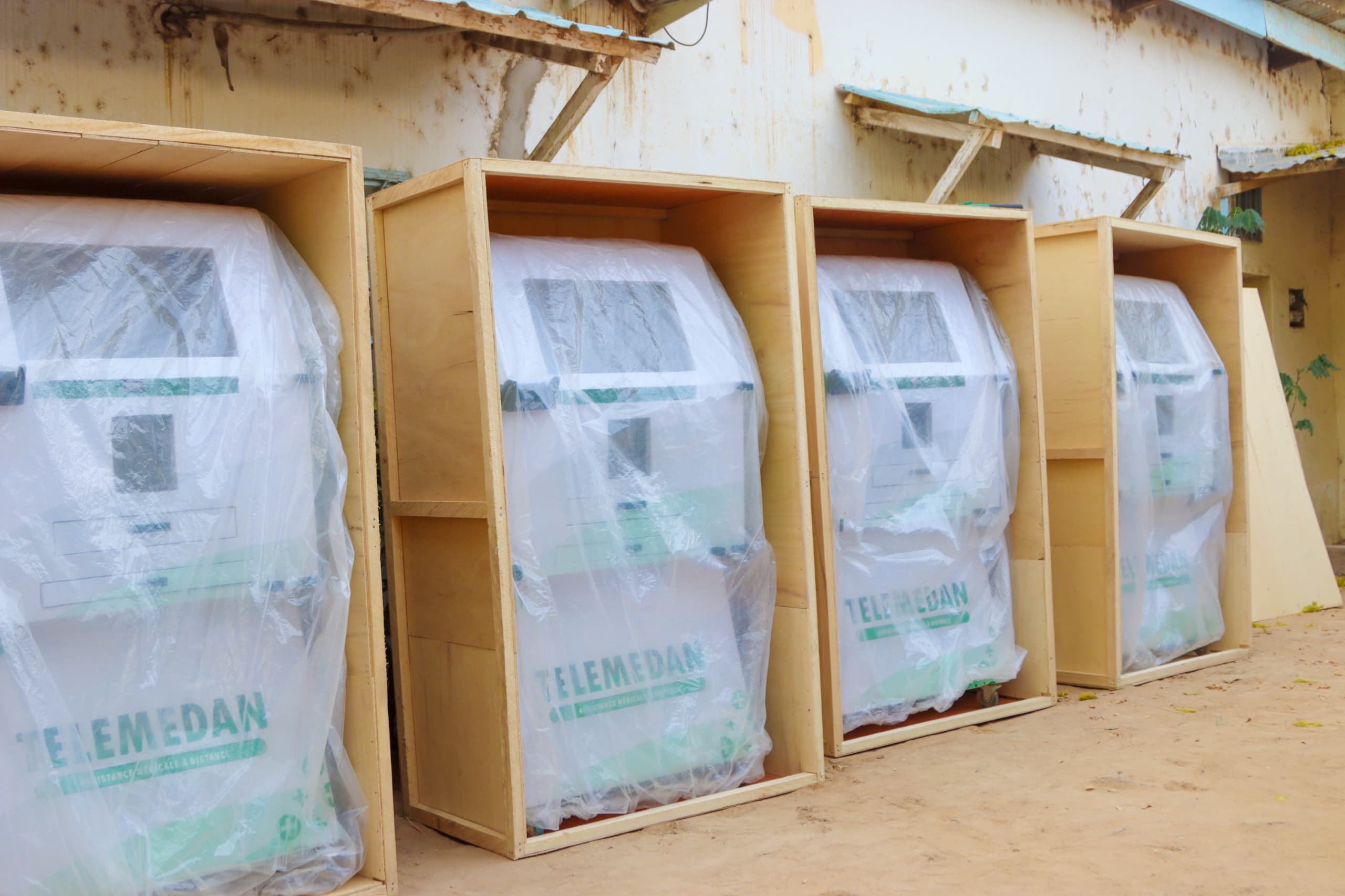
In 2021, Mahamat and Ahmed Kotoko launched Telemedan, a solar-powered medical kiosk that connects Chadians in rural provinces to medical doctors.
Inside the kiosk
Telemedan works like a small clinic, designed to handle consultation and diagnosis of a patient in one place.
A patient could walk in, book an appointment to connect with a doctor using video conferencing. According to Mahamat, Chad’s Ministry of Health provides the doctors through a 2022 partnership
Mahamat explained that the doctors follow a pre-screening process and are selected through the National Digital Health Program, a government initiative for the effective implementation of digital health tools in the country.
“This ensures that the clinicians involved are qualified, aligned with national standards, and integrated into the public health system,” he said.
The kiosk is equipped with a set of medical devices that allow the doctor to gather real-time diagnostic data during the session. These tools are what Mahamat describes as on-site diagnostics, and include a dermatoscope for examining skin conditions, a stethoscope for heart activity, an otoscope for ear examinations, an oximeter for measuring blood oxygen levels, and temperature sensors.
For maternal care, the kiosk also includes a probe that can be used to monitor the foetus. This setup is meant to close the gap that a standard video consultation cannot, because the doctors are receiving inputs that emulate a physical examination.
Interacting with these tools is not always known, particularly for first-time users. Because of this, each kiosk is manned by a trained local operator who steps into position to set up the devices and provide assistance.
“The kiosk is placed in a private area where there are only the patients and their doctors. The local operators can be nearby if the patient needs help with the on-site diagnostics,” he added.
Telemedan’s kiosks also handle care continuity; doctors can issue prescriptions at the end of a session, which patients can print directly from the kiosk. At the same time, patients receive updates and reminders through SMS on their phones to ensure that they can follow up on appointments or treatment without needing a smartphone.
For users with a smartphone, Telemedan is extending this information and follow-up layer through a mobile application that is currently in development. According to Mahamat, this app will allow patients to access their prescriptions and medical records as an extension of the Kiosks.
Mahamat noted that the kiosks are optimised for environments with unreliable infrastructure; they are solar-powered and connect to the internet using a mix of 4G and satellite systems, depending on what is available in each location.
“In some areas it’s working perfectly,” he said of 4G, “but in some areas that are very, very far we are using the satellite antenna… for more efficiency.”
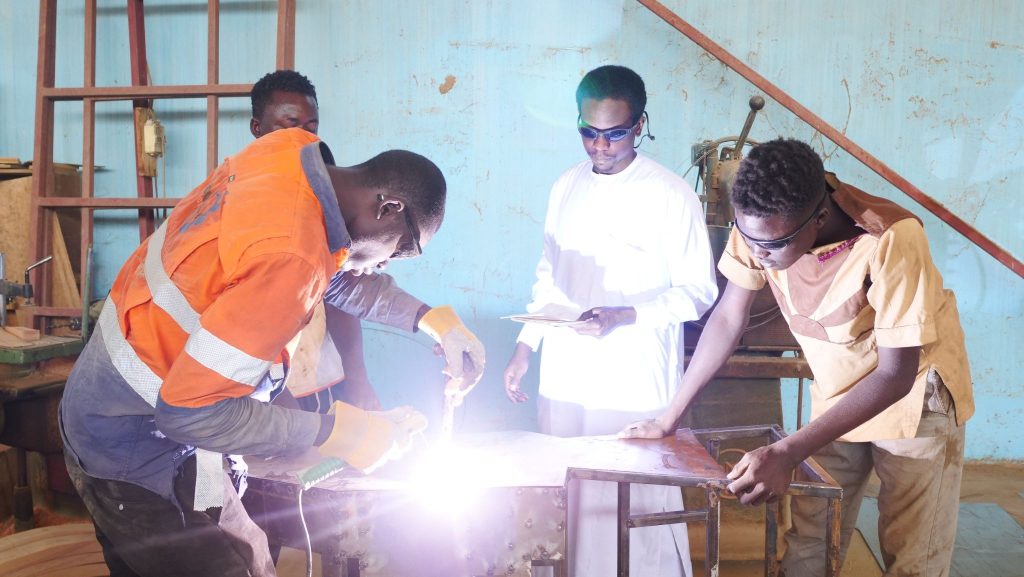
Each kiosk takes about two weeks to produce, according to Mahamat, because some components, like the touchscreen, are imported before local assembly. He noted that the kiosks are designed to be low-maintenance, not needing constant intervention. Local operators are trained to handle minor physical issues, such as disconnected components, while more complex software problems are resolved remotely by the Telemedan team.
“If you have a problem with the software, we can fix that at a distance,” he said, but for hardware issues like a broken screen, the team may need to step in physically.
Telemedan has begun to layer in additional capabilities, more recently, an AI-powered tool used for detecting diabetic retinopathy through retinal scans, Mahamat noted, describing it as one of the first steps in integrating AI into the system.
Partnerships and pricing
Telemedan’s business operation is such that the people who need the service the most are not the ones who pay for the infrastructure. The kiosks themselves cost about $10,000 per unit, and that cost is not passed on to patients, because Telemedan sells directly to governments and public health programmes and organisations that are working to expand access to care.
This structure makes Telemedan a business-to-government (B2G) and business-to-business (B2B) model, with patients as end users rather than customers. Once a kiosk is deployed, it is no longer owned by Telemedan as it becomes part of the system operated by that government or partner.
Consultations through the kiosk typically range from $2 to $15, depending on whether the patient is seeing a general practitioner or a specialist. Those fees are not set by Telemedan, and are often tied to existing public health insurance schemes or pricing structures defined by the deploying partner, according to Mahamat.
The result of this model is one where revenue is not tied to usage, meaning that selling kiosks will generate revenue, but increased usage by patients does not directly translate into additional revenue. The company is now trying to change that.
“We want to deploy our own network of kiosks, that is, owned by Telemedan, where we could collect fees from the teleconsultation,” Mahamat said.
Since its launch in 2021, the company has installed 37 kiosks across 11 provinces in Chad, reaching an estimated 143,000 people, according to Mahamat. His ambition, however, is larger than Chad.
“The problem we are tackling is not just a Chad problem… it’s an African problem,” he said, noting that expansion to new markets will not be straightforward.
Launching the solution in new markets means navigating regulatory environments, securing partnerships with governments and health agencies, and adapting the kiosk to different environments—realities, which Mahamat is well aware of. However, the focus remains on strengthening what already exists in Chad and preparing the model for the kind of partnerships that an expansion will require.