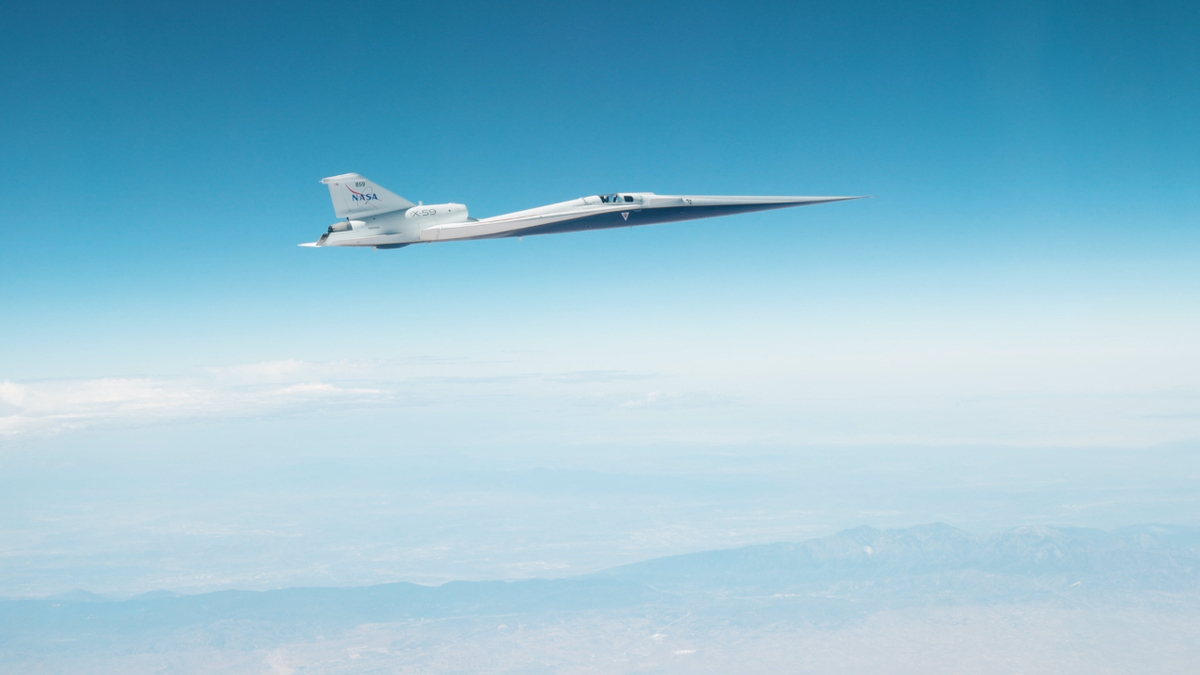
The experimental plane NASA X-59 reached a new milestone last week by reaching a speed of Mach 1.4 (about 1,500 km/h) and an altitude of 55,000 feet (just under 17 km).
This success is not trivial, since it concerns the exact flight conditions that will be required for future phases of the Quest mission, namely the test of silent supersonic flight.
More important than the first supersonic flight
The June 12 flight is considered by NASA to be an even more critical step than the first crossing of the sound barrier a few days earlier.
By validating its ability to operate at Mach 1.4 and 55,000 feet, the Quesst mission team is ensuring that the aircraft can replicate the conditions necessary for upcoming flybys of several American communities.
These flights will collect essential data on the public’s perception of the sound produced by the aircraft. The goal of the X-59 is not to be completely silent, but to turn the deafening sonic boom into a slight thud.
During the acoustic validation phase, the precise sound signature of the device will be measured to confirm that it matches the simulations.
With an F-15 as escort
The X-59 currently does not fly alone. For the first supersonic tests, it is accompanied by a NASA F-15 research plane, a traditional supersonic jet.
It helps mask the noise generated by the X-59, thus avoiding hasty conclusions about its acoustic performance. The F-15 will then be equipped with a special probe designed to measure shock waves emitted by the X-59.
These data will be a first assessment of supersonic performance and the ability to attenuate the sonic boom, even before ground measurements. The team also continues to expand the X-59’s flight envelope by testing different speeds and altitudes.