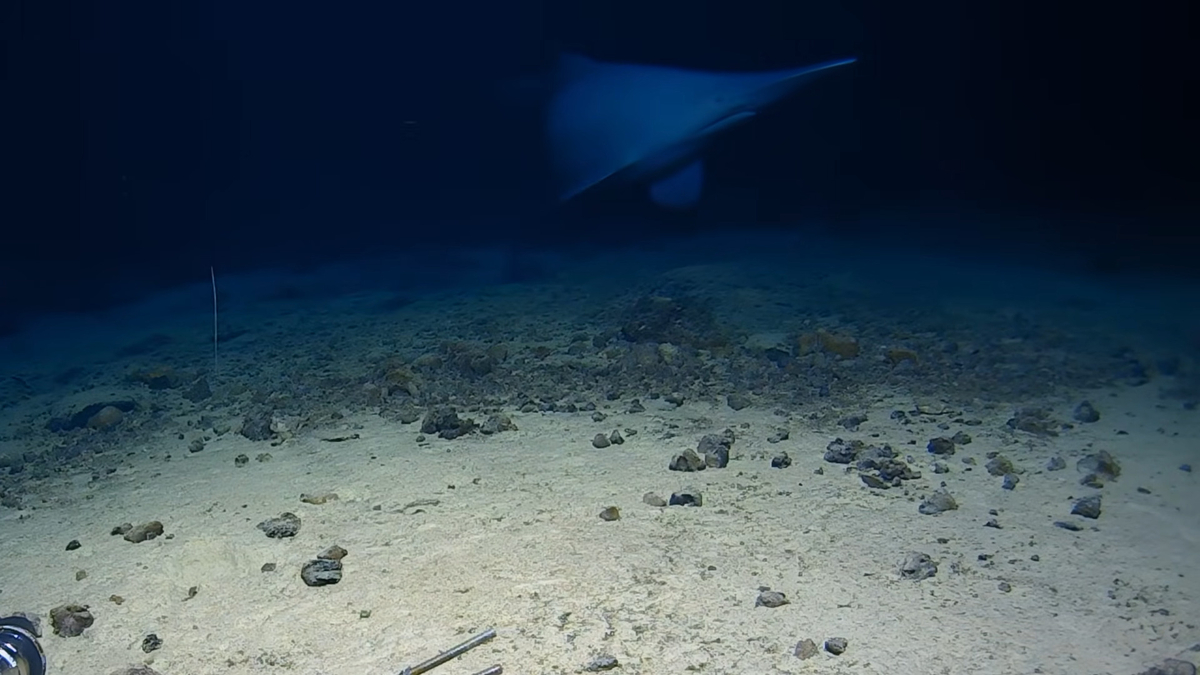
The goblin shark (Mitsukurina owstoni) is one of the most elusive and fascinating sharks on the planet. Until now, the only sightings of live specimens were limited to accidental captures on fishing lines, with the animals dying shortly after coming to the surface.
A study published in the Journal of Fish Biology documents two direct observations of this deep-sea predator in its natural environment.
How were these observations made?
The first sighting was in 2019, during an Ocean Exploration Trust expedition near Jarvis Island. It was in 2025 that Aaron Judah, a doctoral student at the University of Hawaii at Mānoa, analyzed video archives from the ROV Hercules and confirmed the presence of a goblin shark.
The second observation was made in 2024 in the Tonga Trench by scientists from the Minderoo-UWA Deep-Sea Research Center, during an expedition aboard the research vessel RV Dagon, using a camera placed on the ocean floor and using bait to attract animals.
What this discovery indicates
The sighting in the Tonga Trench was recorded at a depth of almost 2,000 meters, 700 meters lower than the previous record for this species and for the entire order Lamniformes, which includes the great white shark.
Previously confined to restricted areas, its known range now extends to the central Pacific. The case of a deep-sea animal that has very low abundance, but an extensive geographic range.
A shark that is unique
Nicknamed “living fossil”, the goblin shark is the last representative of a lineage dating back 125 million years. Its appearance is unique, with a long, flattened snout and protractile jaws that it can project forward at a speed of 3.1 m/s to capture its prey.