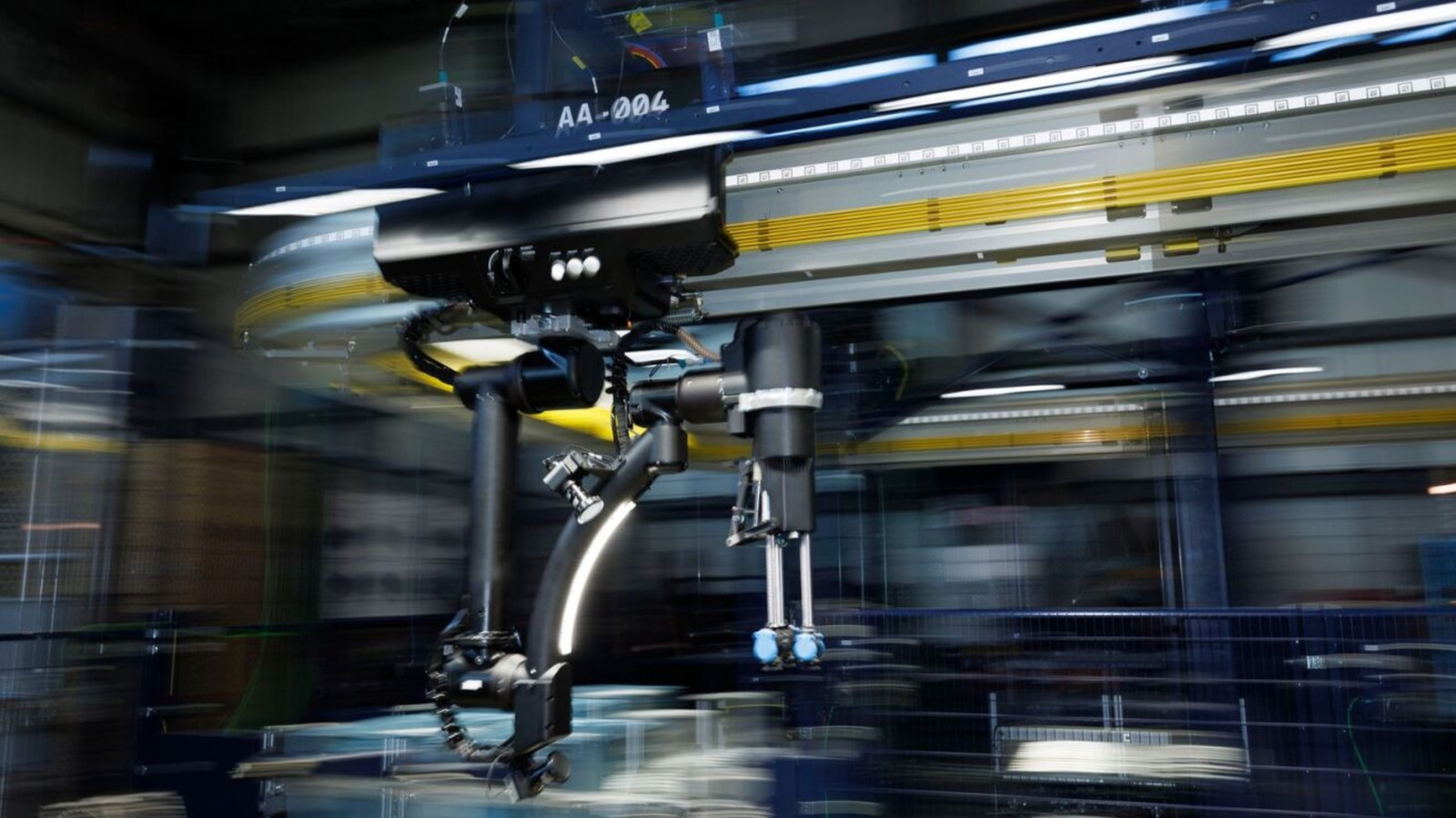
After less than six months on the job, Amazon has fired its latest warehouse robot. Launched in October 2025, Blue Jay was a multi-limbed robot intended to serve as “an extra set of hands” in the ecommerce giant’s warehouses. First reported by Business Insider, the wind down is indicative of the nonlinear incorporation of AI technologies into the workplace, especially in terms of physical systems. This isn’t to say that autonomous robots have not made their mark. Over the past few years, robots, especially from China, have began to transform a variety of industries, from automating agricultural projects to revolutionizing battlefield logistics pipelines. With that said, Blue Jay is another example in a long line of AI robotics programs that have failed to reach lofty expectations, as robotics development has lagged behind its digital counterparts. Furthermore, the physical costs of autonomous robotics has made the price of failure much steeper.
One of the headline projects of Amazon’s Robotics division’s 2025 slate, Blue Jay was initially hailed as the culmination of Amazon’s foray into autonomous robotics. Development time was significantly reduced compared to previous projects like Robin or Sparrow, which each took over three years to move from ideation to operation.
According to Amazon, Blue Jay took only a year to develop, harnessing innovations like digital twins, in which digital simulations virtually test prototypes, to “build systems like Blue Jay smarter and more quickly.” Despite this success, cost considerations and implementation issues, alongside shifting priorities in Amazon’s warehouse systems, has led to the innovative robot being sidelined. Blue Jay’s “underlying technology” will “continue to support employees across our network,” Amazon states.
The robot revolution that never was
Blue Jay was launched alongside Amazon’s agentic AI system, Project Eluna, in October 2025. Described by Amazon as functioning like “a juggler who never drops a ball,” Blue Jay was billed as an extra set of hands that could consolidate several robotic systems into a single station. At release, Blue Jay was touted as “already able to pick, stow, and consolidate approximately 75% of all the various types of items we store at our sites,” in the company’s South Carolina facility. According to an Amazon spokesperson, speaking to News, Blue Jay was launched as a prototype, rather than a fully-fledged, mass-deployed program. Critically, Amazon’s press release at the time declined to mention this, instead billing the fledgling robotics program as helping “keep employees working in their ergonomic ‘power zone.'”
Despite its enthusiasm, Amazon ran into several problems when launching its new innovative robotic warehouse division. For one thing, Blue Jay proved exceptionally expensive and difficult to manufacture. Furthermore, its incorporation into warehouse workflows proved less than ideal. These are common problems in building AI-forward warehouses and manufacturing plants, where high upfront costs, complex systems integration, technical issues, and a shortage of trained personnel often doom projects like Blue Jay before they begin.
These problems are especially prevalent when considering humanoid robots. Perhaps best exhibited by Tesla’s Optimus, whose public snafus have been a point of contention for owner Elon Musk, who’s touted the technology as delivering $10 trillion in future revenue. All told, discontinuation underscores challenges facing companies as they look to incorporate artificial intelligence, autonomous robots, and other AI technologies into their workflows.
Amazon’s robotic future
This shift reflects a broader change in Amazon’s warehouse model. Previously, Blue Jay was envisioned as a cog in Amazon’s “Local Vending Machine” system of large, highly automated warehouses. According to sources interviewed by Business Insider, the conglomerate is moving towards a system called “Orbital,” in which a more malleable, reconfigurable structure will enhance its same-day delivery system through an emphasis on scalable growth and flexibility, while decreasing warehouse sizes. Amazon expects Orbital to enable Whole Foods to better handle perishable goods and frozen products while facilitating its grocery deliveries. Notably, Business Insider reports that such a transition won’t take place until 2027.
The demise of Blue Jay does not spell the end of Amazon’s robotic innovations. According to a New York Times report, which came out only a day before Blue Jay’s momentous initial announcement and cites internal documents, the conglomerate plans to automate roughly 75 percent of its operations. Per the same report, the nation’s then-second-largest-employer estimated it could reduce its U.S. hiring needs by upwards of 160,000 people by 2027. The projected benefits, these documents revealed, amounted to roughly 30 cent savings per item. How Blue Jay’s failure informs such efforts, however, remains to be seen.
To that end, Amazon is more likely to increase these efforts, rather than dissuade them. Since it founded its robotics program in 2012, over 1 million robots have been deployed across its warehouses. Its Vulcan program, which also debuted in 2025, was Amazon’s first robot with a “sense of touch.” A two-armed robot equipped with cameras and suction cups, Vulcan helps Amazon rearrange and move packing compartments. Such investments in autonomous systems will only increase this year, as Amazon kicks off its plan to up AI spending by $200 billion in 2026.