One of the greatest fears of Western navies was not a direct attack, but something much more disturbing: not knowing where the adversary was. That feeling became especially evident when, in the middle of the Cold War, a Soviet submarine managed to follow a US naval group for days without being detected, demonstrating that in certain scenarios the true power lies not in striking first, but in remaining invisible long enough.
It is not seen, but it does not stop. They said in an extensive report in Bloomberg that, hundreds of meters under a mountain in northern Norway, NATO relentlessly monitors a dashboard that does not appear in the daily headlines, but has never stopped being active.
While global attention rightly focuses on more visible conflicts, in the depths of the North Atlantic there is a constant competition to detect, track and keep track of the adversary’s most sensitive assets. It is, if you will, a silent, technical and permanent surveillance, one where the margin of error is minimal and where the absence of news does not mean, by any means, absence of activity.
The Arctic as a strategic epicenter. As we said, although the political and media focus has irrevocably shifted towards the Middle East, the real battle between Russia and NATO is increasingly moving towards the Arctic, thousands of meters under the sea in an environment that combines isolation, depth and extreme conditions that make any monitoring difficult.
This region, which for years was seen as peripheral, has regained its centrality due to the opening of new routes, resources and, above all, due to its military value as a space for transit and concealment. In this scenario, ice and geography, more than obstacles, are natural allies for those who know how to take advantage of them. And Moscow has the advantage.
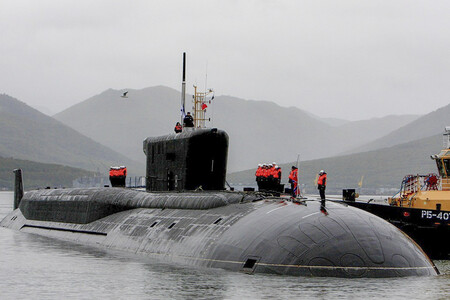
Welcome ceremony for the Borei K550 class nuclear submarine “Alexander Nevsky” at the permanent base in Vilyuchinsk
Borei and Yasen: the Russian challenge. The heart of this strategy is formed by the new generation submarines deployed by Vladimir Putin, especially the Borei and Yasen classes, designed to operate for long periods without being detected and capable of carrying strategic weapons.
Although they do not always match their Western counterparts in stealth, they recalled in Bloomberg that they compensate with tactics adapted to the Arctic environment, such as operating under the ice sheet or protected by other units, which greatly complicates their location. Perhaps for this reason, for NATO the greatest risk is not their presence, but rather the moment in which they are no longer under control.
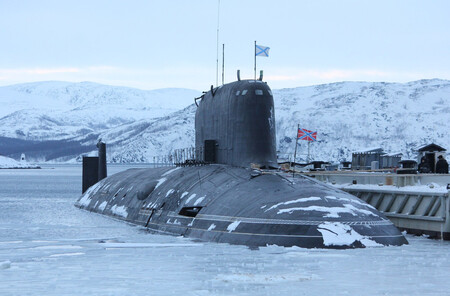
K-560 Severodvinsk
A constant chase. We have told it before. For decades, the key point to detect these submarines was the well-known GIUK corridor, between Greenland, Iceland and the United Kingdom, but technological and operational advances have pushed this hunting species towards higher latitudes.
Now, the goal is to intercept them before they leave the relatively shallow waters of the Barents Sea and enter areas where they can more easily disappear. This evolution has forced us to strengthen cooperation between allies and deploy increasingly sophisticated surveillance systems.
Europe in the shadows. It happens that, given the uncertainty about the long-term commitment of the United States, European countries are increasing their involvement in this surveillance, with Norway as the centerpiece and partners such as the United Kingdom, Germany or Canada reinforcing capabilities and coordination.
The result has been new acquisitions, joint exercises and advanced deployments, all moves that reflect a transition in which Europe attempts to assume more responsibility for its own defense, especially in an environment as critical as the Arctic.
A new Cold War under the ice. Yes, because the result brings us closer to a scenario that increasingly reminds us of the (il)logic of the Cold War, but this time with the difference that there are now much more advanced tools and a completely different geopolitical context.
The Russian Northern Fleet, modernized and prioritized within its military structure, represents one of the Kremlin’s main deterrence capabilities, especially as its conventional forces show weaknesses on other fronts. And in that unstable balance, the Arctic seems to consolidate itself as a kind of “perfect hideaway”, a place where Russia’s greatest challenge to NATO is not announced, it is simply happening under the cold sheet of ice.
Image | NDUP, Mil.ru
In | A nuclear giant designed to make way in the Arctic: this is the most modern icebreaker in the Russian fleet
In | Russia and China already had an advantage over the US in the Arctic. After Greenland, it has multiplied