

A team of physicists led by Long Ju from Massachusetts Institute of Technology (MIT), in collaboration with Dominik Zumbühl’s group from theUniversity of Baselpublished in the journal Nature a discovery that twists the neck of preconceived ideas.
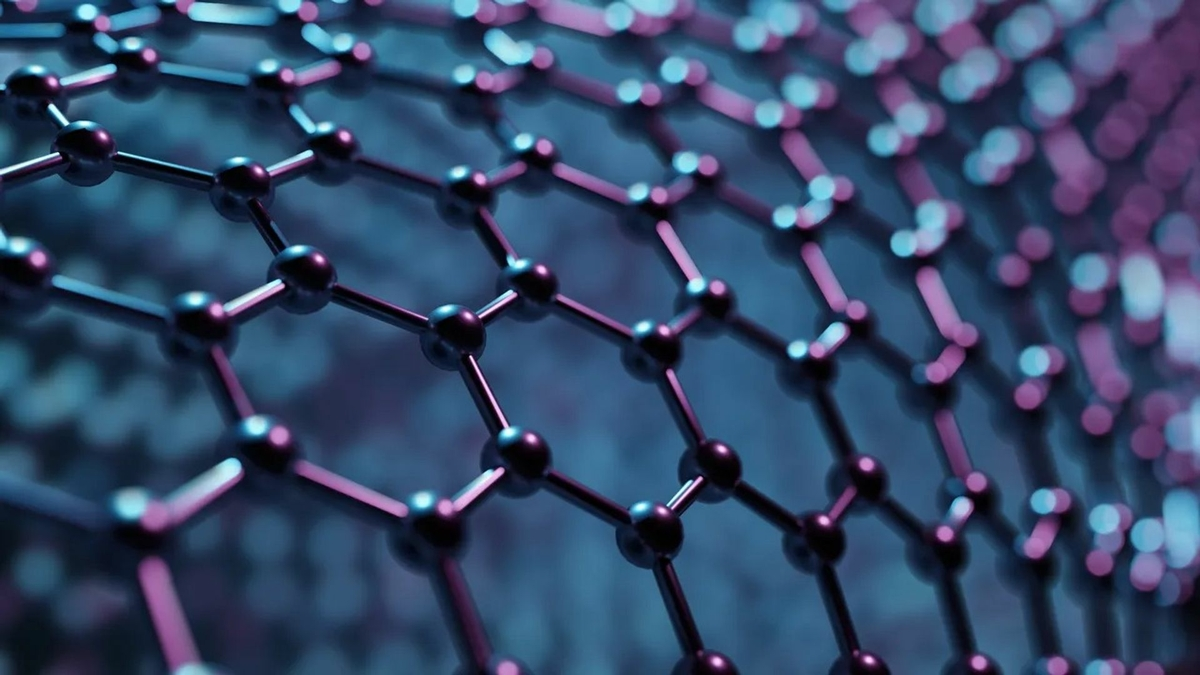
By studying a specific form of carbon, the rhombohedral graphene (a stack of a few sheets of carbon with a slight offset, like a spiral staircase), they revealed not one, but a whole family of superconducting states.
Surprisingly, some of these states not only resist powerful magnetic fields but are even strengthened by their presence, a phenomenon that contradicts classical theory.
Why is this discovery about graphene so surprising?
The discovery is fundamental because it reverses a basic principle: normally, a magnetic field is the poison of superconductivity. It breaks the Cooper pairs (the duo of electrons that allows current to flow without resistance), destroying the effect.
However, the team observed that in rhombohedral graphene, certain states persist and strengthen even under a field of up to 9 Tesla, i.e. 180,000 times the earth’s field.
Three pairs of electrons in three distinct superconducting states and reinforced by a magnetic field which should dissociate them (credit: MIT)
This observation calls into question the very foundations of superconductivity as described by the théorie BCS (Bardeen-Cooper-Schrieffer), which has long been the law.
Instead of a fragile phenomenon, researchers are faced with a quantum state of unprecedented robustness and which seems to play by its own rules. This behavior, although theorized in the past, had rarely been observed in such a pure and controllable material.
How did researchers find these superconducting states?
Rather than following the usual method of “doping” the material by adding electrons, they did the opposite: they removed them. By gradually decreasing the electron density in their samples graphene at four and five layers, they saw the emergence four distinct superconducting signatures at different densities.
These samples are not complex artificial constructions. They are obtained by mechanical exfoliation, a technique that literally involves using adhesive tape to peel atomic layers from a block of graphite.
The challenge is then to identify these precious rhombedral structures under the microscope, naturally present but rare. It is by subjecting these fragile carbon flakes to ultra-low temperatures and a powerful magnetic field that the quantum ballet has been revealed.
What mechanism could explain this unprecedented phenomenon?
The exact explanation remains a mystery, but researchers put forward a bold hypothesis. In classical superconductivity, electrons pair with opposite spins. An external magnetic field pulls on these spins in opposite directions and eventually breaks the couple.
The MIT team suggests that here the electrons could form pairs with spins aligned in the same direction. In this configuration, the magnetic field would pull the two partner spins in the same direction, without threatening their bond.
This would not only explain their incredible resistance but also why their condition is stabilizing. The measurements even showed that the critical temperature (the maximum temperature for superconductivity) increased frome 55 to 90 millikelvins under the influence of the field.
What are the future implications of such a breakthrough?
In the short term, this discovery offers an exceptional playground for physicists. Rhombohedral graphene becomes a model system to explore a whole new family ofsuperconducting states unconventional, the mechanisms of which still escape our understanding.
It is an open door to exotic quantum phenomena, such as “chiral” superconductivity already observed in this material.
In the longer term, although any application is still far away, controlling such phenomena is a crucial step. This could perhaps lead to more robust electronic components or advances in topological quantum computing.


