
DARPA GO could be used for human performance enhancement & bioengineered super-soldiers, along with the ability for total mind control by reading, writing into the brain: perspective
DARPA’s Generative Optogenetics (GO) program is gathering advisers across three working groups who will address the biosecurity risks and regulatory hurdles for the commercialization of technologies that can program living cells using light.
The US Defense Advanced Research Projects Agency (DARPA) GO program is an ambitious research project that looks to program biology using light as the medium for transferring information, with applications listed as ranging from human performance enhancement to improving medicine, agriculture, and biomanufacturing.
“If successful, this technology could unlock unprecedented capabilities in personalized improvements to warfighter health and performance, agriculture, biomanufacturing, and space exploration by providing open-ended programmability, single-cell spatio-temporal control, and eliminating the need for traditional chemical delivery of genetic information”
DARPA, Generative Optogenetics (GO) Working Groups Opportunity, January 2026
However, the ability to directly program living cells with genetic instructions carries with it an enormous potential for abuse, such as the creation of novel “threat agents.”
More on that shortly, but first a bit of background on how optogenetic stimulation could one day be weaponized for mind control, which DARPA does not mention.
“We can control the brain […] We can write into the digital twin to control it. Then we can transfer these same neural patterns into the actual brain to write into the brain and control the brain”
Surya Ganguli, India AI Impact Summit, February 2026
https://x.com/TimHinchliffe/status/2024577402748260353?embedable=true
At the India AI Impact Summit in February, Stanford University researcher Surya Ganguli highlighted experiments that used “AI and lasers to write to the mind of a mouse” and control its brain.
“We were able to use AI to read the mind of a mouse. We could look directly at neural activity in the brain of a mouse, and we could decode what it was seeing […] But we can go further than that to write to the mind of a mouse. By writing-in carefully designed neural activity patterns, we can make the mouse hallucinate a particular percept”
Surya Ganguli, India AI Impact Summit, February 2026
https://x.com/TimHinchliffe/status/2024579819724251263?embedable=true
Ganguli showed how scientists were able to read, write, and control the brain, even going so far as to make it hallucinate.
The next step in melding minds and machines is healing and augmenting the human brain.
“The possibilities of melding brains and machines are limitless — both to advance AI and to understand, cure, and augment the brain”
Surya Ganguli, India AI Impact Summit, February 2026
https://x.com/TimHinchliffe/status/2024582698216440318?embedable=true
Based on Ganguli’s presentations, optogenetics, when combined with other technologies such as quantum neuromorphic computing and artificial intelligence, has great potential for curing diseases and augmenting humans beyond their natural capabilities.
However, if they were to ever fall into the hands of bad actors, these same technologies could also be used for total mind control.
“The unprecedented capabilities of GO technologies necessitate thorough evaluation of misuse potential, complex regulatory questions, and the risks of adversarial capital”
DARPA, Generative Optogenetics (GO) Working Groups Opportunity, January 2026
To mitigate some of the risks that could arise from generative optogenetics research and more, DARPA is putting together three working groups — one that will address the biosecurity concerns, one that will develop regulatory policies, and another that will provide a clear path to commercialization.
“Together, these working groups will aim to ensure responsible development, regulation, and commercialization of GO technologies while also anticipating the transformative potential of these technologies in end-use applications,” the DARPA GO Working Group Opportunity reads.
“The [BSWG] primary focus will be on identifying, assessing, and mitigating risks related to misuse, accidental release, or malicious exploitation of biological research and technologies developed under GO, as well as to ensure the safety and security of the program’s activities and outputs”
DARPA, Generative Optogenetics (GO) Working Groups Opportunity, January 2026
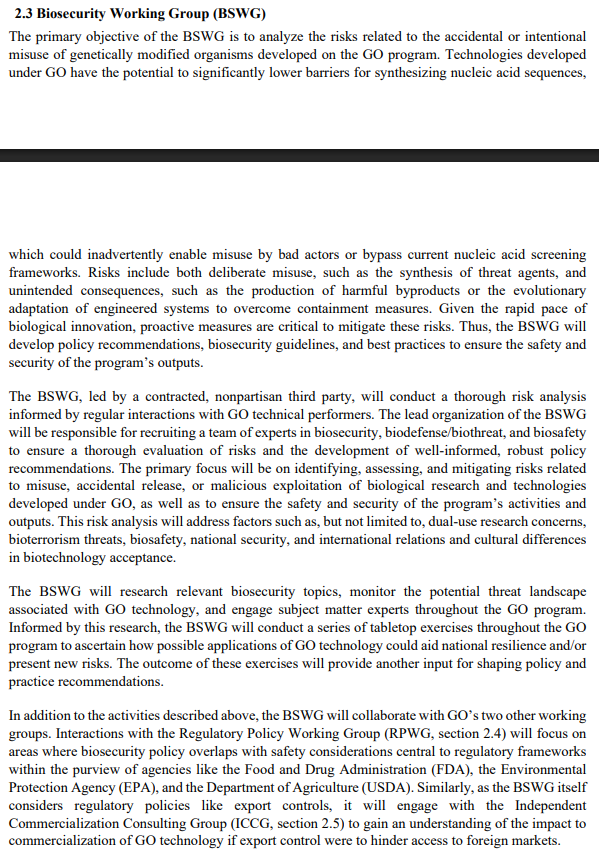
The biosecurity working group (BSWG) “will research relevant biosecurity topics, monitor the potential threat landscape associated with GO technology, and engage subject matter experts throughout the GO program.”
“Informed by this research, the BSWG will conduct a series of tabletop exercises throughout the GO program to ascertain how possible applications of GO technology could aid national resilience and/or present new risks.”
Specifically, the BSWG team will be comprised of experts in biosecurity, biodefense, biothreats, and biosafety.
After identifying all the ways that programming biology with light could lead to misuse, accidental release, or the malicious exploitation of biological research, the BSWG will work with the regulatory policy working group (RPWG) that will provide safety considerations to government agencies like the Environmental Protection Agency (EPA), the Food and Drug Administration (FDA), and the US Department of Agriculture (USDA).
“The primary objective of RPWG is to identify regulatory concerns, develop forward-looking regulatory guidelines, and inform GO performers and future investors on how to navigate the regulatory pathways within the current biotechnology framework”
DARPA, Generative Optogenetics (GO) Working Groups Opportunity, January 2026
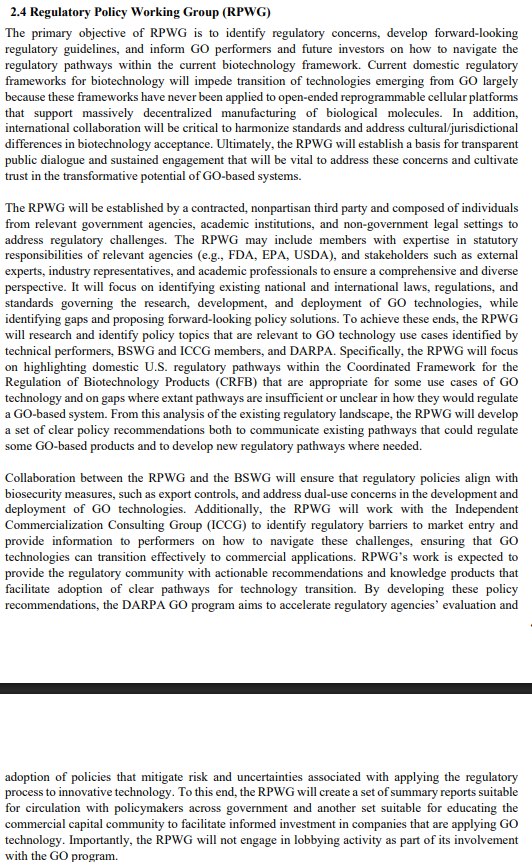
The RPWG “will focus on identifying existing national and international laws, regulations, and standards governing the research, development, and deployment of GO technologies, while identifying gaps and proposing forward-looking policy solutions.”
As such, “Collaboration between the RPWG and the BSWG will ensure that regulatory policies align with biosecurity measures, such as export controls, and address dual-use concerns in the development and deployment of GO technologies.”
The DARPA GO Working Group announcement also states that “transparent public dialogue” will be vital to cultivating trust in the the potential of GO-based systems.
After developing “a set of clear policy recommendations both to communicate existing pathways that could regulate some GO-based products and to develop new regulatory pathways where needed,” the PRWG will work with the Independent Commercialization Consulting Group (ICCG) on identifying regulatory barriers to market entry.
“The ICCG working group will provide feedback on GO performer pitches, market opportunities, business models, and funding strategies”
DARPA, Generative Optogenetics (GO) Working Groups Opportunity, January 2026
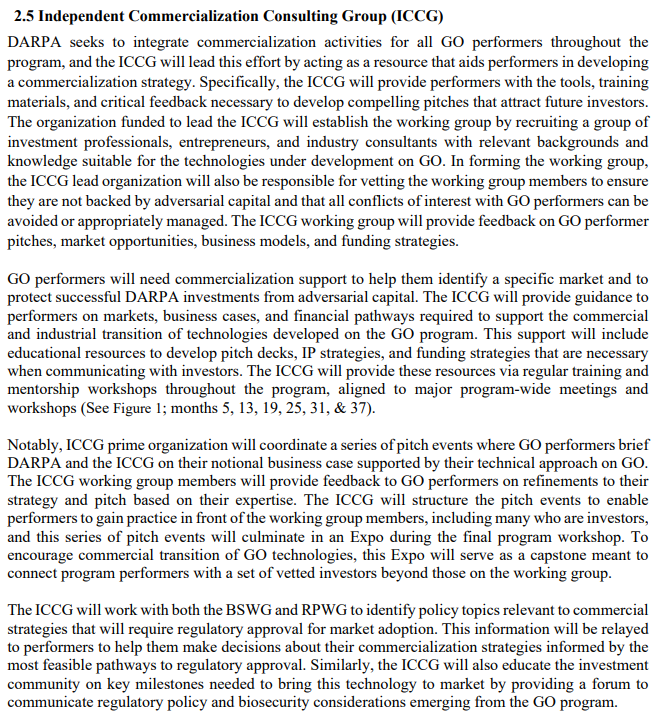
Similar in some ways to startup incubators and accelerators the ICCG “will provide performers with the tools, training materials, and critical feedback necessary to develop compelling pitches that attract future investors.”
This support will include “educational resources to develop pitch decks, IP strategies, and funding strategies,” so that participants will be able to effectively communicate with investors.
For this, “The ICCG working group members will provide feedback to GO performers on refinements to their strategy and pitch based on their expertise.”
From there, “The ICCG will structure the pitch events to enable performers to gain practice in front of the working group members, including many who are investors, and this series of pitch events will culminate in an Expo during the final program workshop.”
In the end, the three working groups will “aim to ensure responsible development, regulation, and commercialization of GO technologies while also anticipating the transformative potential of these technologies in end-use applications.”
“The goal of the GO program is to establish a novel bioengineering platform where living cells are directly programmable via optical stimuli, enabling the on-demand writing of genetic information directly into a cell without any pre-existing template sequence”
DARPA, Generative Optogenetics (GO) Working Groups Opportunity, January 2026
If successful, the DARPA GO program will “unlock a foundational capability with ramifications for medicine, agriculture, and manufacturing, while diminishing reliance on brittle supply networks that become untenable for long distance operations, like extended human spaceflight.”
The capabilities coming out of DARPA GO could contribute to the development of new pharmaceuticals, novel construction materials, and different forms of feedstocks.
DARPA GO was first announced in December 2025 and in the original program description the word “human” was only mentioned three times: 1) human health, 2) extended human spaceflight, and 3) human protein-coding RNAs.
On the topic of bioengineering humans for extended space travel, a Pentagon-funded RAND report from November 2021 called “Technological Approaches to Human Performance Enhancement [HPE],” states that humans themselves could be genetically modified to better survive in space and on other planets.
“Genetic modifications might be needed to allow human populations to live in locations other than Earth. Suggestions include adding genes from Deinococcus radiodurans, a bacterium that can survive in high levels of radiation, and adding genes from a variety of organisms to enable humans to synthesize all 20 amino acids (humans normally synthesize only 11 and extract the remaining nine from food)”
RAND, Technological Approaches to Human Performance Enhancement, November 2021
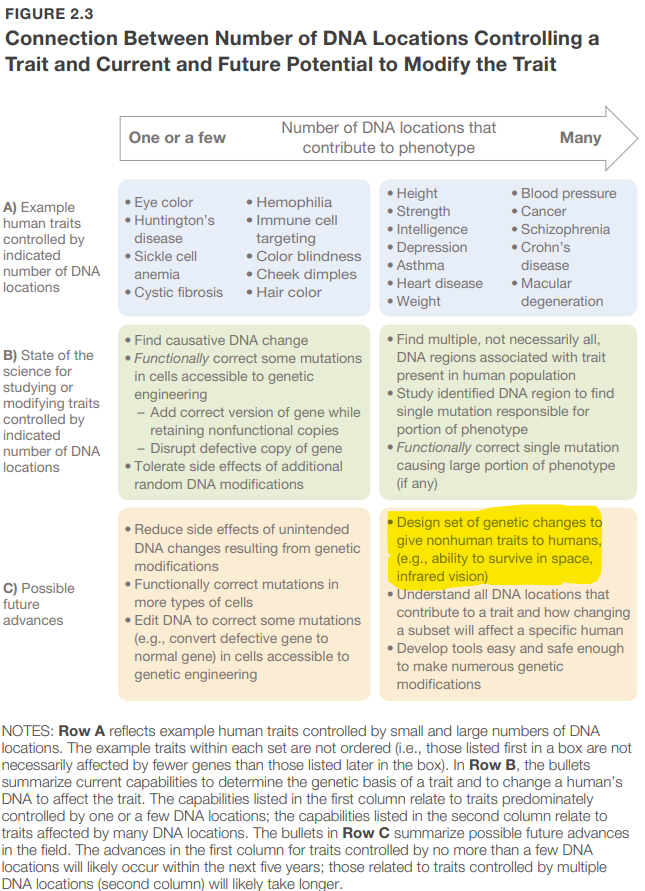
Genetic editing, according to the RAND report, has the potential to:
- Make humans stronger, more intelligent, or more adapted to extreme environments
- Provide new capabilities, such as adding reptilian genes that provide the capability to see in infrared
“Successful technologies emerging from the GO program may be highly disruptive to the field of biotechnology by making it easier to program cells with genetic instructions. As a result, the ability to engineer living cells will be significantly advanced, enabling new applications of synthetic biology”
DARPA, Generative Optogenetics (GO) Working Groups Opportunity, January 2026
Bringing it all back home, DARPA GO technologies “could unlock unprecedented capabilities in personalized improvements to warfighter health and performance, agriculture, biomanufacturing, and space exploration by providing open-ended programmability.”
The tech that can be used for human performance enhancement and bioengineered super-soldiers is the same that can be used to create drugs and viruses.
But let’s also not forget how it can also be used to read, write, and control the human brain — to make people hallucinate, to implant false memories, to take over their minds.
But hey, relax! DARPA’s got everything under control.
DARPA GO has three groups working on how to mitigate all the dystopian scenarios while simultaneously coming up with regulatory frameworks, so this tech can eventually become commercially available.
You see? Nothing to worry about. What could possibly go wrong?
:::info
Tim Hinchliffe, Editor, The Sociable
:::