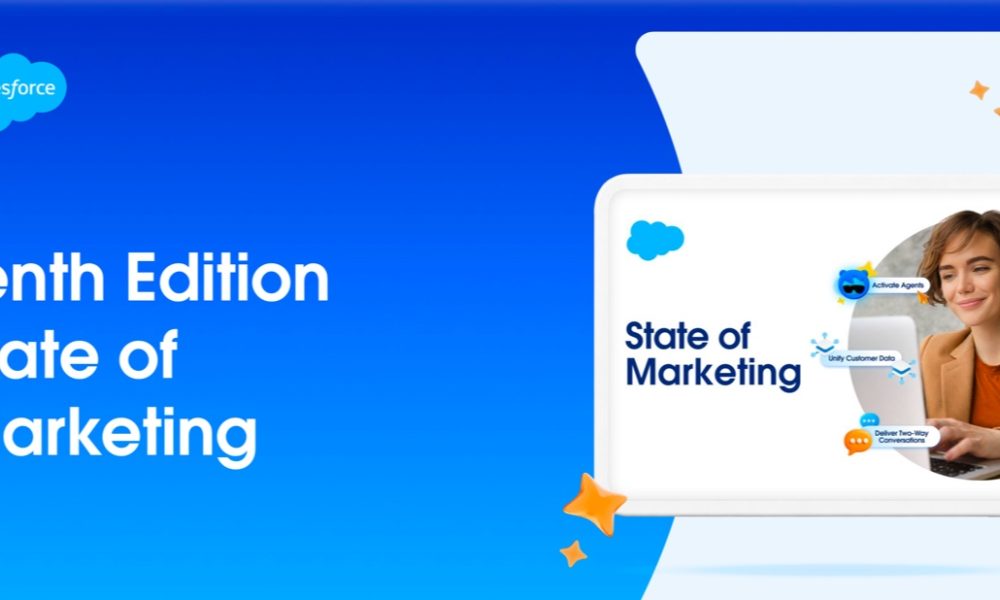
Salesforce draws in the tenth edition of his State of Marketing a panorama in which AI is already at the center of the agenda, but it still does not close the gap between what customers expect (two-way and contextual conversations) and what marketing teams, especially in Spain, are currently capable of delivering.
This tension is aggravated by a classic problem already seen in the nine previous editions of the study, but not yet resolved, such as the fragmented datawhich limit both the potential of AI and the “fine reading” of very different realities between B2C, B2B and B2B2C businesses.
The tenth edition of the State of Marketing is based on a anonymous survey carried out between October 8 and November 17, 2025 to 4,450 marketing managers from 26 countries, including 150 professionals in Spain. The sample covers from CMOs (15%) and VPs (20%) to middle managers and directors (65%), with representation from sectors such as retail, financial services, health, industry, technology or consumer.
From the point of view of the business model, the report is clearly focused on relationship logic with the end customer: 40% of those surveyed operate in B2C environments, 12% in B2B and 48% in B2B2C schemes, where the brand coexists with intermediaries but maintains a direct relationship with the consumer. For any B2B reader, this requires reading the conclusions with a critical filter, since many tensions described in the report (discovery, SEO, “response engines”) arise in segments highly exposed to the mass consumer, although the underlying problem (data, channel orchestration, impact of AI) is perfectly transferable to business marketing.
Spain: a lot of AI, generic campaigns and little real conversation
In the Spanish case, Salesforce highlights an uncomfortable paradox: 57% of marketing professionals are already using AI, but 83% recognize that they continue to run generic campaigns. Clients, however, have moved the bar: 83% of marketers in Spain affirm that their audiences expect to maintain two-way conversations with brands, that is, being able to respond to a message and get a real response.
This expectation clashes with the operational capacity of the teams: 74% of marketing professionals in Spain admit that they have difficulties responding quickly because they cannot access the context they need, and only 61% declare themselves capable of reliably responding to email and 58% to SMS or text messages. Despite this, 79% of professionals in Spain say they would trust AI to respond to clients and help scale efforts, which reinforces the idea that the bottleneck is not in the technology itself, but in the data layer that feeds it.
“Faster Spam” vs. Agentic Marketing
Salesforce’s own narrative is quite self-deprecating. Laura GuzmanArea Vice President of Salesforce, summarizes the situation with a forceful phrase: we are using the most powerful technology in history to send “more one-way spam, faster.” Behind that sentence there is a clear confirmation: without context, without a unified vision of the customer, AI is limited to multiplying the volume and speed of campaigns, not their relevance.
Maria Angeles SantosRegional Vice President of Salesforce, introduces the concept of “agent marketing”a model in which AI agents stop automating what has always been done to operate as intelligent interfaces capable of maintaining conversations and growing the business by leveraging the right context. On a global scale, the report shows that 75% of marketing organizations use at least one form of AI (predictive, generative or agentic) and that high-performing teams are 1.9 times more likely than low-performing ones to have AI agents.
This leap towards agentic marketing, however, is not homogeneous: although 83% of global marketers say that customers increasingly want two-way conversations, 69% admit that they have difficulty responding quickly to queries from customers and prospects. Once again, the pattern we see in Spain is repeated in the global aggregate: skyrocketing expectations, AI underway, but an operation that remains anchored in campaign logic.
Data: the real bottleneck of personalization
The most structural reading of the study is that the great brake is no longer “lack of AI”, but quality, governance and availability of customer data. In Spain, only 55% of marketing professionals report having full access to service data, 51% to sales data and 45% to commercial data, leaving the rest browsing with partial information. It is not surprising that, in this context, 100% of Spanish marketers encounter obstacles to personalization and that problems with data appear as the most frequent.
When we look at the barriers to personalization on a local scale, the top 3 is again very “operational”: lack of alignment between teams, too much data to process and poor quality of information. Globally, marketing professionals point out the data silos between channelsthe excess of information that is difficult to process and low quality as the main blockers of AI-driven personalization. The report also quantifies the advantage of organizations that have successfully unified their data: they are 42% more likely to respond regularly to customers and 60% more likely to use AI agents to scale their efforts.
AI rewrites discovery: from SEO to “response engines”
One of the most relevant chapters of the report has to do with how AI is transforming digital discovery and, with it, the marketing funnel itself. Salesforce recalls that approximately half of all searches on Google already incorporate AI-generated summaries that can completely bypass traditional branded sites, eroding the top of the funnel as we knew it. In parallel, during the recent Christmas season, AI and Agents generated around 20% of global ordersa sign that the “assistants” begin to directly mediate the purchasing process.
In Spain, the effect is already perceived in the way in which marketers rethink their SEO strategy: 89% say AI is transforming their approach and 91% say they have started optimizing AI-generated responses on platforms like ChatGPT or Google Summaries. Globally, 40% say they have already optimized for AI-powered search, 48% are in the process, while only 11% have not started and 1% do not plan to do so, while 85% say AI is redefining their SEO strategy.
Salesforce talks explicitly about “response engine optimization” (AEO); Instead of thinking about a ranking of ten blue links, the objective becomes the response that a model generates when the client asks their question. This has an especially critical reading for highly considered B2B and B2B2C sectors (technology, industry, professional services), where consultative search via LLM can replace a good part of traditional research in the web and media.
Tangible benefits of AI… when the foundation is well laid
Beyond the narrative, the report collects concrete metrics on the impact of AI when it is deployed on a reasonable basis of data and processes. Among teams already using AI, main use cases They are content personalization, campaign performance prediction, creative generation (visual and copy) and customer behavior prediction. In this group, Salesforce sees average improvements of 20% in marketing ROI, 20% in customer satisfaction, 19% in conversion rates and 19% in retention, along with a 19% reduction in marketing costs.
Additionally, professionals who use or expect to use AI agents anticipate being able to spend eight more hours a week on creative work once those agents are fully deployed. In terms of customer experience, organizations with agents show higher levels of satisfaction with their ability to connect touchpoints between marketing, sales and service, reinforcing the idea that agentic AI is not just “another tool”, but a catalyst for structural changes in how the customer relationship is orchestrated.
El CMO como “Chief Convergence Officer”
In parallel with the technological transition, the role of the CMO is expanding. Globally, 86% of marketing professionals say the CMO role is becoming broader, assuming responsibilities ranging from brand marketing (79%) and product marketing (77%) to content, analytics, channels, events, advertising, market research, creative design and public relations.
This expansion of the perimeter occurs in an environment where priorities and challenges overlap: implementing or operationalizing AI and adapting to its impact on marketing appear simultaneously as priorities number one and two, but also as the two main perceived challenges. Added to this is the need to gain operational efficiency, demonstrate marketing ROI and adapt to constantly changing customer behaviors. For a B2B CMO, the implicit message is that it is no longer enough to “be the voice of the brand”, it must also be the guarantor of a connected data fabric and shared governance with sales and service.
What should B2B marketing take advantage of from this report?
Given the weight of B2C and B2B2C in the sample, any B2B reader will do well to separate the tactical from the structural. Many of the frictions that appear (competition for attention in search engines, impact of AI summaries on organic traffic, pressure on the top of the funnel) are especially acute in consumer and retail. However, the essence of the diagnosis applies equally to an industrial manufacturer, a technology company or a professional services provider: Without unified data, AI is nothing more than an amplifier of inefficienciesand without real ability to maintain contextual conversations across all channels, the promise of “personalization” remains a slogan.
In B2B environments, where sales cycles are long and decision-makers are multiple, the idea of “agent marketing” may even have a longer history than in B2C. Agents capable of orchestrating interactions over months, integrating signals from sales, support, and product, and serving as an intelligent front-end for strategic accounts fit well with mature account-based marketing models. The Salesforce study, even without segmenting its conclusions by type of business, offers clear indications that high-performance teams are precisely those that have resolved this layer of data first and have made the leap from campaigns to conversations.