Learning languages was never on my to-do list. I grew up speaking Arabic and French natively, then English slowly shifted from a middle school course to an essential part of my life through movies, TV shows, and music. When my highschool offerred Spanish courses, I took one lesson and walked out. Three was enough.
But things changed when I met my husband, who also speaks Spanish. A word here, a sentence there, a honeymoon in Valencia, some YouTube videos, and I suddenly realized I could understand Spanish without trying. It was too close to French to be difficult. Something similar happened with Italian. Still, I needed lessons from a good language-learning app. So, I started with Duolingo, got bored with it, then tried Memrise, and fell in love. In less than three weeks, I was able to learn enough German to make it to Berlin and sort of understand all kinds of conversations around me. But Memrise changed over time — it got prohibitively more expensive, it nearly abolished the free tier, and a lot of the charm slipped away.
I went back to Duolingo and hated it enough to completely stop trying to learn any language. Perhaps music and movies would be enough. That is, until I started using Babbel several weeks ago, and now, I’m in love.
What’s your favorite language-learning app?
220 votes
Babbel doesn’t teach me to say “the turtle eats the apple”
Rita El Khoury /
Memrise used to do that very well, and Babbel takes a similar approach. The courses started with useful conversations. Greeting people, introducing yourself, saying where you come from and where you live, describing apartments, ordering food, asking for directions, and so on. These are all part of the A1.1 (a.k.a. Newcomer I) lessons, and they make so much sense to start with.
There’s a flashcard element to Babbel that works well for my brain, with photos, written text, and pronunciation all combining to help me remember that “das Bröt” is bread. But Babbel takes things further with extra tooltips that explain different concepts. Like the fact that adding “-chen” implies a smaller version, so “das Brötchen” is a smaller bread.
With other language apps, I had to wonder why something was “das” and other things were “der” or “die,” but Babbel made the effort of explaining articles to me. Beyond the flashcard lessons, there are several grammar or pronunciation lessons with useful nuggets. I’d spent months on Memrise before realizing that “Sie” is both a formal “you” (like the French “vous”) and a “they.” Babbel had a lesson to teach me just that from the start.
I never understood why the “i” was pronounced differently in some German words — I thought it was a coin toss, honestly — until Babbel explained that the “i” can be short when followed by consonants and long when followed by an “e” or an “h.” There’s another similar lesson for when to shorten or extend the “e.” Useful! And who knew that even the “it” could be gendered?
With its tooltips, Babbel explained concepts and rules that I spent months on Duolingo noticing but never really understood.
Babbel had a whole alphabet lesson with the pronunciation of every letter that I never saw on Duolingo, despite months of learning. Handy if I ever need to spell my name or ask someone to spell a word to me. It has a lesson about filling in official forms and documents, and useful sample discussions with neighbors, teachers, and restaurant waiters. The cat drinking water is the last of its concerns in those first, essential lessons.
All kinds of practice make perfect
Rita El Khoury /
Like many other languages, Babbel lets me start a new lesson to learn something new or revise existing content. I like that I can pick what I need to go back over, from listening to speaking, flashcards, and writing. Regular lessons mix all of these, but revisions can focus on one of them. There’s a summary at the end that shows me what I got right and what I need to remember.
But Babbel doesn’t stop there. Practicing takes other forms, beyond the simple lessons. There is a small grammar guide to practice some basic principles, as well as guided conversations where I can try to follow a script, get hints if I don’t remember something, and learn to use sentences in context. Audio recaps go over concepts already learned, and although I haven’t started the podcasts because they require a more advanced level, I appreciate that they’re there and integrated into the experience. I learned a lot of English and Spanish by just listening, so I’m looking forward to integrating this into my learning.

Rita El Khoury /
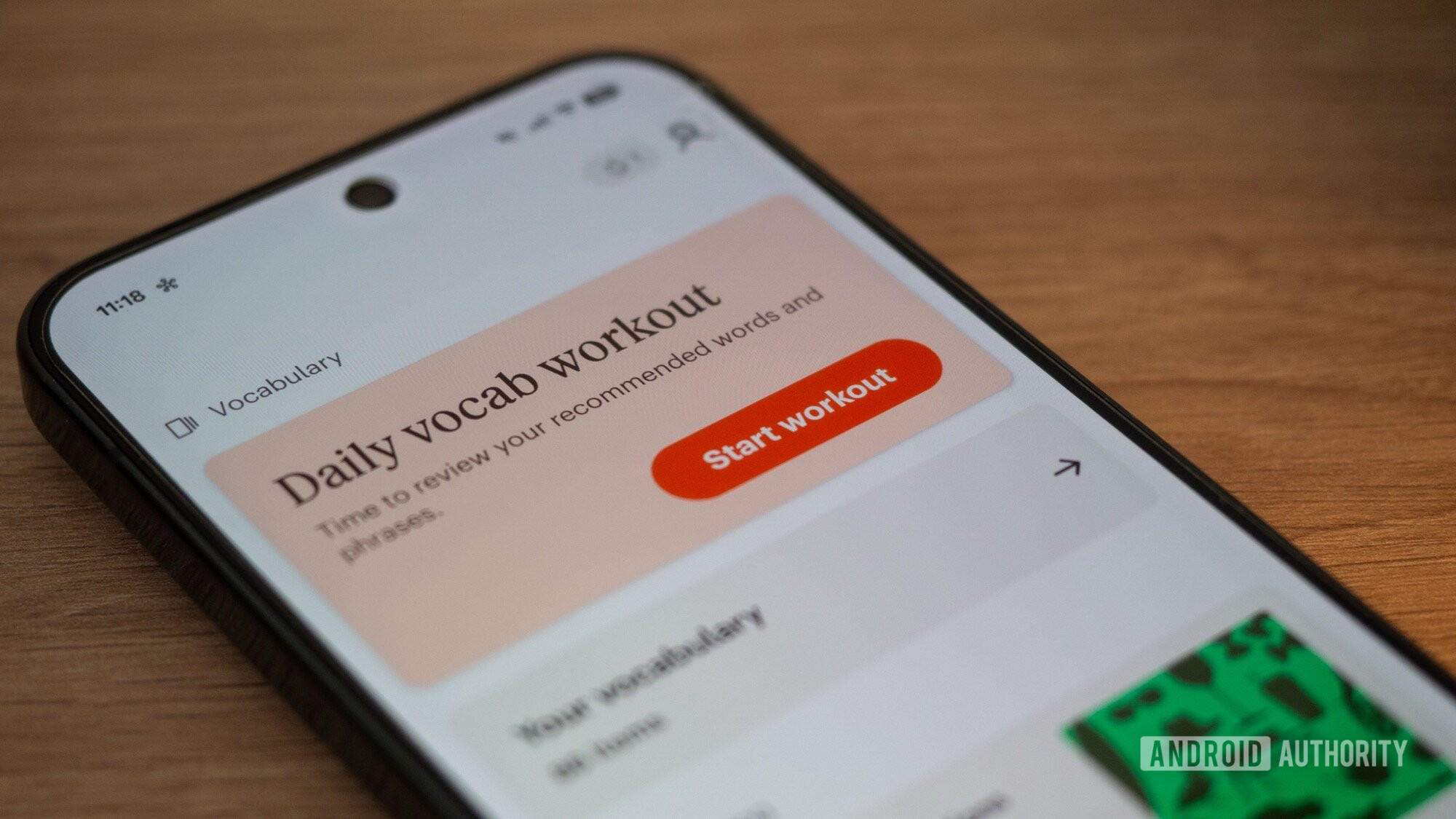
There’s a vocabulary section, too, but I have to manually go in and create collections with the words I want to review. The automatic “All Items” (divided by how weak or strong my knowledge of them is) and “Recent mistakes” help, but I just wish there were an automatically updated list of my weakest words, instead of having to go in and manually select them every few days.
Still, it’s nice to be able to mix and match learning styles across days and lessons, depending on my mood. If I’m exhausted and don’t want to confuse myself with newer concepts like “wohin” vs “woher,” I can just revise a bit, do a guided conversation, listen to an audio recap, or whatever. Learning doesn’t have to stop when I’m too exhausted, and often a small, easy win puts me back on the right track to start a proper lesson. If not, that’s fine, too.
Audio recaps, podcasts, guided conversations, an AI-powered Speak feature, and many ways to practice complete the flashcards-based approach.
I would’ve been happy with Babbel as is, but then I started digging in and found other lessons and other ways to learn. There are lessons by topics (grammar, listening and speaking, business, countries, and more), as well as a new Speak section that uses AI through guided conversation topics to help you actually carry on a chat. I’m too shy to try to strike up a conversation with strangers before I can string two words together, but talking to an AI with my very basic “Ich bin Rita?” Fine, I’ll do that. As long as it helps me get over some of my hang-ups, it works.

Rita El Khoury /
Babbel doesn’t gamify learning as aggressively as Duolingo — I would’ve hated it if it did. There are streaks, and you can miss a day or two a week without losing them. There are daily notifications to remind you to learn, and that’s it. The app isn’t obsessed with pitting you against friends or creating leagues of people whose sole job is to add a new day to their streak without actually learning much. I appreciate that.
Babbel isn’t without faults, but it does the job

Rita El Khoury /
In my time with Babbel, I’ve tried to learn Italian, Spanish, and German, but since I speak different languages, I have the luxury of learning from different languages, too. Italian and Spanish are so much easier to learn using French as a basis, while German makes more sense starting from English. This made me see some of the flaws of Babbel.
For one, I have to change the app’s entire language when I want to switch from English>German to French>Italian. This takes a few seconds, but it’s a hiccup that’s too annoying to do over and over again. Other apps support multiple simultaneous language pairs, so I’d love to see Babbel do it, too, because sometimes I find myself too lazy to switch and just stick to one language for a few days before switching to the other.
I’m this close to pulling the plug and paying for a lifetime subscription. This approach to language-learning works for me.
I also noticed that learning from English gives you more lessons, more features, and more access. The AI-powered “Speak” mode isn’t available for Spanish or Italian when I use French as the basis for my learning, but if I try to access those from English, I get them. The French-Italian course also lacks the standalone audio recap lessons (there’s a lot of audio in the flashcards, but the dedicated recaps aren’t there).
So your mileage may vary wildly depending on which language you start from. Good thing Babbel offers a free trial to start, to let you see exactly what you’re getting before you plunge in and pay for the service… which isn’t cheap. It’s €102 per year, €78 for six months, and €51 for three months. Sometimes, the prices are different if I check them on the web, though. And there’s even a lifetime subscription for €299.99. I’m really close to pulling the plug and paying for that, but I’m waiting until my six-month subscription ends to decide. It does seem like the best language-learning app possible for the way I learn.
Don’t want to miss the best from ?


Thank you for being part of our community. Read our Comment Policy before posting.