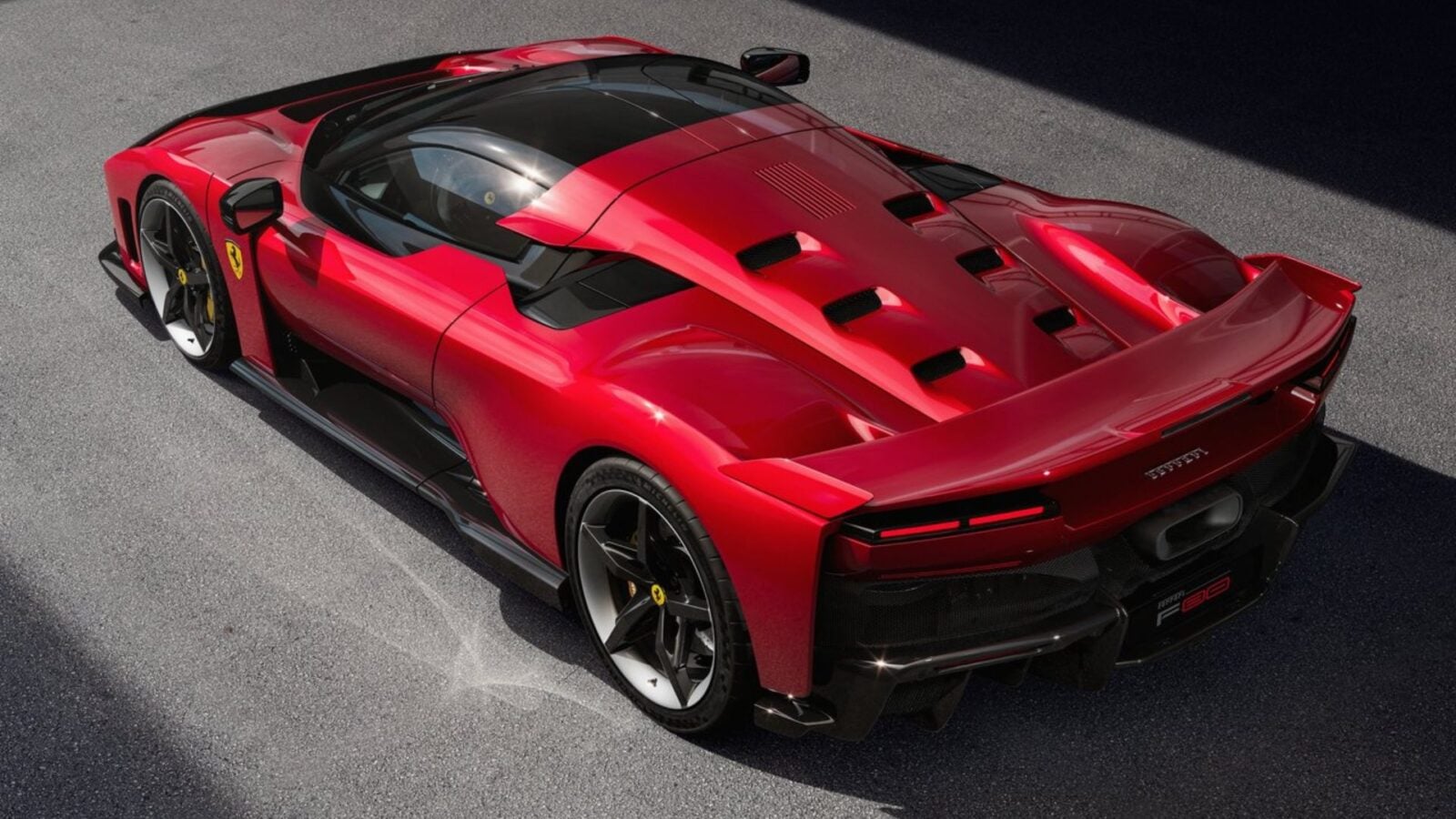
Ferrari has filed a patent in the United States aimed at optimizing the aerodynamics of its future models. The question concerns the fins, which the Italian brand promises to be deformable in order to best adapt to different driving situations.
Without control, power is nothing. This quote, which owes nothing to a famous philosopher, has never been more true today. With electrification becoming almost systematic, any eccentric can in fact bring out a monster of several thousand horsepower. With such a stable, accelerations are logically more vigorous, but the risk of leaving the road becomes just as much.
A response to the overbidding of power
It is better not to rely too much on electronic crutches to avoid ending up on the heap. This is all the more true on the track, where drivers push the vehicles to their limits. The aids are then all cut off, which makes driving as exciting as it is dangerous. To quench its thirst for performance, Ferrari has found a new solution. Instead of adding more and more power, the brand prefers to focus on aerodynamics.
The flexible wing: Maranello’s new lethal weapon
Its latest patent filed with the American Patent and Trademark Office suggests a completely new rear wing in this sense. Made of a flexible material, this part can bend on demand in order to increase aerodynamic downforce or reduce drag depending on the situation. Ultra versatile, the fin can not only twist longitudinally, but also laterally. That’s all the difference.
Also read: This €550,000 Ferrari will be deliberately destroyed (and this is a first)
How does it work? The magic of dynamic deformation
In fact, this accessory will not be made in one piece like most fins. The one proposed by the prancing horse will have several sections, each connected to actuators to allow them to bend as needed. Concrete case: when approaching a turn, the wing will rise to serve as an airbrake. Nothing very spectacular so far. It is mainly thanks to the multiple sections that Ferrari goes further.
A decisive advantage in the middle of a turn
The piece will then not rise uniformly in order to better fit the curves. The wing will be able to bend more to one side, which will mechanically increase the aerodynamic downforce on the wheels located inside. The car will then pivot more efficiently thanks to the optimized grip on the wheels concerned. When exiting a turn, the wing will immediately return to its initial profile to find more balanced support.
Reliability and durability: the real challenge for Ferrari
Ferrari had already worked on a similar system acting on the bodywork. The goal was then to create a formidable machine that was extremely efficient on the track while maintaining elegant lines when stationary. Of course, the idea can gain ground, but uncertainties remain: how will such a part wear out over time? Will its reliability be guaranteed in the long term? These are all questions that the Italian brand will have to raise before potential marketing.
👉🏻 Follow tech news in real time: add 01net to your sources on Google, and subscribe to our WhatsApp channel.
Source :
Autoblog