Photo by Andrew Neel on Unsplash
Social media isn’t optional for businesses anymore — but neither is compliance. With over 5.17 billion people active on social media, the stakes for getting it wrong have never been higher. A single non-compliant post can trigger regulatory fines, legal action, or lasting reputational damage.
Yet many marketing teams still treat compliance as an afterthought.
This guide breaks down everything you need to know about social media compliance, including the key risks, the laws that apply to your industry, and a practical checklist to keep your team protected.
What Is Social Media Compliance?
Social media compliance means following all laws, regulations, and platform policies that apply to how your organization uses social media, from how you advertise and disclose partnerships to how you handle customer data and store communications.
In practice, the rules come from multiple sources: government legislation, industry regulators, platform community guidelines, and your own internal policies. That layered complexity is what makes compliance challenging, especially for teams operating across multiple regions or in heavily regulated industries like healthcare, finance, or education.
Why Does Social Media Compliance Matter?
Non-compliance isn’t just a legal problem. It can affect every part of your business, from your bottom line to your brand reputation. Here’s what’s at stake:
- Legal penalties and fines: Regulatory bodies like the FTC, SEC, and GDPR authorities can issue significant fines for violations. A single HIPAA breach, for example, can cost an organization up to $1.5 million per year.
- Reputational damage: A non-compliant post can go viral for all the wrong reasons. Recovering public trust after a compliance scandal is a slow, costly process that no brand wants to go through.
- Account suspension or loss of privileges: Social media platforms can restrict, shadow ban, or permanently remove accounts that violate their community guidelines. Losing an established account means losing your entire audience along with it.
- Data breaches and privacy violations: Mishandling customer data collected through social media can expose your organization to lawsuits and regulatory action. Privacy laws like GDPR and CCPA have teeth, and regulators are increasingly willing to use them.
- Employee and influencer liability: Compliance risk doesn’t stop at your official accounts. A non-compliant post from an employee or influencer partner can still be traced back to your organization, making internal policies and training essential.
Common Social Media Compliance Risks
Understanding where compliance risks come from is the first step to avoiding them. These are the most common issues organizations face:
1. Data Privacy and Protection
Social media platforms collect vast amounts of personal data, and businesses that use this data for marketing must operate within strict legal boundaries. Laws like GDPR, CCPA, and COPPA govern how you collect, store, and use customer information — and the penalties for mishandling it are significant.
2. Confidentiality Breaches
Beyond data privacy, organizations must also protect confidential information about anyone connected to their business. In healthcare, accidentally resharing a patient’s post without written consent can be a HIPAA violation. In education, sharing student information without authorization can breach FERPA. Even well-intentioned posts can cross the line.
3. Advertising and Endorsement Violations
Influencer partnerships and sponsored content are tightly regulated by bodies like the FTC in the US and the ASA in the UK. Failing to properly disclose paid relationships, making unsubstantiated product claims, or using misleading testimonials can all trigger enforcement action. The FTC significantly updated its endorsement guidelines in 2023, so if your influencer policies haven’t been reviewed since then, now is the time.
4. AI-Generated Content Risks
AI tools are now widely used to create social media content, but they introduce a new layer of compliance risk. Using AI to generate images can accidentally reproduce copyrighted material or the likeness of real people. Feeding confidential data into AI writing tools, or deploying chatbots that give medical or financial advice, can all create serious liability. Some regions already require AI-generated content to be labeled, and more are moving in that direction.
5. Intellectual Property Violations
Using images, video clips, music, or quotes without proper licensing is a compliance risk that many marketing teams underestimate. Even memes can be copyrighted. Stick to original content, licensed assets, or material with an appropriate Creative Commons license to stay safe.
6. Reputational Risk
An unmonitored account, a poorly worded post, or a rogue employee comment can escalate quickly on social media. Without active monitoring and a crisis management plan in place, small issues can become very public, very expensive problems.
Social Media Compliance Laws
Now that you know what can go wrong, let’s talk about the rulebook. And fair warning — it’s a long one. Here’s a quick table with social media compliance laws across the globe: 👇
| Regulation | Region | Who it applies to | What it covers |
| CAN-SPAM | United States | All businesses using commercial messaging | Consent, opt-outs, and sender transparency |
| FTC Endorsement Guidelines | United States | Brands and influencers | Disclosure of paid partnerships and material connections (updated 2023) |
| COPPA | United States | Platforms and marketers targeting under-13s | Collection and use of children’s personal data |
| CCPA/CPRA | United States (California) | Businesses collecting California residents’ data | Consumer data rights, collection, and use in marketing |
| HIPAA | United States | Healthcare organizations | Handling of protected health information on social media |
| FINRA/SEC | United States | Financial services firms | Fair, balanced social content and strict archiving requirements |
| CASL | Canada | All businesses sending commercial electronic messages | Consent rules for commercial communications |
| PIPEDA | Canada | Private-sector organizations | Collection, use, and disclosure of personal information |
| GDPR | Europe | Any organization handling EU residents’ data | Data collection, storage, processing, and user rights |
| EU AI Act | Europe | Organizations using AI tools | Requirements for AI use in content creation and automation |
| ASA Guidelines | United Kingdom | Brands and influencers | Advertising standards, influencer disclosure requirements |
| CBPR | Global | Organizations transferring data across borders | Cross-border personal data transfers |
Remember that legislation surrounding social media is still a relatively new field, so regulations can often change. It is also important to mention that you should comply with the laws in your country of operation and also the country where your target audience is based.
When creating an effective social media compliance policy, you must loop in your legal and compliance professionals to ensure your accounts are safe.
Social Media Compliance in Regulated Industries
Some industries face a much higher compliance bar than others. If you operate in any of the sectors below, general best practices aren’t enough. You need to understand the specific regulations that apply to your social media activity.
- Healthcare: Governed primarily by HIPAA, healthcare organizations must never share protected health information (PHI) on social media — and that includes staff and student accounts, not just official brand pages. Penalties for violations can range from $145 to $2,190,294 per violation.
- Financial services: FINRA and the SEC require financial firms to ensure all social media content is fair, balanced, and complete, with strict pre-approval and archiving requirements. This now extends to AI-generated content, which regulators treat the same as any other communication.
- Education: FERPA and COPPA place tight restrictions on how educational institutions handle student data and how minors appear in social media content. Even resharing a student’s public post without written authorization can constitute a violation.
- Government: Public sector organizations are subject to FOIA and the Federal Records Act, meaning all social media activity must be archived and accessible. Government accounts also generally cannot block followers, as doing so may infringe on First Amendment rights.
Social Media Compliance Checklist
Staying compliant on social media isn’t a one-time task — it’s an ongoing process. Use this checklist to build consistent habits across your team. 👇
1. Understand the regulations for your industry
Ensure that you are up to date with the latest regulations in your industry both in your operating country and all regions where your target audience is based.
2. Limit access to your organization’s social media accounts
A controlled environment is a safe environment. Not everyone on your team needs full access to every account. Review permission rights frequently, avoid sharing passwords among team members, and ensure that when someone leaves their role, their access is revoked immediately.
3. Monitor social media activity (including employee and affiliate accounts)
Establish active monitoring processes to stay on top of all social media posts and mentions, including employee and affiliate accounts, not just your official brand pages. Create a crisis management plan, so your team knows exactly how to respond if something goes wrong, and react quickly when issues arise to avoid further complications.
4. Maintain records
Most industries require businesses to maintain their records (including social media posts!) for a set amount of time for legal and customer service purposes. Check relevant regulations, securely store your records, and audit regularly.
5. Curate your content
Create an extensive pre-approved content library to support employee advocacy while remaining compliant.
6. Have a robust content approval workflow
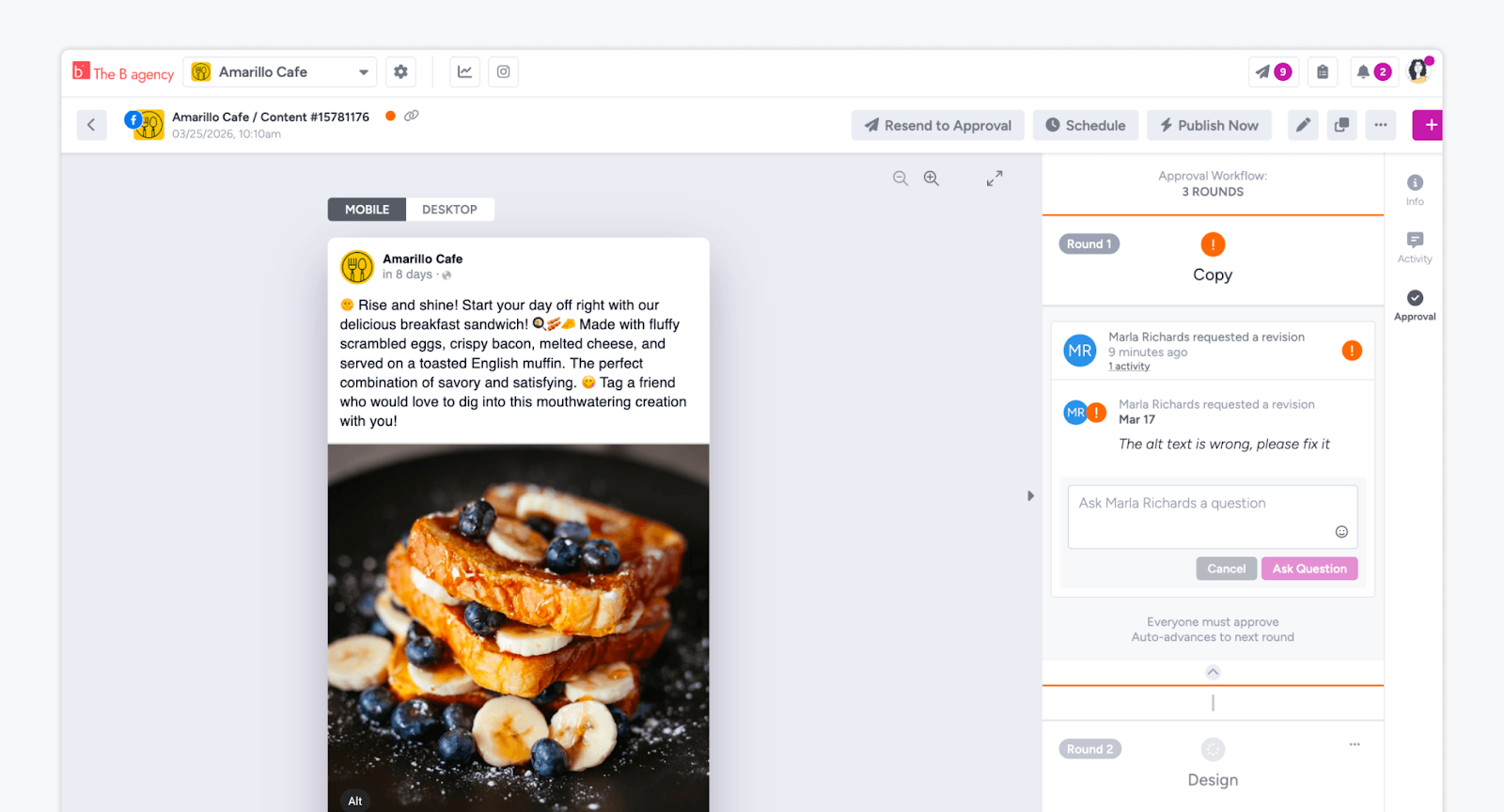
A strict content approval process is the backbone of social media compliance. Every piece of content should pass through the right eyes before it goes live. And this is where Gain comes in.
Gain’s customizable content approval workflows let you add as many rounds of review and as many approvers as your compliance process requires. Content moves automatically from one reviewer to the next, so nothing gets published without the right sign-off.
Approvers get automatic reminders when they owe feedback, and every comment, change request, and approval is logged, giving you a clear audit trail if you ever need to demonstrate compliance. Role-specific permissions mean each stakeholder only sees what they need to see, and dynamic previews show approvers exactly what content will look like before it goes live.
7. Invest in training
Compliance infractions often come down to a lack of awareness. With mandatory employee training, your organization can get ahead of the most common mistakes. Communicate company policy clearly, and give your team templates and real-world examples to help them understand what compliant content looks like in practice. Training should be ongoing, especially as regulations and platform policies continue to evolve.
8. Create social media compliance policies
Every organization needs a clear, detailed social media policy that is easily accessible to all employees and team members. Consider building out the following:
- A privacy policy outlining how you collect and use customer data
- An acceptable use policy setting expectations for how fans and followers can interact with your brand
- An influencer compliance policy covering disclosure requirements and content pre-approval for any influencer partnerships
- An AI usage policy clarifying which tools are approved, what data can and cannot be fed into them, and when disclosure is required
Real-world Social Media Compliance Examples
Reading about compliance policies is one thing. Seeing how real organizations put them into practice is another.
Below are a few examples of how businesses and institutions across different industries approach social media compliance, and what makes each one worth paying attention to.
U.S. Environmental Protection Agency (EPA)
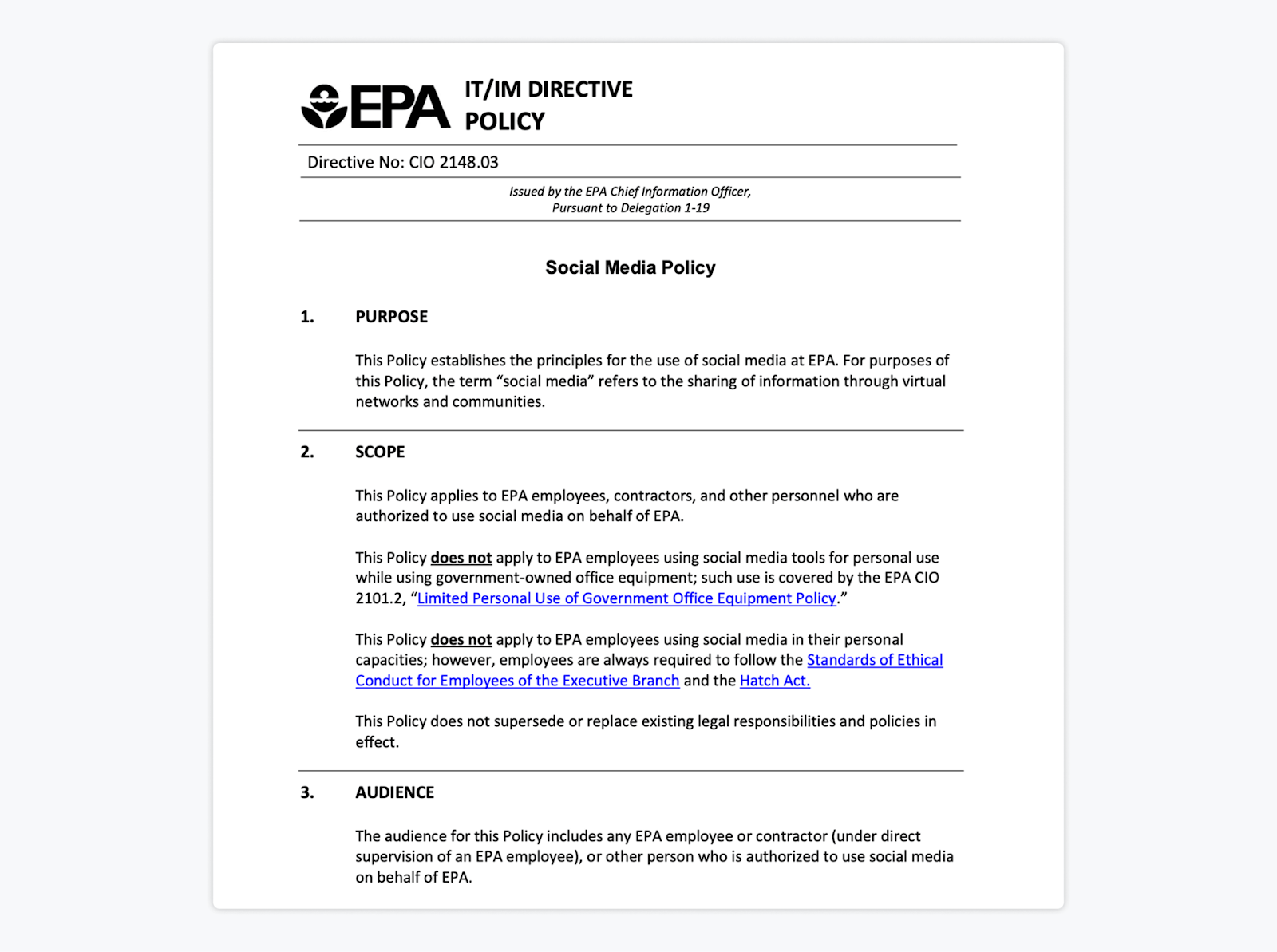
A strong example of how a government institution can formalize social media governance across a large, multi-department organization. Here’s what we like about it:
- Clear scope and accountability: The policy explicitly defines who it applies to (employees, contractors, and authorized personnel) and assigns specific compliance responsibilities to named roles across departments, leaving no ambiguity about who owns what.
- Third-party platform controls: The EPA only permits use of pre-approved third-party social media sites with formal Terms of Service agreements in place, reducing the risk of unauthorized or non-compliant platform use.
- Privacy by design: The policy explicitly prohibits using third-party social media sites to collect personally identifiable information, a straightforward rule that protects both citizens and the agency.
British Red Cross
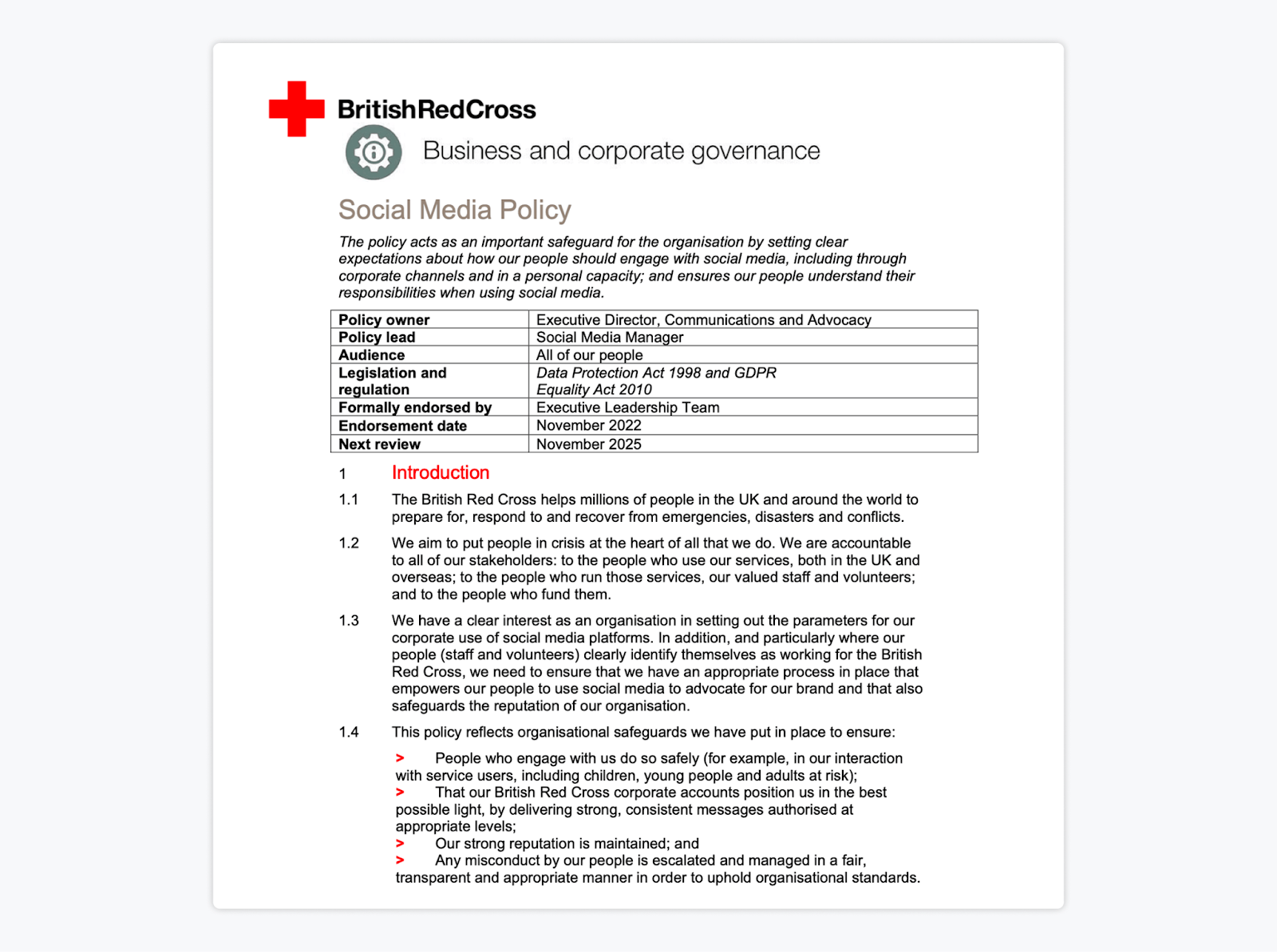
A great example of how a large nonprofit can balance brand protection, volunteer management, and safeguarding responsibilities within a single cohesive policy. Here’s what we like about it:
- Personal and corporate use covered: Clear expectations are set for both official accounts and personal use by staff and volunteers, recognizing that reputational risk doesn’t stop at the brand’s official channels.
- Vulnerable audience protections: Specific guidelines cover how to engage with children, young people, and adults at risk — a level of safeguarding detail rarely seen in standard compliance policies.
- Defined ownership and escalation paths: The Social Media Manager holds final approval authority, with a documented escalation route to the Director of Media for disputes, making accountability impossible to sidestep.
Global Banking School (GBS)
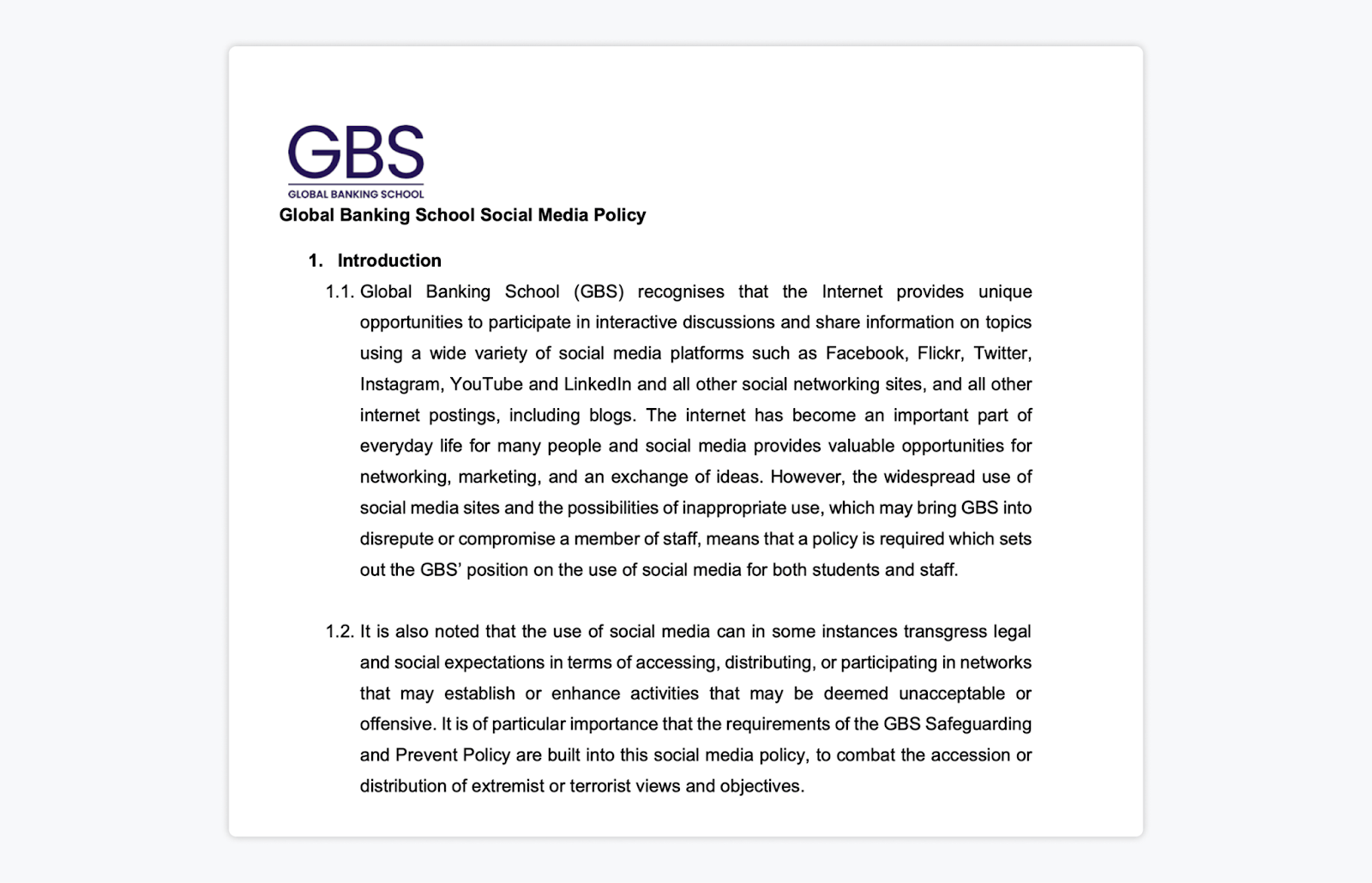
A thorough example of how an educational institution can address compliance across both staff and students, while tackling the unique risks that come with an academic environment. We particularly like:
- Explicit do’s and don’ts: Rather than relying on vague guidelines, GBS lays out specific prohibited behaviors, from spreading unverified information to posting photos without written consent, making compliance expectations impossible to misinterpret.
- Safeguarding and prevention duty built in: The policy explicitly addresses extremist and terrorist content, reflecting the institution’s legal obligations under the UK Prevent Duty — a compliance consideration unique to the education sector.
- Student and staff covered equally: Unlike many institutional policies that focus solely on employees, GBS applies the same standards to students, alumni, and contractors, closing a compliance gap that education institutions often overlook.
FAQs
A social media policy covers how your organization and employees should behave on social media, including tone, content guidelines, and best practices. A social media compliance policy goes further, addressing the specific laws, regulations, and industry standards your organization must follow to avoid legal and financial risk. In practice, many organizations combine both into a single document, but regulated industries typically need a more detailed, compliance-focused policy that aligns with sector-specific requirements such as HIPAA, FINRA, or GDPR.
The consequences range from financial penalties to lasting reputational damage. GDPR violations can result in fines of up to 4% of global annual revenue. HIPAA breaches can cost organizations up to $1.5 million per year. Beyond fines, regulatory bodies can impose restrictions on your marketing activities, and in serious cases, legal action can follow.
Several industries face far more rigorous compliance requirements than others, including healthcare, financial services, education, government, pharmaceuticals, legal services, and alcohol brands. Each comes with its own regulatory framework, from HIPAA in healthcare and FINRA in financial services, to strict advertising restrictions for regulated consumer products. If you operate in any of these sectors, a generic social media policy simply won’t be enough. You need a compliance strategy that accounts for the specific laws and regulators that govern your industry.
Time to Take Social Media Compliance Seriously!
On the whole, staying compliant on social media is a complicated task. As the environment evolves, keeping track of all the moving parts is essential. When you create your social media compliance policy, remember that even the slightest (but very public) mistake can cause costly legal battles and reputation damage.
With a content approval automation tool like Gain, you can keep on top of your social media compliance at ease. Give yourself peace of mind and try Gain free!