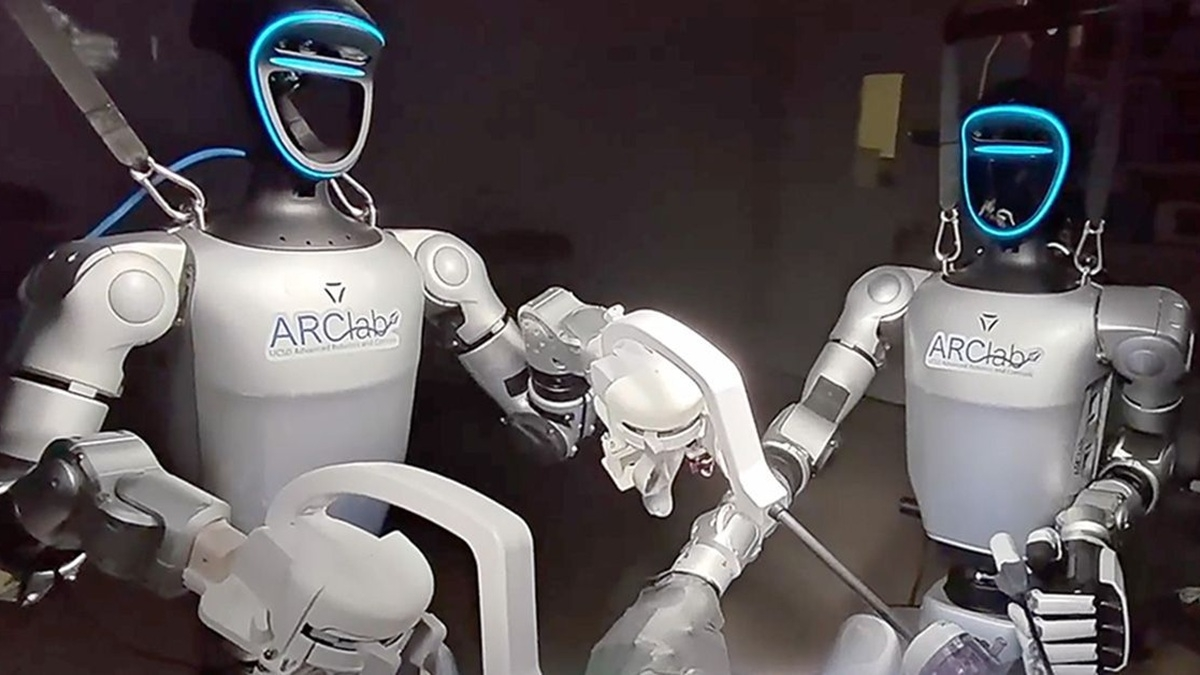
This is a world first which took place in the laboratories of theUniversity of California San Diego (UC San Diego) and whose results were published in the prestigious journal Nature.
Surgeons have remotely controlled of the humanoid robots from the Chinese manufacturer Unitree to perform two cholecystectomies (removals of the gallbladder) on pigs.
They sought to validate a radical concept: using versatile robots, and not ultra-specialized machines, as extensions of the surgeon’s hands, wherever they are.
What does this first surgical procedure with humanoid robots consist of?
For this experiment, a surgeon, installed in front of a control console, directed the arm movements of humanoid robots to manipulate surgical instruments and operate on an animal.
The system combines a stereo vision for the practitioner, hand controllers and a foot pedal to engage or disengage the tools. This is a high precision remote operation in which the machine becomes the direct extension of human expertise.
Two scenarios were successfully tested. The first involved a hybrid team : a piloted robot, assisted by a human surgeon in the flesh. The second pushed the concept further with a duo of humanoid robots working in tandem and performing a fully robotic surgical ballet, but always under human control.
To achieve this, the teams had to develop physical adapters so that the robots, nicknamed Surgecan grasp the standard medical instruments.
Why humanoid robots rather than specialized surgical systems?
The reasons are economic. A specialized surgical system like the famous da Vinci weighs almost a ton, takes up considerable space and costs several million dollars.
Conversely, the robot Unitree G1 weighs barely 27 kg for 1.50 m and its price, although variable with the options, starts at a fraction of this amount. This significant difference opens up immense prospects for rural areas, less fortunate hospitals or even theaters of operations on the battlefield.
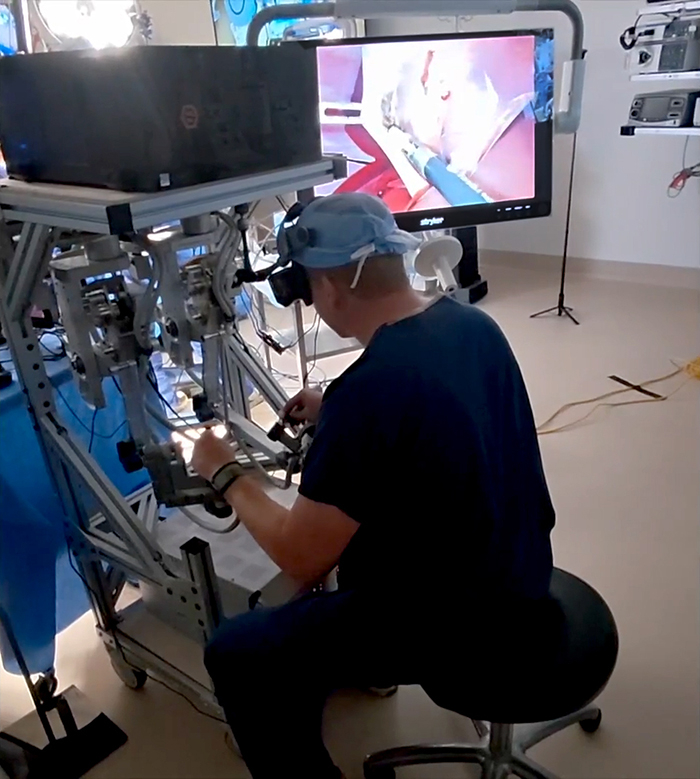
Remote control of robots during surgical operation
Beyond the economic aspect, it is their versatility which changes the situation. A humanoid robot is not limited to a single task. He can potentially move around, get tools, assist the team in multiple ways before and after the act.
It is still not a question of replacing the surgeon but of multiplying his hands and making the robotic surgery less elitist by integrating it more naturally into an existing workflow.
What are the current challenges and limitations of this technology?
The experiment highlighted several technical obstacles to overcome. Accuracy required frequent recalibrations robots in full operation, considerably extending the duration of procedures compared to current standards.
Furthermore, the latency (the delay between the command and the action of the robot) remains a critical point, currently a few hundred milliseconds where a threshold of 150 ms is considered ideal for gesture security.
Other physical constraints appeared, such as limited range of robot arms (450 mm), much lower than that of a human, which increased the cognitive load of the operator.
However, the research team puts these challenges into perspective. The first robotic laparoscopic surgeries took six hours for an operation that lasts only 30 minutes today.
What future for these new kind of “surgeons”?
The long-term goal goes beyond simple teleoperation. The UC San Diego team aims to develop a independent surgical assistant. It would then be possible to entrust the robot with additional but crucial tasks in an operating room: bringing the right tools at the right time, adjusting the lighting, or even cleaning the room after the procedure.
This would make it possible to overcome the shortages of qualified personnel and let human teams focus on critical decisions. However, complete autonomy, where theartificial intelligence would take control of the scalpel alone, remains a distant and complex horizon.
The short and medium term vision is rather that of a collaboration homme-robot increasingly narrow and intuitive. The real challenge is to create a theater of operations of the future where humans and machines will form one integrated and augmented team to offer cutting-edge care to as many people as possible.