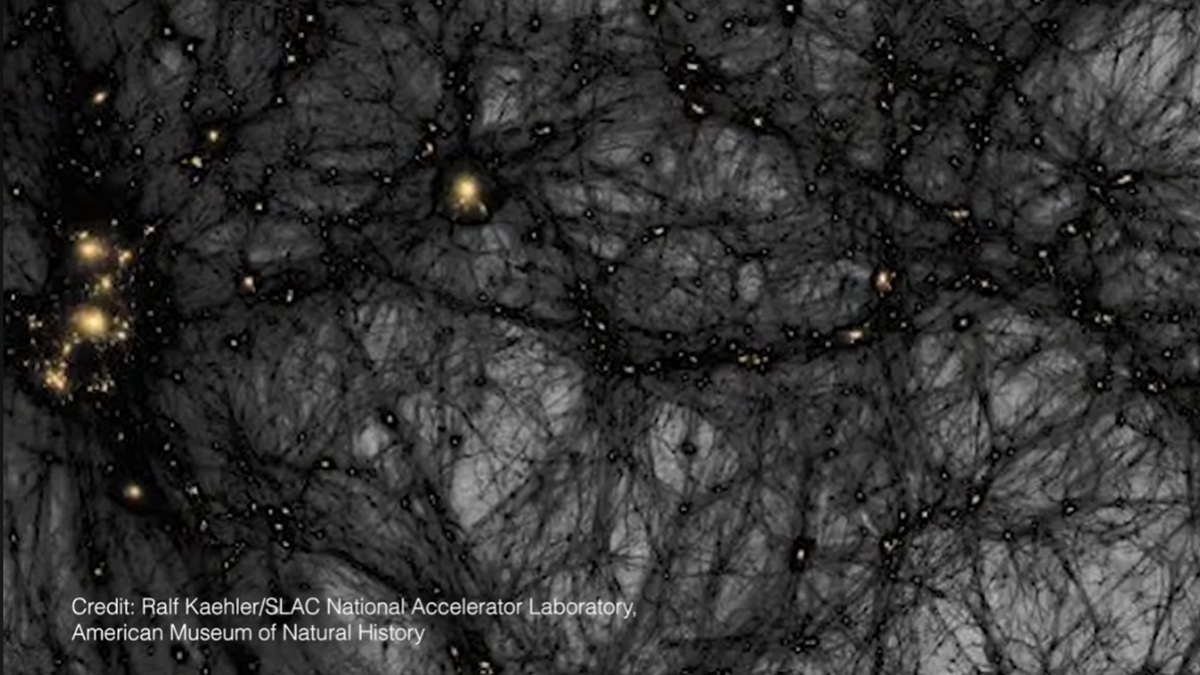
A new theory ofUniversity of Sheffield proposes that the dark matter resides in a fifth hidden dimension.
The unique geometry of this dimension would create a natural “resonance”, explaining why this substance interacted strongly in the early universe while being almost undetectable today. This model links two of the greatest mysteries of modern physics.
The study published in the journal Physical Review D by researchers Yu-Dai Tsai and Taegyu Lee of the University of Sheffield postulate that dark matter vibrates in harmony with an extra dimension, which would explain its ghostly behavior.
How would a fifth dimension explain the behavior of dark matter?
The central idea is that this additional dimension has specific geometry and shape which force dark matter particles to align in a very precise way.
This alignment would cause a phenomenon called dark matter resonancea bit like the string of a violin which vibrates intensely when you play the right note.
This resonance would have made the interactions of the dark matter much stronger at key moments, such as just after the Big Bang. Over time, the expanding universe would have “detuned” this resonance, making dark matter increasingly inert and difficult to detect today.
It would still be there but it would no longer vibrate with the same intensity. It is an idea which suggests a hidden harmony in the fundamental laws of the universe, a kind of musical structure underlying reality.
What is a “dark photon” and what is its role?
For cosmic music to work, you need a bow to make the string vibrate. In this theory, this bow is the black photon. It is a hypothetical particle which would be the carrier of a “dark force”, in the same way that the ordinary photon (elementary particle which makes up light) is the carrier of the electromagnetic force.
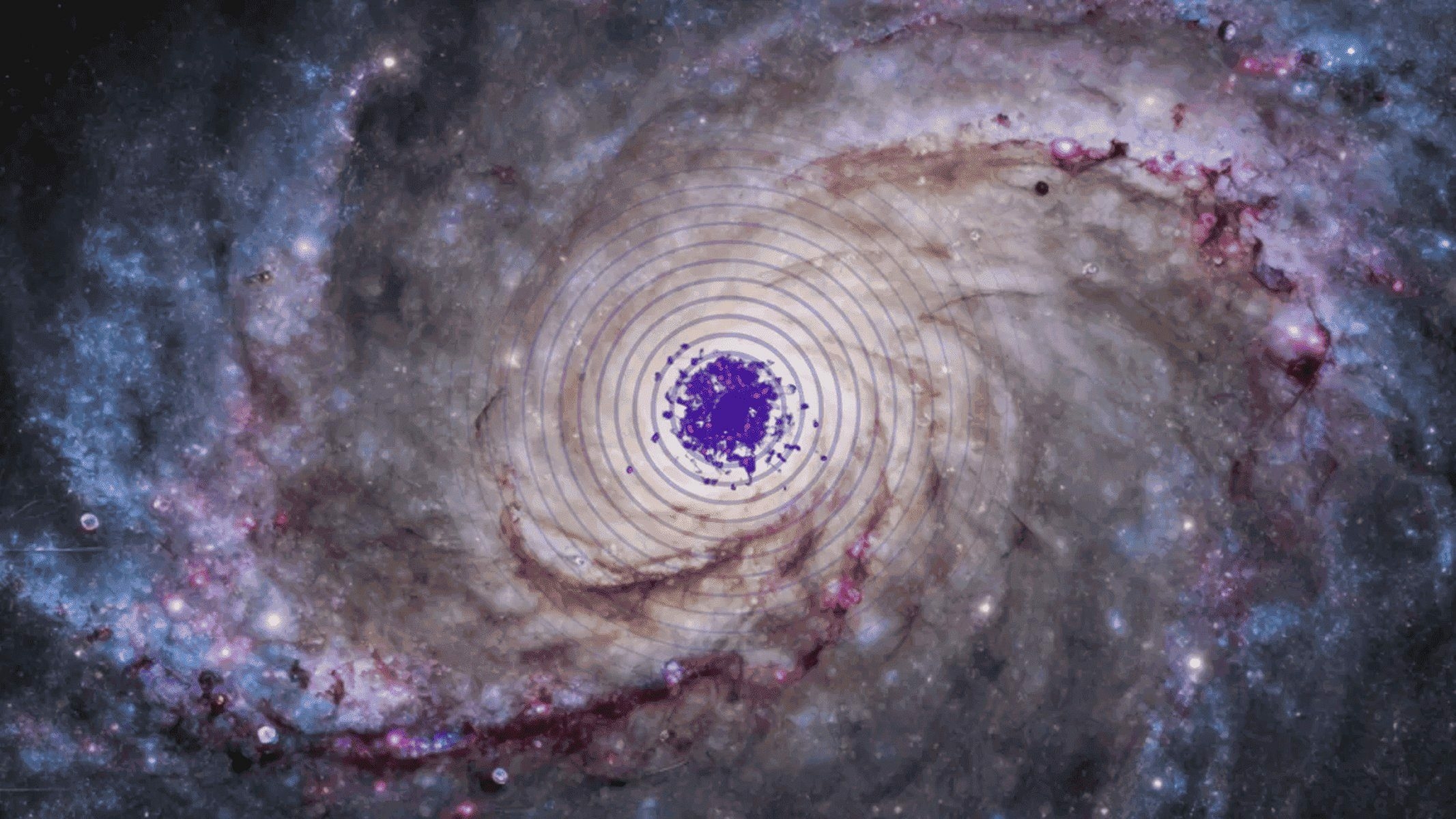
This dark photon would exist alongside dark matter in the hidden dimension. The geometry of this dimension would therefore act on the dark matter/dark photon tandem to orchestrate the famous resonance. Without the dark photon, dark matter would remain silent.
Why is this new theory so different from previous models?
The concept of dark matter resonance is not entirely new. However, most previous models treated this resonance as a starting assumption.
Physicists had to “hand-tweak” particle masses to make the theory work, in a fit that often seemed too good to be true.
Sheffield’s proposal is radically different. Resonance here is not a coincidence or a manual adjustment. It follows naturally, inevitably, from the mathematical structure of the dimension itself.
The theory offers a deeper, more elegant origin to a key phenomenon for understanding dark matter.
What are the concrete implications for future research?
This theory, if verified, offers physicists clear and new targets in their quest. Instead of searching randomly, they can now focus on detection of predicted specific signals by this resonance model.
It connects two of the greatest puzzles in physics: the mystery of dark matter and the existence of a possible hidden dimension, which would connect two problems into a potential solution.

LUX-ZEPLIN detector in search of dark matter
Beyond fundamental knowledge, this research has direct technological benefits. The hunt for dark matter pushes the development of ultrasensitive detectorscryogenics and advanced electronics.
These advances end up benefiting fields like medicine, computer science and communications. The quest for the invisible is therefore, paradoxically, a very concrete driver of innovation.