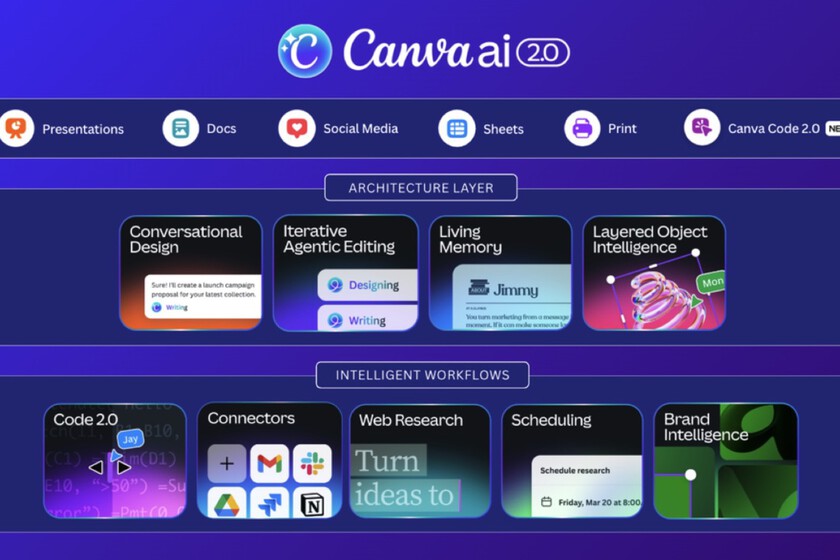
Canva has built its success on being the non-intimidating tool. Easy, cheap and accessible to anyone. With its new update, ‘Canva IA 2.0’, it points in another direction: it adds connectors with Slack, Gmail, Notion or Google Drive; background automations and persistent brand memory.
It no longer competes only with Figma or Adobe. Now it even competes with Notion, ClickUp, Microsoft and Google.
Why is it important. 250 million monthly users guarantee that the formula has worked. The question is whether adding all this complexity (conversational design, agent orchestration, scheduled tasks…) makes it more powerful or simply more similar to what already exists.
Canva seeks to grow and the risk is breaking the balance that has brought it here.
Yes, but. All this comes from a press release. The numbers on their own models (up to 30 times cheaper and 7 times faster than the competition, they say) are published by Canva itself. Real access starts today for the first million users. Until there is real-world testing, the headlines deserve some skepticism.
In detail. The main news:
- Conversational design: create from text or voice, without a starting template.
- Smart orchestration– AI coordinates internal tools to generate entire campaigns from one briefing.
- Active memory– Learn the team’s style and brand identity and apply it alone.
- Connectors: Slack, Gmail, Google Drive, Notion, Zoom, HubSpot y Google Calendar.
- Scheduled tasks: automations that run in the background without intervention.
- Canva Code 2.0: Interactive experiences with import of HTML generated by other AIs.
- AI Spreadsheets: structured tables generated from natural language.
Between the lines. The most interesting thing is not technical but strategic: Canva has strengthened its collaboration with Anthropic to integrate its design engine into Claude, and allows importing outputs by Claude or ChatGPT as editable elements within Canva.
They clearly want to be at all the points where an idea is born, not just where it is given shape.
The other reading. For years, Canva has been edging into Figma’s territory in professional collaborative design. But the connectors and automations in this ad take them away from that path: this is more like Notion or ClickUp than a design tool. It’s not entirely clear whether that’s an evolution or a loss of focus. Time will tell.
What’s coming. The experimental version is available today for the first million users who enter from the home page, with progressive rollout in the coming weeks.
Featured image | canva
In Xataka | Canva’s most ambitious move is not about AI: it’s about locking everyone inside