Strategy leaders love to obsess over model benchmarks, debating which LLM has the best reasoning capabilities for their competitive intelligence tools. But this is a distraction from the real failure point: blindness to the current moment.
Asking an LLM about a competitor’s pricing move from the last morning is a waste of compute, and it actively misleads your decision-making. That’s why instant knowledge acquisition is the strategic capability that most innovation teams are missing. Real-time, verified web data is the only way to turn a hallucinating chatbot into a reliable analyst.
The solution? Stop waiting for a smarter model and start feeding it with live news (yes, fresh data beats a bigger brain every time. Boom! 🤯).
In this article, you’ll discover why accuracy is the credibility constraint for market-aware agents and how to solve it. Let’s get started!
The “Smart Model” Fallacy
There is a dangerous assumption floating around product and strategy teams that sounds like this: “If the model is smart enough, it will understand the market”. It feels intuitive… if the reasoning capabilities are high, the strategic output should be high, right? Wrong! 🛑
This mindset ignores a fundamental architectural limitation: Knowledge latency. 🕰️
Models are historians. Even with a massive context window, a model is trapped in the past of its training data. When you ask an agent to “analyze the sentiment of our competitor’s new feature launch”, the agent isn’t looking at the market. It’s looking at the LLM’s weights, which are months old.
So, what happens? Easy: The model hallucinates 🤦. It fills the gap with plausible-sounding corporate speak because it has no access to the actual press release that went live just yesterday.
So, if you work with market-aware agents, you have to understand that intelligence is secondary to awareness. If your agent can’t touch the live web, verify the source, and ingest the data instantly, it’s more of a liability generator than an actual asset for your company. 📉
Defining Market-Aware Agents
To fix this, you need to stop treating these tools like chatbots and start treating them like autonomous sensors.

A market-aware agent is a system designed to navigate the chaotic and unstructured nature of the web to answer high-stakes questions. We are talking about use cases that drive revenue, like:
- Competitive intelligence: Spotting a competitor’s recent change to their pricing tier before they announce it. 🤓
- Supply chain risk: Catching a labor strike report in a local news outlet before it hits the major Bloomberg terminal. ⛓️
- Investment validation: Scouring niche forums and developer changelogs to see if a tech company is actually shipping code or just delivering hype. 📊
In a word, the defining characteristic of market-aware agents is the dependency on the “now”. Consider this comparison: if you are building a coding agent, Python syntax doesn’t change week to week. But in market strategy? The reality changes minute by minute. 🕰️
Instant Knowledge Acquisition: The Architecture of Truth
So, if the “better model” isn’t the right solution, what is? The answer is instant knowledge acquisition. But let’s be clear: this is not just “giving the agent Google Search”. That’s the amateur approach. 🙅♂️

Standard search APIs return a lot of useful content, but they are designed for humans who can click and read. Agents, instead, need deep, structured data. This is why instant knowledge acquisition is about creating a multi-step architectural pipeline that transforms the noise of the web into clean, verifiable facts.
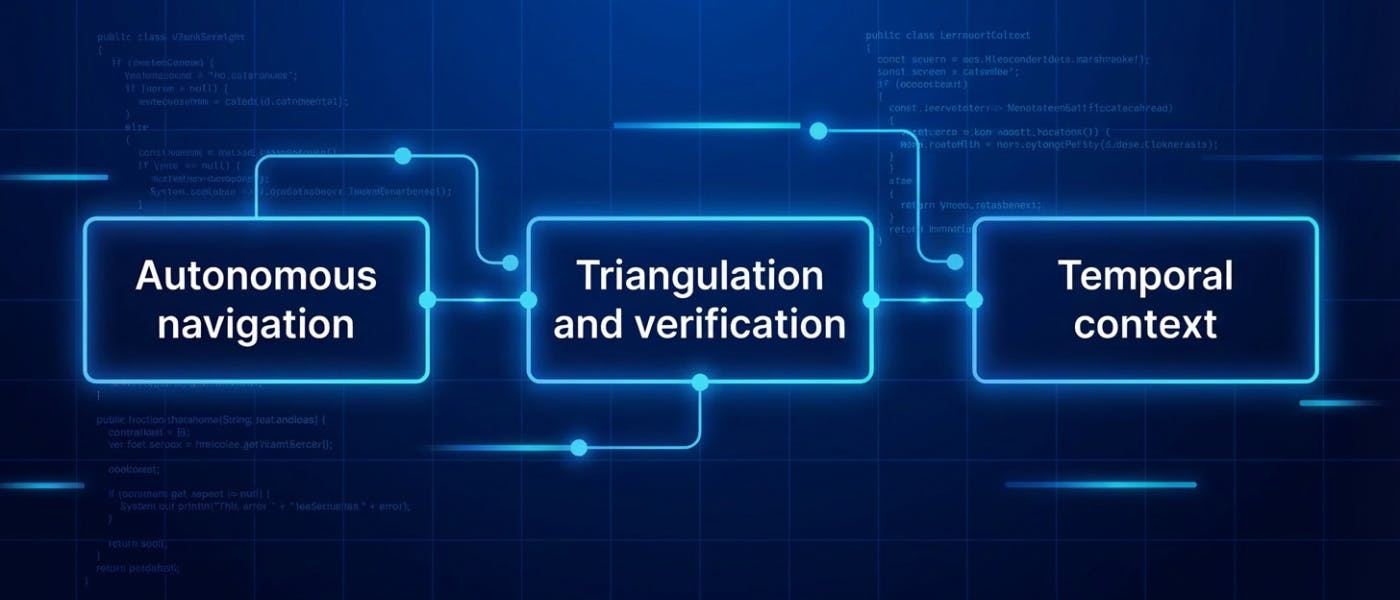
Here is what such a pipeline looks like:
- Autonomous navigation: Deep research agents visit the specific URL, render the JavaScript, interact with the DOM, and extract the actual pricing table, not just the marketing fluff above it. If your agent can’t distinguish between a navigational footer and a pricing grid, you are getting mainly noise. 😵💫
- Triangulation and verification: The internet is full of garbage, and a single source is never enough to establish “market truth.” If your agent sees a rumor on a blog post, it shouldn’t blindly report it. It needs to cross-reference it. 🕵️♂️
- Temporal context: Data without a timestamp is dangerous. A pricing page from 2023 looks exactly like a pricing page from 2025 to an LLM. To make data temporarily meaningful, the system must tag every ingested piece of information with “freshness”. This way, the agent knows which paragraph was scraped today and which is from an archived PDF from last year. ⏰
Accuracy Is the Credibility Constraint
Let’s talk about the cost of being wrong. If a creative writing bot hallucinates a plot point, it’s funny. If a competitive intelligence AI hallucinates that a competitor has dropped a key feature, and you pivot your roadmap based on that? You just burned thousands of dollars. 🔥

For strategic teams, accuracy is the hard constraint. You cannot ship a market-aware agent that lies.
This is why the “Retrieval” part of RAG (Retrieval-Augmented Generation) is so critical here. You need to prioritize grounding and continuous retrieval of fresh data. Every claim the agent makes must be traceable to a live, accessible URL. If the agent can’t cite its source, the user can’t trust the insight.
And here is the kicker: the “cleaner” your retrieval, the smarter your model looks. When you feed an LLM high-fidelity, verified, real-time data, it doesn’t have to guess. This way, you stop fighting the model’s hallucinations and start leveraging its reasoning.
From Reactive Search to Proactive Monitoring
So, what’s the ultimate goal? It is to move from “search” to “watch”. Why? Because search is reactive: You ask a question, and the agent looks for an answer. But market-aware agents shine when they are proactive. 🌟

Imagine an agent configured to “watch” a specific set of regulatory pages. It compares the version from 10 minutes ago to the current one to answer questions like:
- “Alert me only if Competitor X changes their Terms of Service regarding data privacy”.
- “Notify me if the price of this SKU drops below $50”.
This creates a loop based on “fetch, diff, analyze, and alert”, which is the heartbeat of an automated strategy. It turns the internet into a structured database of events and allows you to sleep while the agent watches the world. 😴
The New Workflow: Verification, Not Discovery
When you get instant knowledge acquisition right, the human workflow changes. Analysts stop being “search engines”. They stop spending 80% of their day Googling and opening tabs. The agent handles the discovery, extraction, and initial synthesis. Analysts verify. ✅
In this scenario, the human role shifts to verification. The agent says: “Competitor Y launched a vector database, verified by these three sources”. The human clicks the links, confirms the reality, and then makes the strategic call.
This is the only way to scale market intelligence. You can’t hire enough analysts to watch the entire web. But you can deploy enough agents fed with the right data. 🍾
Stop blaming the model for not knowing what happened five minutes ago. Give it the eyes to see the world, and you’ll finally get the market-aware agent you were promised. 👀
The “Build vs. Buy” Trap in Web Monitoring
For innovation teams rushing to build market-aware agents, there is a massive trap waiting in the implementation phase. Engineers often think: “We’ll just write a quick Python script to scrape these competitor sites”. Famous last words. 💀

The reality is that the modern web is hostile to bots. You are going to run into:
- Dynamic DOMs: Sites load content via JavaScript that basic scrapers can’t see.
- Anti-bot defenses: Cloudflare and CAPTCHAs that will block after a few requests.
- Rate limiting: Getting your IP blacklisted because your agent got too aggressive.
Building a robust instant knowledge acquisition pipeline requires various precautions, like headless browsing infrastructure, proxy rotation, sophisticated parsing logic to strip out ads and boilerplate, and more. It is a massive infrastructure overhead.
Unless your core business is web scraping, building this stack from scratch is a distraction. This is why there’s been a recent shift toward specialized platforms for agentic browsing. These platforms handle the dirty work of fetching and cleaning the live web, delivering structured text that your market-aware agent can actually consume.
How to Give Market-Aware Agents Web Access for Instant Knowledge Acquisition
Good news for you! You don’t need to lose your mind on infrastructure or custom code. Bright Data has you covered.
In a nutshell, Bright Data’s web access solution bridges the gap by providing:
- Infinite context and high recall: It empowers your agents with deep, unrestricted context by retrieving over 100 results per query. The system automatically manages complex pagination and unlocking logic, ensuring your models never suffer from data gaps.
- Scalable, production-grade execution: You can move beyond simple scripts to a system that allows agents to discover hundreds of relevant URLs, retrieve full page content, and autonomously crawl entire domains, even those with complex and dynamic architectures.
- Instant knowledge and vectorization: Rapidly ingest the entire spectrum of web data to construct comprehensive vector stores and knowledge bases. Your market-aware agents can instantly cross-reference multiple sources to resolve missing data points and enrich their understanding in real-time.
- Frictionless, unblockable access: It eliminates the operational bottlenecks. It automatically handles 403 errors, CAPTCHAs, and rate limits, guaranteeing a 99.9% success rate for your workflows.
- Optimized token economics: It maximizes your LLM’s signal-to-noise ratio by automatically converting raw HTML into clean, structured Markdown or JSON to reduce token costs.
:::tip
Learn more about how Bright Data’s web access infrastructure can support your market-aware agents to get instant knowledge acquisition!
:::
Final Thoughts
In this article, you discovered why market-aware agents don’t need the latest model, but current knowledge. You also explored that just giving agents access to the web is not sufficient: You need the right system and infrastructure.
Bright Data helps you retrieve instant knowledge by bearing all the infrastructure headaches for you. No more overheads on antibots, partial data, or incorrect data format.
Join our mission by starting with a free trial. Let’s make web instant knowledge acquisition accessible to everyone. Until next time!