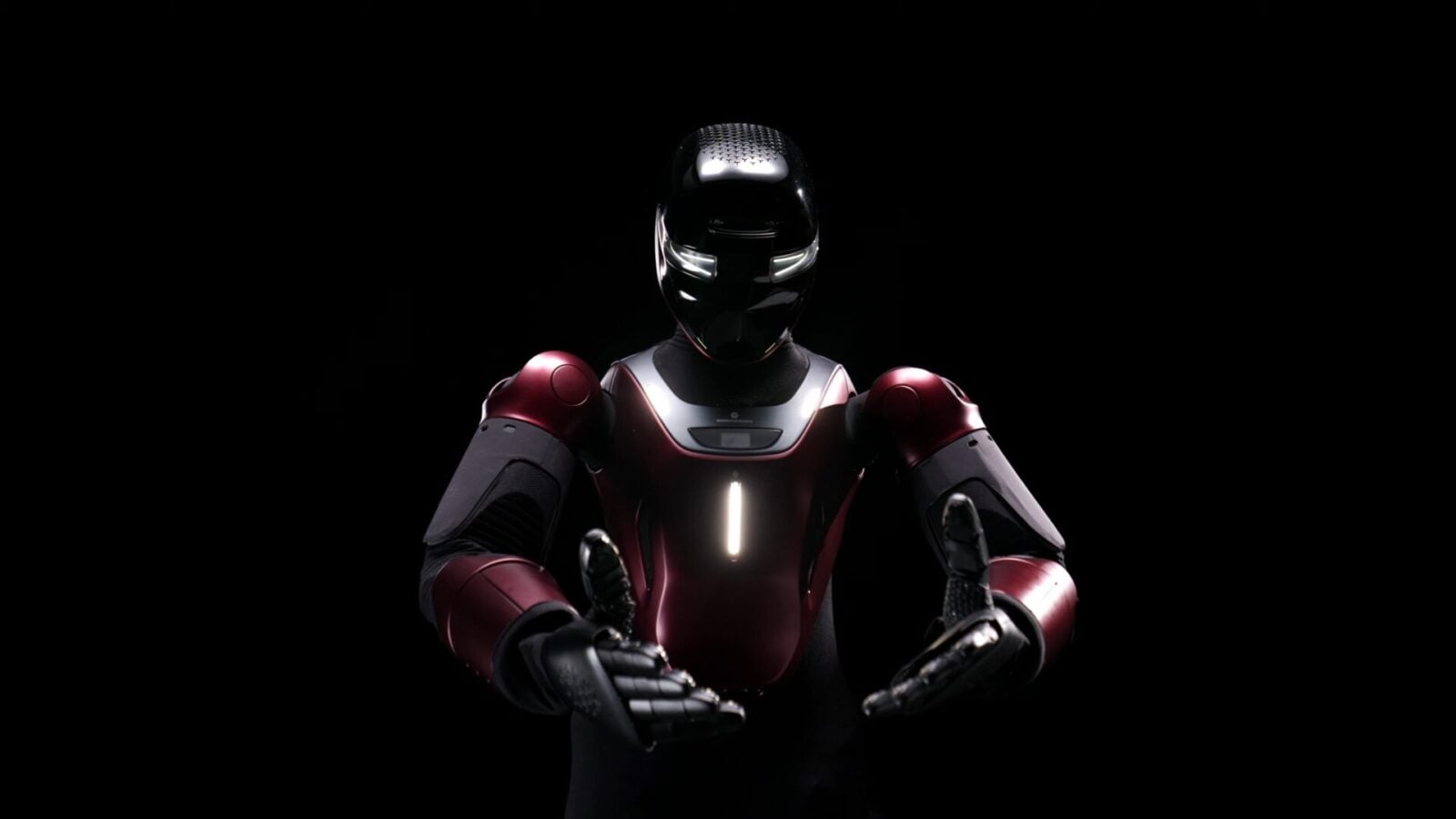
The humanoids of Silicon Valley see everything, but feel nothing. An Italian startup is taking the opposite approach with a robot covered in sensitive skin, already promised to shipyards. And it only took six months.
Tesla, Figure, Unitree: the race for humanoid robots has been based on the same recipe for several years. Cameras everywhere, neural networks behind them, and the hope that vision will be enough to understand everything about the physical world. Genoese deep tech Generative Bionics arrives with an opposite conviction: a robot called to work among humans first needs to sense them. His first born is called Gene.01, he was unveiled this week at the AMD Advancing AI event, and his particularity can be summed up in one sentence: his entire body is lined with sensors.
Why teach a robot to feel that it is being brushed against?
Gene.01’s skin detects touch, proximity, force and temperatureover its entire surface. Concretely, the robot perceives that a human is approaching even before contact, and adjusts its behavior during it. This is exactly what is lacking in current industrial robots, condemned to live in wire cages (an engineering solution of relative elegance) because a mechanical arm that feels nothing is a walking danger for anyone who comes within range.
Read also: The NEO robot gets new, almost human hands, and that changes everything
The touch challenge also solves a problem that cameras alone cannot solve. A vision AI can recognize an egg, it will never know how much pressure to hold it without breaking it. Thanks to its force sensors, Gene.01 learns by demonstration: we guide its movement, it retains the movement and the pressure exerted. A bit like teaching a child to carry a full glass, by holding their hand rather than showing them a video tutorial. The American and Chinese leaders in the sector rely first on cameras and rely on massive training to compensate. Two philosophies, the same objective: getting the humanoid out of the laboratory.
From CES concept to shipyard in six months, really?
In January, Gene.01 was just a concept presented at the AMD keynote at CES in Las Vegas. Six months later, the machine works, walks and smells. The fastest transition ever made to a functional humanoid, assures Generative Bionics, which loves records as much as sensors. The speed, however, can be explained without magic: the company was born in 2024 as a spin-off from the Istituto Italiano di Tecnologia, the Genoese laboratory which has been manufacturing humanoids for more than 20 ans. The lineage goes back to iCub, this little child robot which roamed European laboratories, and the design method was published in the journal Nature Machine Intelligence. A CV, in short.
The crux of the matter followed: 70 million euros raised at the end of 2025 to finance the product, AI training and a first factory. The first client is already known, and it is not in the trade show demo: Fincantieri, a shipbuilding giant, is preparing a humanoid welder for its construction sites. Gene.01 is designed as an adaptable platform (AI, bodywork and even hands change depending on the targeted profession), with logistics, industry and health in its sights. Everything claims an ambition for European sovereignty: actuators developed with the German Synapticon, final assembly on the continent, and model of the robot published as open source for developers.
👉🏻 Follow tech news in real time: add 01net to your sources on Google, and subscribe to our WhatsApp channel.