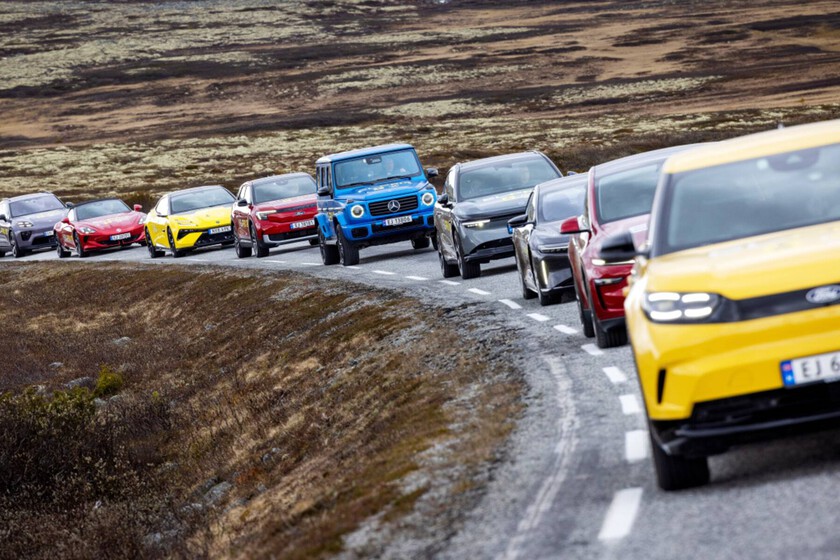
One by one, line up and see how far they go. The examiners of the Norges Automobil-Forbund (NAF), the Norwegian automobile association, have once again put the most representative electric cars on the market to the test. This time, the test was carried out in summer and the results, once again, leave us with interesting conclusions.
Further. The electric car market has a new king when it comes to going further than anyone else. It is the BMW iX3 that has traveled a total of 781 kilometers before coming to a complete stop. The figure is even higher than that announced by the WLTP approval, which leaves it at 770 kilometers before stopping.
The BMW iX3 bases its great result on a gigantic 108.7 kWh battery but its consumption has barely remained at 14.2 kWh/100 km, which is why it combines a huge battery with an enviable consumption for such a large, heavy car with so much frontal surface area.
a surprise. If you have been aware of the latest launches in the electric car market, it is very likely that this first position of the German SUV has not surprised you. That honor probably goes to the XPeng X9, a Chinese electric minivan that, at the moment, is not sold in Spain.
And this minivan is approved for 580 kilometers according to the WLTP cycle. However, in the Norwegian test it managed to cover 646 kilometers before stopping. That is, he was able to travel 66 kilometers more than expected and was the one who managed to put the most distance between driving in real circumstances and the homologation tests.
Those who added. Far from those +66 kilometers, another 11 cars managed to obtain figures above what was expected. Except for the Mercedes GLB and GLC (+30 and +22, respectively), no other managed to travel 20 kilometers more than those stipulated by the WLTP cycle.
Of those 11 cars, five are Chinese (taking into account that the Mazda 6e is, in reality, a Deepal car with a Japanese body). In addition to the latter and the Xpeng, the MG S6 EV, the Smart #5 and the Dongfeng Vigo (a huge Chinese SUV) were the Chinese cars that slipped into this category. Among the “traditionals”, in addition to Mercedes and BMW, Kia was the other brand with two cars that offered better than expected performance.
Those who remained. On the other hand, there are those who remained. Of the 24 cars, another 12 cars performed less than what was reflected in the WLTP cycle. If you’ve done the math, you’ll see that one is missing. The Toyota Bz4X nailed the test: it promised 506 kilometers of autonomy and stopped after 506 kilometers of travel.
Of those that met the forecasts the worst, the MG IM6 recorded 59 kilometers less than expected, followed by the Hyundai Ioniq 9 (-34 km) and the Mercedes CLA (-33 km). From here, all recorded deviations of less than 30 kilometers.
More positive than negative If we continue at the bottom of the table, we have four other Chinese cars. In addition to the MG, the Polestar 3 (-24 km), the Deepal S05 (-14 km) and the BYD Atto 3 EVO (-10 km) also fell short of expectations.
That is to say, there were more cars classified on the positive side of the comparison and the other half on the negative side, but this is well understood considering their battery type. All the Chinese cars that obtained better results than expected use NCM chemicals, except for the Dongfeng proposal, which is LFP and is the car that is closest to its homologation.
On the contrary, almost all the proposals that lose kilometers among the Chinese models are cars that use LFP chemicals. This is not met with the Polestar 3, which does have NCM chemistry and which, unlike the Dongfeng, is the negative exception. And LFP chemistries tend to be more stable. They do not perform as well as an NCM in good weather but, in exchange, they perform better in cold conditions.
And how is all this done? On the NAF website you can check all the details of when and how the exams are carried out. The Norwegians test cars twice a year to see how they perform when cold and how they perform when hot.
The test is carried out continuously until the car comes to a complete stop and uses a route that is considered standard for what Norwegian drivers encounter, including going up to a pass. In addition, they review the temperature and what the weather was like in each place. This time clouds and mild temperatures predominated.
But, in addition, in the test they also note how many kilometers each car traveled before marking an energy reserve of 20% and 10%. They emphasize the importance of the latter because a driver almost always charges in this range, reducing the risk of being stranded before reaching the destination. If you are more curious, in this link they leave all the data and each car has its own technical sheet with the consumption at all times, the expected kilometers and consumption and those finally reflected.
Photo | NAF
In | The big drawback to the electric car is that it takes a long time to charge. CATL has a solution of 6 minutes and 27 seconds