Oracle has made a qualitative leap in its business applications strategy with Fusion Agentic Applications and the expansion of AI Agent Studio, as it goes from adding “copilots” to turning Fusion into an autonomous, results-oriented and deeply governed execution layer. And for decades, ERP (Enterprise Resource Planning), HCM (Human Capital Management) or CRM (Customer Relationship Management) have been above all systems of record, that is, they have reflected what had already happened, but the real execution occurred outside, in emails, spreadsheets and parallel processes.
As recently pointed out Natalia Rachelsonsenior vice-president of Cloud Applications Development at Oracle, “2026 will be the year in which companies truly begin to operationalize AI in their organizations,” underlining that the focus shifts from experimenting with models to managing them as mission-critical assets.
With Fusion Agentic Applications, Oracle explicitly proposes a transition towards “results systems”; that is, applications that reason, make decisions and act continuously to achieve specific business objectives (get paid sooner, reduce provisioning costs, increase cross-sell), using the same Fusion data, policies and approval hierarchies.
Unlike copilots or assistants embedded in the interface, these agents are natively integrated in transactional systems and can be executed in real time, at the enterprise level and under the existing governance framework, rather than simply suggesting steps to the user.
What is a Fusion Agentic application
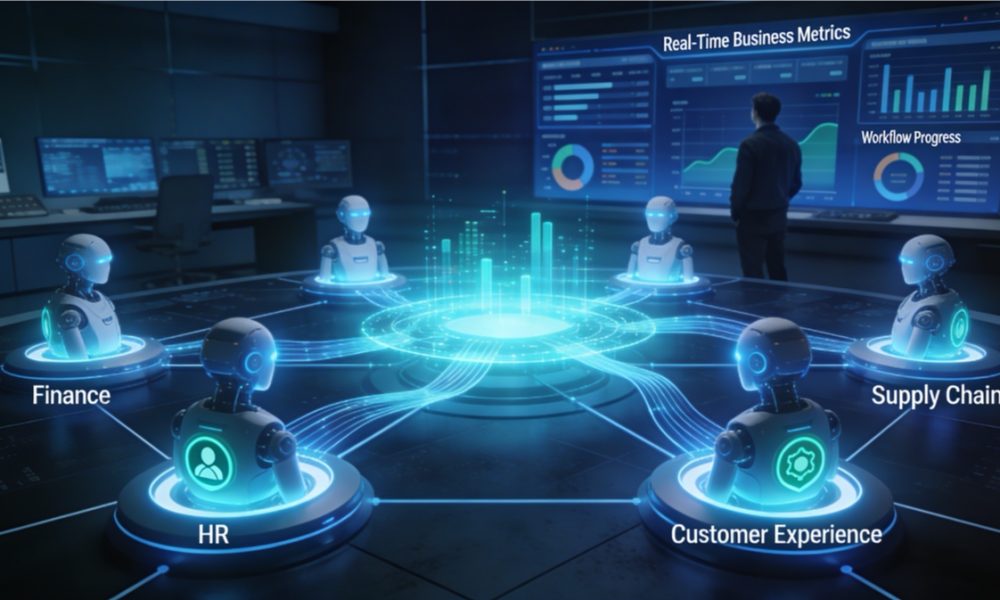
Oracle define las Fusion Agentic Applications como coordinated teams of specialized AI agentsgoal-driven, proactive, reason-driven, and designed to execute in complex business environments. Each agentic application brings together several agents with well-defined responsibilities and authority (for example, risk analysis, proposal preparation, negotiation or task prioritization), who share a persistent context since they know the history, current state of the process, previous decisions and the original intention of the user or the business.
This shared memory allows the system not to start over after each interaction, but to continue advancing the entire process (not just isolated tasks) and only escalate to the human the exceptions or decisions where their judgment materially changes the result.
Use cases: finance, HR, supply chain and CX
In this first wave, Oracle puts on the market 22 Fusion Agentic Applications for very specific objectives in finance, HR, supply chain and customer experience.
For example, Workforce Operations Agentic Application automates data collection, accelerates shift change approvals and helps reduce payroll incidents, moving from reactive workforce management to proactive and intelligent work operations. For its part, Design-to-Source Workspace coordinates engineering, purchasing and sourcing to reduce product costs, cycles and compliance risk, unifying what were traditionally disconnected functions into a continuous process.
But we also have Cross-Sell Program Workspacewhich identifies expansion opportunities in the installed base, orchestrates cross-selling campaigns and explicitly seeks to increase win-rate ratios and lower acquisition costs, as well as
Collectors Workspacewhich prioritizes collections, adjusts contact strategies, seeks to reduce days of sales outstanding (DSO) and improves payment commitments, converting manual collections into a continuous flow of intelligent cash.
These cases are supported by the previous wave of AI agents that Oracle had already introduced in Fusion Applications for tasks such as detecting accounting anomalies, talent management or recommending sales opportunities, also built on Oracle AI Agent Studio and deployed at no additional cost to the client.
AI Agent Studio and Agentic Applications Builder: the agent factory
The other key piece of the announcement is the launch of Oracle AI Agent Studio for Fusion Applications as a design platform to create, configure, validate and deploy agents and multi-agent flows, integrated directly into Fusion. AI Agent Studio already allowed customers and partners to extend pre-configured agent templates or build new agents and workflows from scratch, with a no-code environment, secure access to Fusion APIs, knowledge stores and integrated testing, validation and security tools, available at no additional cost to Fusion Applications customers.
Now add the Agentic Applications Builderwhich raises the level of abstraction, since instead of thinking about individual agents, it allows composing complete agentic applications from Oracle, partner or external agents, using natural language to select agents, define objectives, connect data and design the workflow, without the need for traditional development.
New Intelligent Workflow Capabilities
The announcement also incorporates a set of capabilities that turn AI Agent Studio into an “intelligent workflow” platform for complex end-to-end processes such as:
– Workflow orchestration: Orchestration of multi-step, multi-agent processes with explicit rules on how work progresses between nodes, built-in logic and control points for human supervision, providing determinism where the company demands it.
– Content intelligence: Ingestion and understanding of unstructured content (PDF, emails, third-party documents) combined with transactional data, so that agents convert it into contextual signals that can be used within ERP, HCM, SCM or CX.
– Contextual memory: Memory mechanisms that allow agents to remember context throughout interactions, workflows and collaborations between agents, retrieving only the memories relevant to each task and sharing context when necessary.
– Multimodal LLM capabilities: Support for agents to process and generate not only text, but also images, audio or video, using multimodal models available in OCI.
– Monitoring, observability and prompt test bench: Step-by-step traceability of what each agent does, real-time metrics, prompt and debugging testing environment to be able to iterate on the behavior of the agents before and during production.
– Agent ROI dashboard: Dashboard that quantifies the impact of each agent and application (time saved, cost savings, productivity) by flow and function, essential to justify investments and scale deployments.
Technical architecture: LLMs, OCI and end-to-end governance
Both Fusion Agentic Applications and AI Agent Studio run on Oracle Cloud Infrastructure (OCI) and rely on a catalog of foundational models provided by partners such as Cohere, NVIDIA o Googlein addition to other options that Oracle exposes through its service OCI Generative AI.
For example, Oracle has announced the availability of NVIDIA Nemotron models to bolster reasoning capabilities in Oracle Fusion Applications, combining these models with Fusion business data to automate decisions, document understanding, and contextual reasoning within business flows.
In parallel, the collaboration with Cohere and the use of Oracle AI Database with vector capabilities allow the construction of RAG patterns where agents consult semantically indexed corporate data without the need to move it outside the security perimeter of the database.
More recently, Oracle has extended its multi-model strategy by integrating Google’s Gemini models through OCI Generative AI, reinforcing an approach where the customer can combine different LLMs within the same applications and agent flows.
All of this is articulated around the security and governance of Fusion Applications, since agents execute with the same model of permissions, policies, approval hierarchies and traceability as the rest of the suite, and the new observability capabilities allow monitoring what decisions an agent makes, with what data, what prompts have been modified and where a human intervenes, aligning agent management with existing SaaS standards.
From loose agents to agentic applications: the evolution of Fusion
The launch of Fusion Agentic Applications does not come out of nowhere, it is the next step in a roadmap that Oracle has been rolling out since at least 2023-2024. First came generative AI capabilities at OCI, in collaboration with Cohere, as a foundation for integrating models into data and infrastructure services.
Oracle then introduced AI Agent Studio for Fusion Applications, positioning it as a “design center” for customers and partners to create agents and agent teams tailored to their needs, with advanced testing, validation and security tools built in, and with native integration into finance, HR, supply chain and CX flows.
In 2025 and early 2026, Oracle populated Fusion with dozens of pre-built agents for ERP, HCM, SCM and CX, which automate specific tasks such as campaign planning, account analysis, anomaly detection or next best action recommendations.
The current step is to level up. Instead of delivering loose pieces that the customer has to assemble, Oracle offers complete agentic applications, with defined business objectives, composed of teams of agents and deployed on the same platform that customers can use to build their own solutions.
In the words of Natalia Rachelson, who has consistently defended the combination of “the best data with the best technology” as Oracle’s differential advantage in AI, the challenge is no longer just generating content, but producing relevant and usable results for each client, relying on the depth of data and a sovereign and high-performance AI infrastructure.