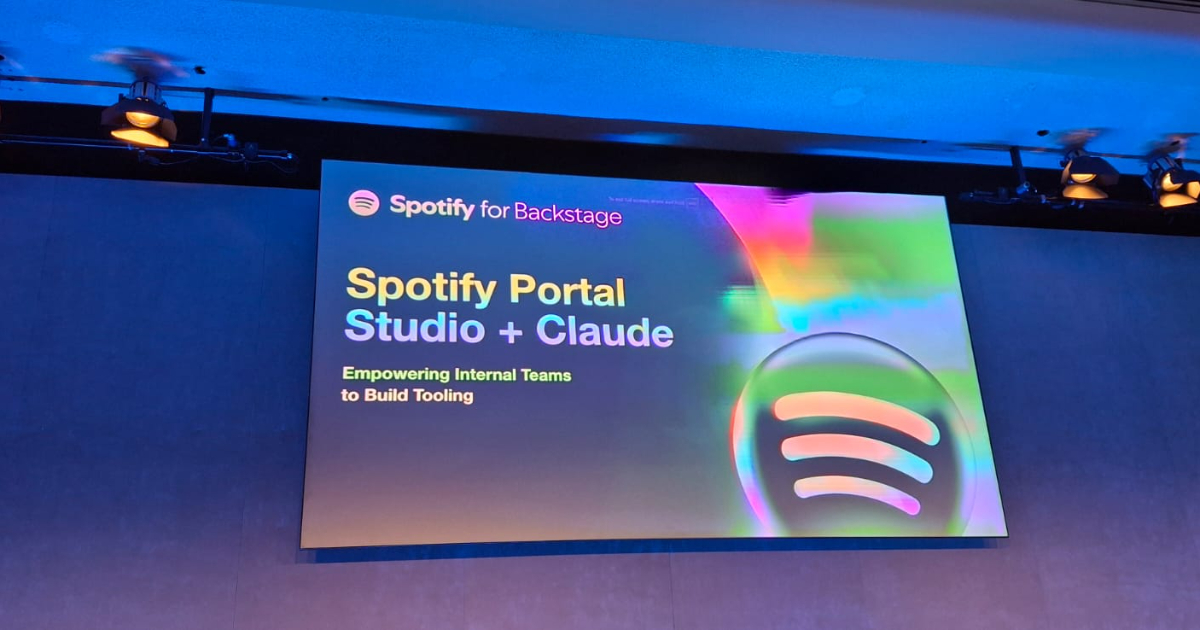
At QCon London 2016, engineers from Spotify presented how the company accelerates internal tool development using its internal developer platform and AI-assisted workflows. Stuart Clark, Senior Developer Advocate, and Mike Lewis, Staff Engineer, presented how Spotify combines its internal platform Portal Studio with the AI assistant Claude to dramatically shorten the time required to deliver internal tooling.
The talk focused on a common problem inside engineering organizations, many of the tools teams need most, small dashboards, workflow automations, or quick utilities, are too small to justify dedicated engineering resources, yet too important to ignore. As a result, teams often rely on spreadsheets or manual processes, or they build isolated tools that cannot easily be reused.
The Hidden Cost of Small Internal Tools
Engineering teams frequently encounter situations where they need lightweight internal tooling to solve operational problems. These tools might automate a workflow, expose operational data through a dashboard, or simplify interactions with infrastructure.
Because these tools rarely qualify as large engineering projects, they are often delayed or deprioritized. Over time, teams resort to spreadsheets or ad-hoc scripts that gradually evolve into informal systems.
This fragmentation leads to duplicated work across teams and creates operational risk. Scripts and dashboards are often maintained by individuals rather than teams, making them difficult to maintain or even discover later.
Internal Developer Portals
To address these challenges, Spotify built an internal developer platform called Portal, based on the open-source framework Backstage.
Developer portals centralize access to infrastructure tools, services, documentation, and operational data. Instead of navigating multiple systems, engineers interact with a single platform that exposes internal tools through plugins and standardized interfaces.
The platform also provides guardrails that ensure internal tools follow consistent patterns, including ownership metadata, permissions, approved integrations, and auditability.
This combination enables teams to build tools independently while still operating within a shared governance model.
Portal Studio
To support the development lifecycle of these tools, Spotify created Portal Studio, an environment designed for building and iterating on portal plugins.

Portal Studio allows engineers to develop internal tools locally while previewing how they will appear inside the developer portal. Developers can quickly prototype integrations, test interfaces, and iterate before publishing tools to the broader engineering organization.
The system relies on a modular plugin architecture inherited from Backstage. Backend services communicate through APIs, while frontend components are packaged as plugins that can be integrated directly into the portal interface.
This architecture enables teams to build custom tools without modifying the core platform.
AI-Assisted Tool Creation
A key component of the workflow demonstrated was the use of AI to accelerate tool creation.
Using natural language prompts, developers can ask Claude to generate scaffolding, templates, and code for portal plugins. Instead of manually creating boilerplate code and configuration files, engineers can describe the desired functionality and allow the model to generate an initial implementation.
Portal Studio then provides the environment to validate and refine the generated code before publishing it to the portal.

The combination allows teams to move from idea to working internal tooling significantly faster than traditional development approaches.
Live Demo: From Prompt to Plugin
During the session, the speakers demonstrated the workflow by building a small internal tool live.
The process started with a plain-language prompt describing the functionality of a new tool. Claude generated the initial plugin structure and implementation code. Developers then used Portal Studio to test and refine the plugin within a preview environment.
After iterating on the generated code, the tool was published as a new plugin inside Spotify’s developer portal.
The demonstration illustrated how the combined platform and AI workflow can reduce the time required to deliver internal tools from months to days.
Platform Engineering and Governance
While AI accelerates development, the platform layer provides the governance needed to operate these tools safely in production.
Portal Studio enforces standardized templates, permissions, and ownership models. Approved integrations ensure that new tools interact with infrastructure in controlled ways, while auditability provides visibility into who created and modified tools.
This governance layer helps organizations avoid the risks associated with ad-hoc scripts or isolated dashboards while still enabling teams to build solutions quickly.
Scaling Internal Tooling Across the Organization
The broader goal of the platform is to enable a sustainable ecosystem for internal tooling.
By standardizing how tools are built, integrated, and discovered, the developer portal reduces duplicated work across teams. Engineers can reuse existing integrations and patterns rather than rebuilding similar tools independently.
This approach also helps organizations maintain operational consistency as engineering teams grow and infrastructure environments become more complex.
AI and Platform Engineering
The session highlighted how AI and platform engineering can complement each other. AI accelerates the generation of code and scaffolding, while platform engineering provides the structure, governance, and integration points required to operate that code reliably.
Together, the two approaches enable organizations to deliver internal tooling faster while maintaining operational standards.
As internal platforms continue to evolve, the combination of developer portals, modular architectures, and AI-assisted development may significantly change how engineering organizations build and maintain internal tools.