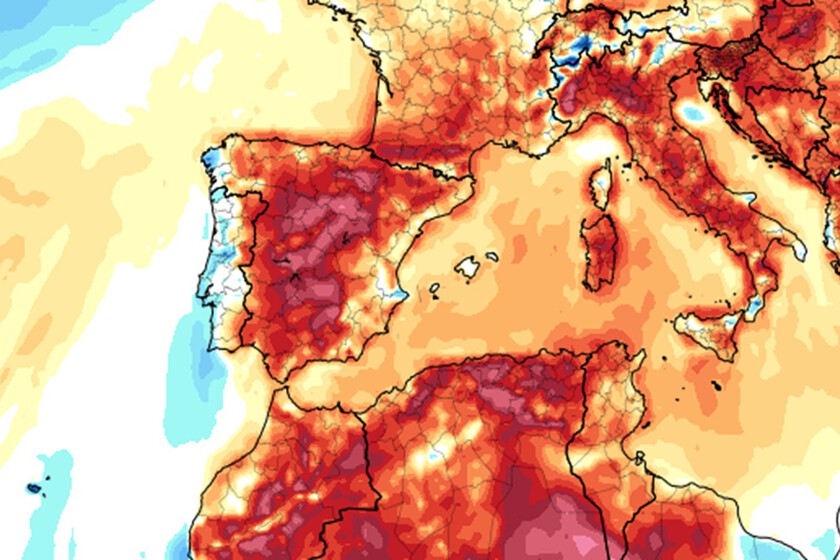
When a new summer season arrives, almost all of us have a conversation that includes one sentence: “Every year it gets hotter; the summers before were not like that.” And although for some it may seem like a true exaggeration based on nostalgia, the reality is that the data confirms that we really do have much hotter summers.
Certificate. Multiple independent studies, supported by official organizations such as the State Meteorological Agency or the Ministry for the Ecological Transition, have reached a devastating conclusion: the average summer temperature in Spain has increased around 2 °C in the last three decades. Although this is not the worst, because even the nights are no longer a refuge from the heat that occurs during the day.
The data. If we look at the thermometers with the perspective that time gives, the trend is an ascending line without brakes. According to the Sustainability Observatory, if we compare the decade of 1969-1978 with that of 2009-2018, the average summer temperature has gone from 21.4 °C to 23.8 °C, so we are talking about an increase of 2.4 °C.
But you don’t have to go that far to notice the acceleration of the phenomenon, since the most recent climatological reports from MITECO and AEMET indicate that the summer of 2025 broke all records since 1961, reaching an average peninsular temperature of 24.2 °C, which represents an anomaly of 2.1 °C above the average we had as a reference, surpassing the previous record held in 2022 of 24.1 °C.
Endless summers. The heat is not only more intense, but it lasts much longer. According to data from AEMET Open Data, the current climatological summer lasts five weeks longer than in the 1980s, gaining ground on spring and autumn at a rate of 9 days per decade. And since 1975, the summer heat period has been officially lengthened by 20 days.
The impact is even greater in urban environments, where asphalt and concrete act as heat accumulators, as stated in a study by the Polytechnic University of Catalonia that analyzed the period 1971-2022 in peninsular cities and shows chilling figures: an increase of 3.54°C.
Tropical nights. During the summer, many of us wait for nightfall to get the temperatures to drop so we can go outside or sleep more comfortably. However, nights in which the thermometer does not drop below 20 ºC are the order of the day. And to give us an idea, there are 32 million Spaniards regularly affected by these suffocating nights. In Spain as a whole, they have increased an average of 6 days in the last 50 years.
If we focus on specific areas, Andalusia, Murcia and the Valencian Community, citizens today suffer 12 more tropical nights a year than a few decades ago. And the reality is that to sleep this becomes very complicated, forcing the use of the beloved air conditioning or fan.
In | Raffaele Bernadello, climate change expert: “The need to actively capture CO₂ is increasingly evident”