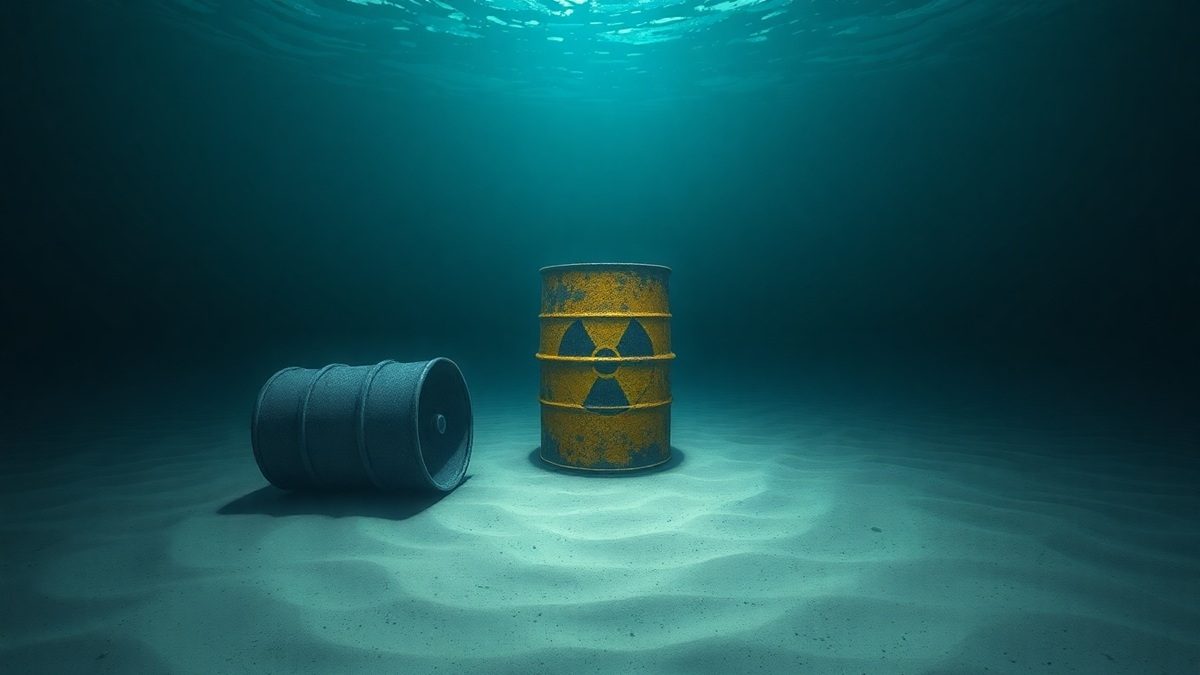
The Nodssum scientific mission explored a nuclear waste storage area 4,700 meters deep in the Atlantic. CNRS researchers observed 3,355 barrels over 163 km², many of which were ripped open and spilling their contents. Although the overall radioactivity measured remains low, levels higher than expected were detected near certain drums, confirming an active leak.
It is a truly toxic archive that scientists have just reopened. Between May and June, the mission Nodssumled by the CNRSplunged into the heart of an area located 1,000 km west of Nantes, in the abyssal plains.
Its mission was to document the state of more than 200,000 barrels of radioactive waste submerged by several European countries until 1982, when this practice was banned.
On board the ship Why not ?around thirty researchers used the manned submarine Nautile to get as close as possible to this underwater cemetery.
How big is this underwater radioactive discharge?
The mission mapped more than 3,350 barrels over a study area of 163 km², which represents only a tiny fraction of the total spill site which extends over 14,500 km².
These barrels lie at a depth of 4,700 meters, in extreme pressure and darkness. It is a legacy of decades of legal (it was then assumed that there was no life at these depths) but unscrupulous management of the waste from the nuclear industry.
Credit : CNRS / NODSSUM
This figure is dizzying and is only a simple overview. The 2025 oceanographic campaign had already enabled a first mapping, but this new mission allowed direct observations and samples crucial.
The work is only just beginning to assess the real extent of this dormant pollution and understand its evolution after half a century spent under the waves.
In what condition did scientists find these nuclear barrels?
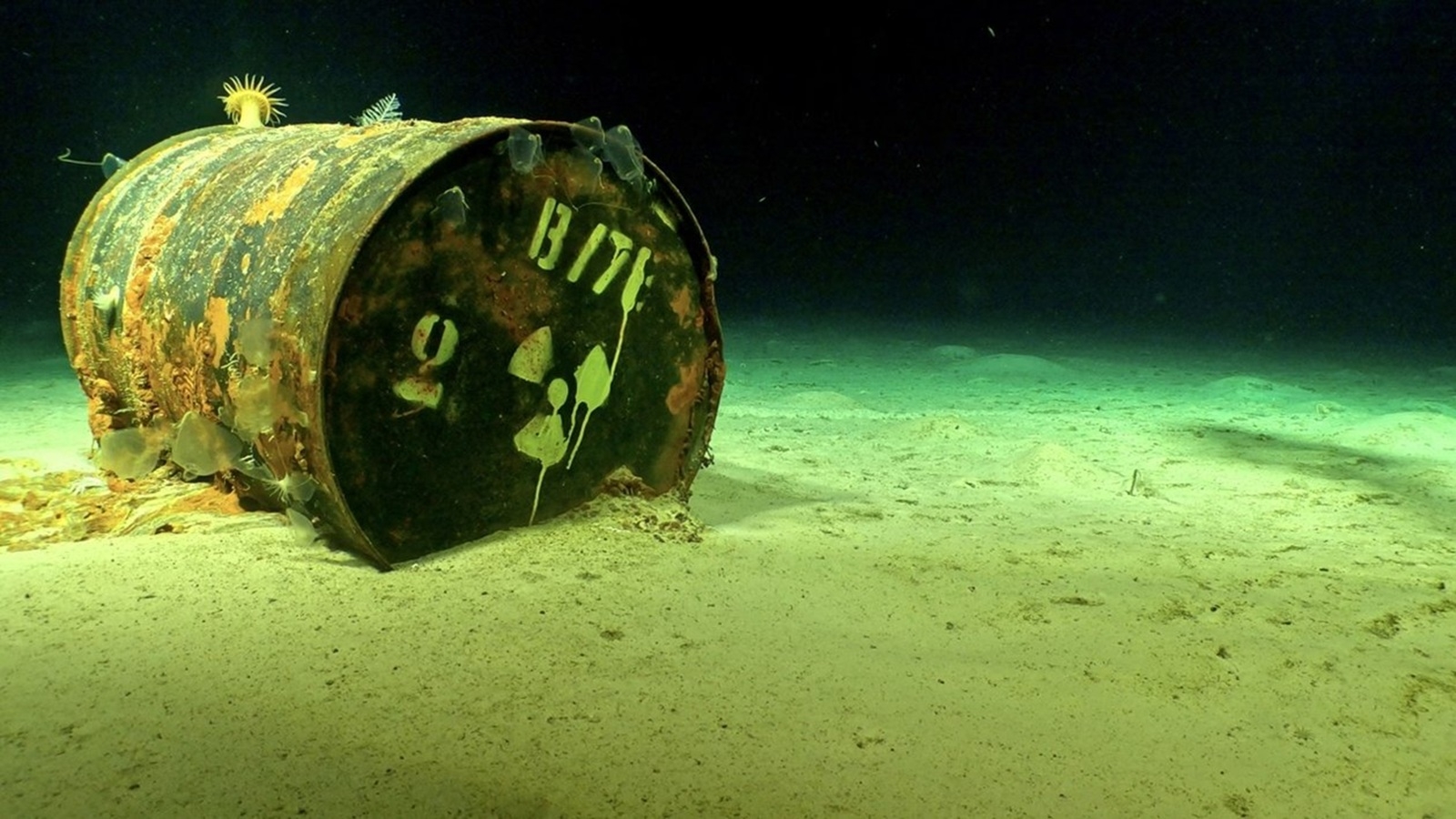
The spectacle filmed by the submarine is both spectral and fascinating. Many barrels are described as “ disemboweled », their contents, a mixture of resin, bitumen or cement, escaping and spreading on the sediments.
Marine geologist Javier Escartin paints a fascinating contrast: ” We see fish, starfish (…). Barrels have been placed there, in the middle of this fauna for more than forty years “. The yellow symbol for radioactivity is sometimes still visible on rust-eaten metal.
Credit : CNRS / NODSSUM
Worse still, life has adapted to this toxic environment. Large anemones are attached to the cylinders, crustaceans walk around there. This biological colonization raises a fundamental question about the transfer of contaminants in the abyssal food chain.
The life has adapted to this toxic tomb but the long-term consequences are still completely unknown for the ecosystem.
Should we be concerned about the level of radioactivity measured?
The answer is nuanced, and therein lies the complexity of the problem. Measurements taken on board the ship show a low overall radioactivity.
As summarized with a touch of irony by Patrick Chardon, specialist at the CNRS: “ We are not in Chernobyl “. However, the instruments did detect activity levels higher than expected in the immediate vicinity of certain drums, confirming the presence of radionuclides (unstable atoms which emit radiation) characteristic of this waste.
There is therefore no no immediate risk for human populations, but the real concern relates to slow and insidious contamination. The samples of water, sediment and living organisms collected will now be analyzed in the laboratory.
The challenge is to precisely quantify the dispersion of these toxic elements and to model their impact on deep ecosystems over the long term.
What are the next steps to understand this abysmal pollution?
This mission therefore marks the start of a long investigation. The next few months will be dedicated to the careful analysis of the hundreds of samples and terabytes of visual data collected.
Scientists will seek to understand the mechanisms of transfer and transport of radionuclides in the deep ocean, a science that is still in its infancy.
The other main objective will be to identify the origin of certain barrels by analyzing their design and contents. This “nuclear archeology” could make it possible to trace those responsible for this historic pollution.
Finally, the ocean, far from erasing our mistakes, keeps them intact, reminding us that even in the abyss, nothing ever really disappears.