Buying an SSD seemed, until not so long ago, one of those fairly simple decisions in the PC world: choose capacity, look at speeds, compare prices and little else. But the market behind this daily gesture has changed significantly. What we have seen in recent months is not a disappearance of the need for storage, but a much deeper strain on the supply chain. SSDs are still necessary, but an increasing share of drives that could previously end up in the channel retail seems to be finding other destinations before reaching the retail window.
what’s happening. The clearest signal was put on the table by Nelson Duann, vice president of Silicon Motion, one of the major manufacturers of SSD controllers. In an interview with Tom’s Hardware during Computex 2026, the executive summarized his reading of the market: “The retail SSD market has practically disappeared.” He was not talking about a specific drop or a minor adjustment, but rather about what happened during the first half of 2026, a period in which retail sales of SSDs fell significantly.
The chain has moved. The key point is who is buying those units now. Duann explained that the controllers sold by Silicon Motion to module assemblers, that is, companies that integrate memory, controllers and other components to sell complete SSDs, largely end up in units destined for PC manufacturers. It’s not a minor detail: according to that reading, manufacturers like Acer, Asus, Dell or HP can’t get enough NAND or SSD supply directly from the big memory manufacturers, so they are turning to a channel that previously looked much more towards the end user.
The pressure of AI. The background appears clearly in the TrendForce data. According to the consulting firm, cloud service providers increased demand for enterprise SSDs in the first quarter of 2026 due to the need to build infrastructure for AI servers, with high-speed data transmission and enormous storage capacities. Added to that was another factor: the structural shortage of traditional hard drives pushed a significant portion of orders toward QLC enterprise SSDs.
There are figures. TrendForce says the combined revenue of the world’s five largest NAND Flash vendors grew 83.7% quarter-on-quarter in the first quarter of 2026 to exceed $38.9 billion. The increase came in a scenario of strong demand and limited supply, with average sales prices above expectations. The distribution also shows the scale of the phenomenon: Samsung closed the quarter with 13.51 billion dollars, SK hynix Group reached about 7.53 billion and Kioxia reached 5.96 billion.
The indirect winnerss. The hit to the retail storefront does not mean that the entire chain is losing at the same rate. Duann added that, in the past, most of these companies were focused on selling to the end user, but since the end of last year and through 2026 that dynamic has changed. Demand from PC manufacturers has strengthened and those suppliers are directing a significant portion of their production directly to them. For companies like Silicon Motion, which sell SSD controllers to these assemblers, the market continues to move, although it does so through another door.
What the buyer notices. This industrial readjustment ends up reaching the user in a fairly direct way. As we have seen, the prices of consumer SSDs have increased significantly in recent quarters due to the priority that memory manufacturers are giving to the AI sector. That is to say, the pressure does not stay in the data centers, it also filters down to the shop window and the computer that we end up buying.
everything remains the same. TrendForce indicates that large NAND Flash suppliers will add virtually no new capacity during the year and that, due to AI-related demand, supply shortages will remain. Production will also continue to be heavily focused on server storage applications, with high-capacity QLC enterprise SSDs gaining penetration. In this context, the retail market is conditioned by an industrial priority that does not aim to change immediately.
In summary. The retail SSD market has weakened not because the user no longer needs fast storage, but because the industry has changed its order of priorities. Available NAND is being disputed between data centers, large buyers in the PC industry and companies trying to respond to increasingly server-oriented demand. What once came more naturally to the showcase is now more likely to end up integrated into a new team or AI infrastructure. The SSD is still there, but the usual buyer is no longer first in line.
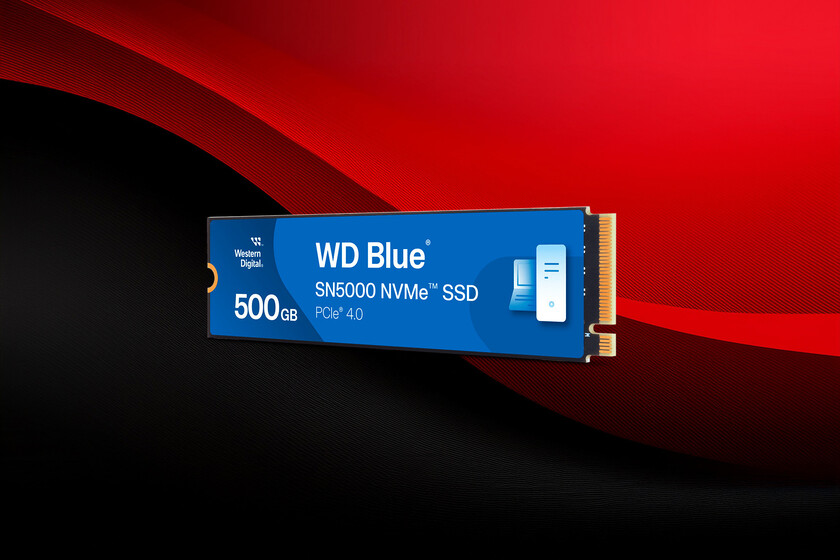
Images | Western Digital + Photoshop
In | SSD prices are so crazy that a 2TB drive for the PS5 costs more than the PS5 itself