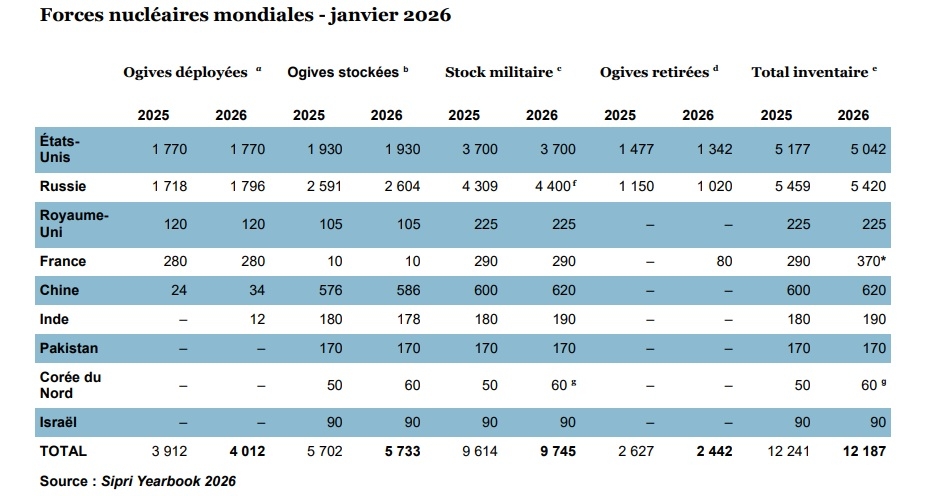
This is an alarm signal from the Stockholm International Peace Research Institute (SIPRI) in its annual report published in June 2026. The study draws a clear conclusion: the nine world nuclear powers (United States, Russia, United Kingdom, France, China, India, Pakistan, North Korea and Israel) have reversed the historical trend towards the reduction of their arsenals.
Of an estimated overall inventory of 12,187 warheads, nearly 9,745 are now in military stockpiles ready for potential use, and a growing number are being removed from warehouses to be mounted on missiles or carried on aircraft.
Modernization is accelerating, transparency is declining and the risk of escalation is reaching critical levels, sounding the death knell for the post-Cold War era of disarmament.
Why are nuclear weapons stockpiles increasing again?
The reason for this worrying inversion is twofold. On the one hand, the pace of dismantling of old warheads, inherited from the Cold War, has slowed considerably.
On the other hand, and this is the most alarming point, the deployment of new weaponsmore modern and more efficient, is accelerating at an unprecedented speed. The countdown is reversed. The logic is no longer one of reduction but of “qualification” and an increase in the so-called “operational” stock.
This shift ends three decades of cautious optimism. Since the fall of the Berlin Wall, the world has lived with the achievement of a constant reduction in the total number of nuclear warheads.
This momentum is broken. We are entering a cycle where the possession and modernization of nuclear weapons become again central instruments of power and foreign policy, reviving the specter of a new Cold war.
Trust has given way to generalized distrust, pushing each actor to sharpen their blades.
Which countries are leading this new arms race?
If Russia and the United States still have between them approximately 83% of stocksthe most explosive dynamic comes from China. Beijing expands its nuclear arsenal faster than anyonewith the ambition to rise to the level of the two historic superpowers by the end of the decade in terms of intercontinental ballistic missiles (ICBM).
SIPRI estimates that China already has 620 warheads, a figure that could exceed 1,000 by 2030.
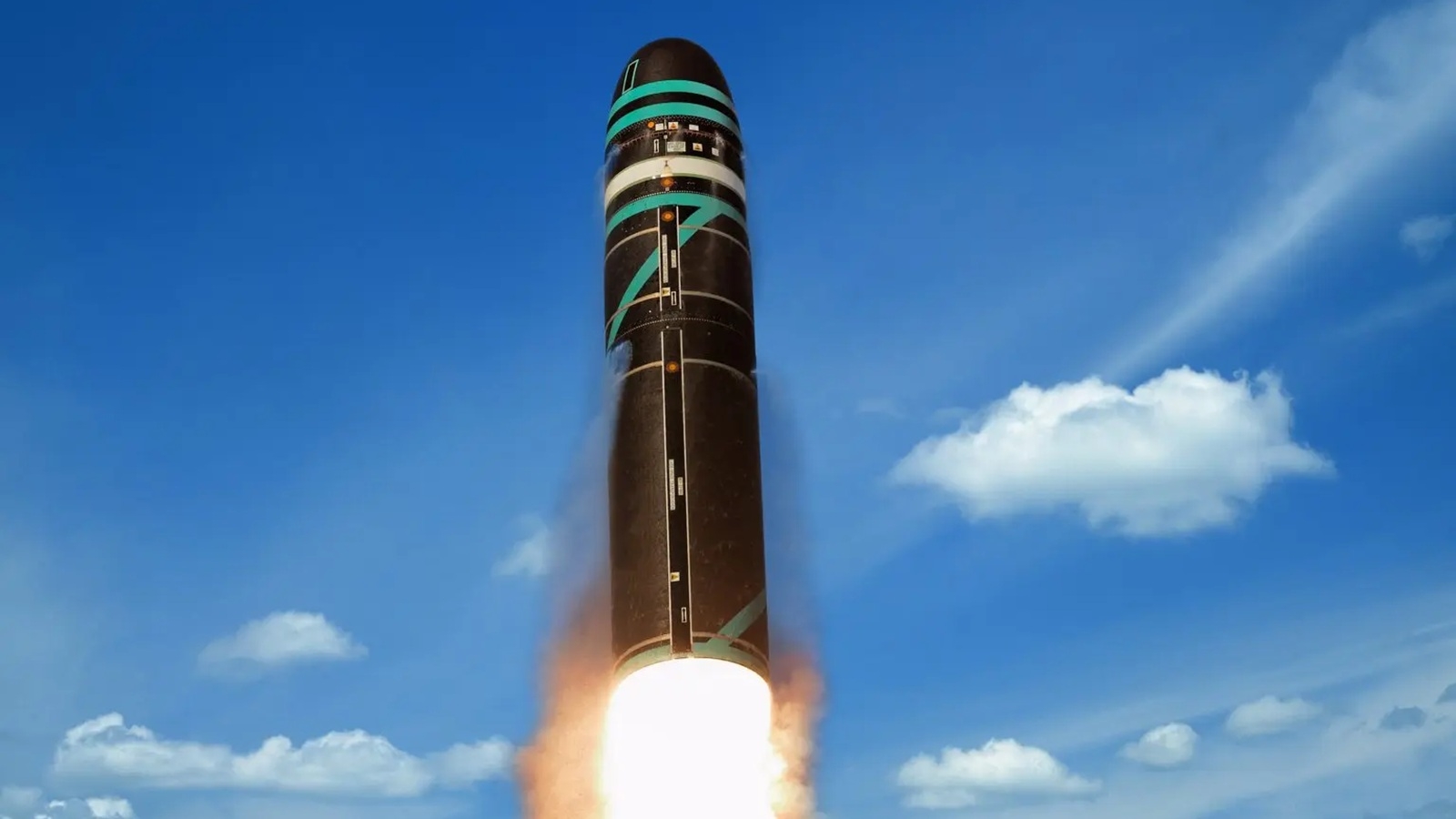
In Europe, France and the United Kingdom are not left out. Both countries recently announced an increase in their arsenals and, in a new development, reduction of their transparency by ceasing to communicate publicly on the exact size of their stocks.
This is a strong political signal and is part of a logic of reinforced deterrence. There modernization of arsenals is also at the heart of the strategies of India and Pakistan, whose latent conflict of May 2025 showed to what extent the regional powder keg could flare up.
Finally, North Korea is pursuing its objective “ exponential expansion » and Israel is discreetly modernizing its capabilities.
What are the consequences of this nuclear escalation?
The most direct consequence is dramatic increase in risks. The expiration of New START treaty in February 2026, without a successor, broke the last security barrier surrounding the Russian and American arsenals.
The architecture of arms controlpatiently built for decades, collapsed. This legal and diplomatic vacuum opens the door to a race without limits for which suspicion and the risk of miscalculation become major factors of instability.
More profoundly, this trend marks the bitter failure of the non-proliferation regime. The dialogue is broken. Communication between nuclear powers is at an all-time low, creating a climate of dangerous opacity.
For SIPRI, we are entering an era of calculated uncertainty where the logic of deterrence itself seems to be on borrowed time. Its director, Karim Haggag, warns: “lGlobal events call into question the logic of nuclear deterrence » herself.