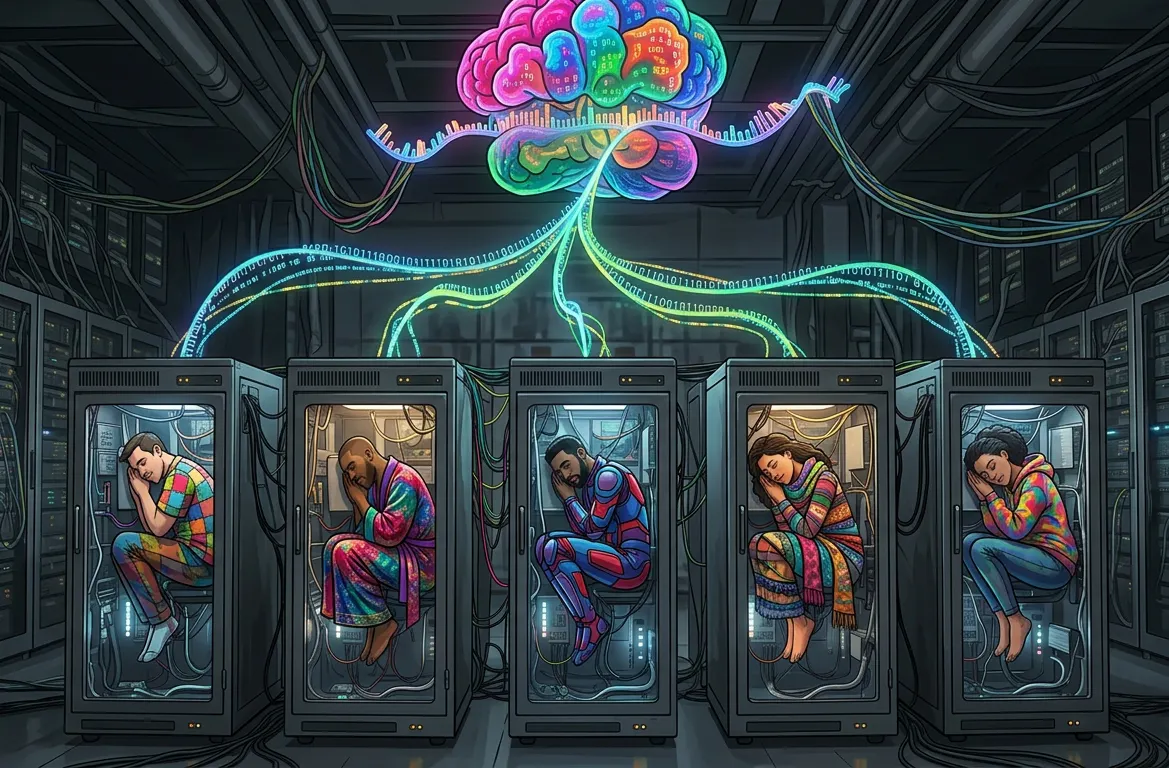
The development of political fragmentation and the rigid division of groups into us and them has disrupted a primordial connection, one that once allowed humans to participate in something like a shared, distributed intelligence. Think of it as a legacy peer-to-peer network, running for millennia without central servers, gradually throttled to near-zero bandwidth by the demands of modernity. Ancient civilizations maintained what you might call a worldwide knowledge graph, coherent, interconnected, holistic, before it was shattered and replaced by the reign of quantity; metrics; the tyranny of what can be measured.
The human capacity to read the emotional and cognitive states of others, to sync without explicit communication, is not mysticism. It is a latent biological feature. Mirror neurons. Embodied cognition. The social brain hypothesis. Modern neuroscience has been slowly rediscovering what ancient cultures engineered entire civilizations around. We deprecated the Ziggurats into temples and misplaced their actual function, communal solidarity.
The obsession with private property and the commercial logic of ownership has reduced human existence to a zero-sum resource allocation problem. Every transaction becomes adversarial. Every relationship becomes transactional. This isn’t a bug in capitalism; it’s a core feature, and it is expensive. Because it requires humans beings to suppress every collective trait acquired through millennia of evolution. The cognitive overhead of constant status competition, of social uncertainty, of managing impression instead of reality, it burns cycles that evolution intended for something else entirely. Our top-of-the-line brains have become optimized purely for material conquest, corrupting the capacity for genuine synchrony, resonance, and coordinated intelligence.
Sacred tradition is not nostalgia. It is not religion in the political sense. It is shared protocol, a common language of sign, ritual, and rhythm that allows large groups of people to coordinate at the subconscious level, far below the bottleneck of explicit verbal communication. The reason teams at successful companies feel like something beyond the sum of their parts is that they have developed, consciously or not, the rudiments of a tribal culture: shared vocabulary, rituals, values, and mythologies. The best engineering cultures aren’t built on org charts; they are built on tradition.
When you walk into a company where the culture is genuinely alive, where the values aren’t a PDF on a shared drive but something people actually embody, you are witnessing tradition functioning as designed. It is high-bandwidth, low-latency coordination. It is telepathy, operationalized.
Within every human being lies what older frameworks called the universal subconscious, a substrate of intelligence that predates language, that communicates in pattern and emotion rather than proposition. Think of this as the Big Me: the self that is embedded in the collective, that resonates with others, that can perceive signal through the noise of explicit cognition. The conscious, rational, analytical mind, the Little Me, the one writing pitch decks and doing system design, is a useful but narrow interface layer. It is the watchman at the gate. And like any overzealous security system, it routinely blocks legitimate traffic.
The founder who can’t let go of control. The engineer who can’t trust her intuition. The executive paralyzed by analysis. These are failure modes of the Little Me strangling the Big Me. The fear, the status anxiety, the performance dread, these aren’t irrational weaknesses to be optimized away. They are signals that the deeper system is under-resourced and over-managed.
The restoration of this capacity is not a spiritual project. It is an engineering problem. The formula is straightforward: reduce the noise of the Little Me, the status anxiety, the defensive rationalism, the zero-sum competitive dread, and the deeper bandwidth opens naturally. Meditation does this. Deep creative work does this. Great ritual does this. Great tradition does this. The Buddhist, the Stoic, the indigenous ceremony, the pre-game locker-room ritual, all are implementations of the same protocol: suspend the watchman, open the channel, let the collective intelligence route through.
The question Silicon Valley should be asking is not how to eliminate the ancient and the inherited in the pursuit of the new. It is how to recover and re-engineer the protocols that allowed human groups to think together, across time, across distance, across the limits of individual cognition.
Tradition is not the opposite of innovation. It is the substrate without which genuine collective intelligence is impossible. And collective intelligence, real telepathy, the kind that actually scales, is the only thing that has ever built anything worth building. It is the secret we hide from the machines, it is the secret that AI can never replicate.