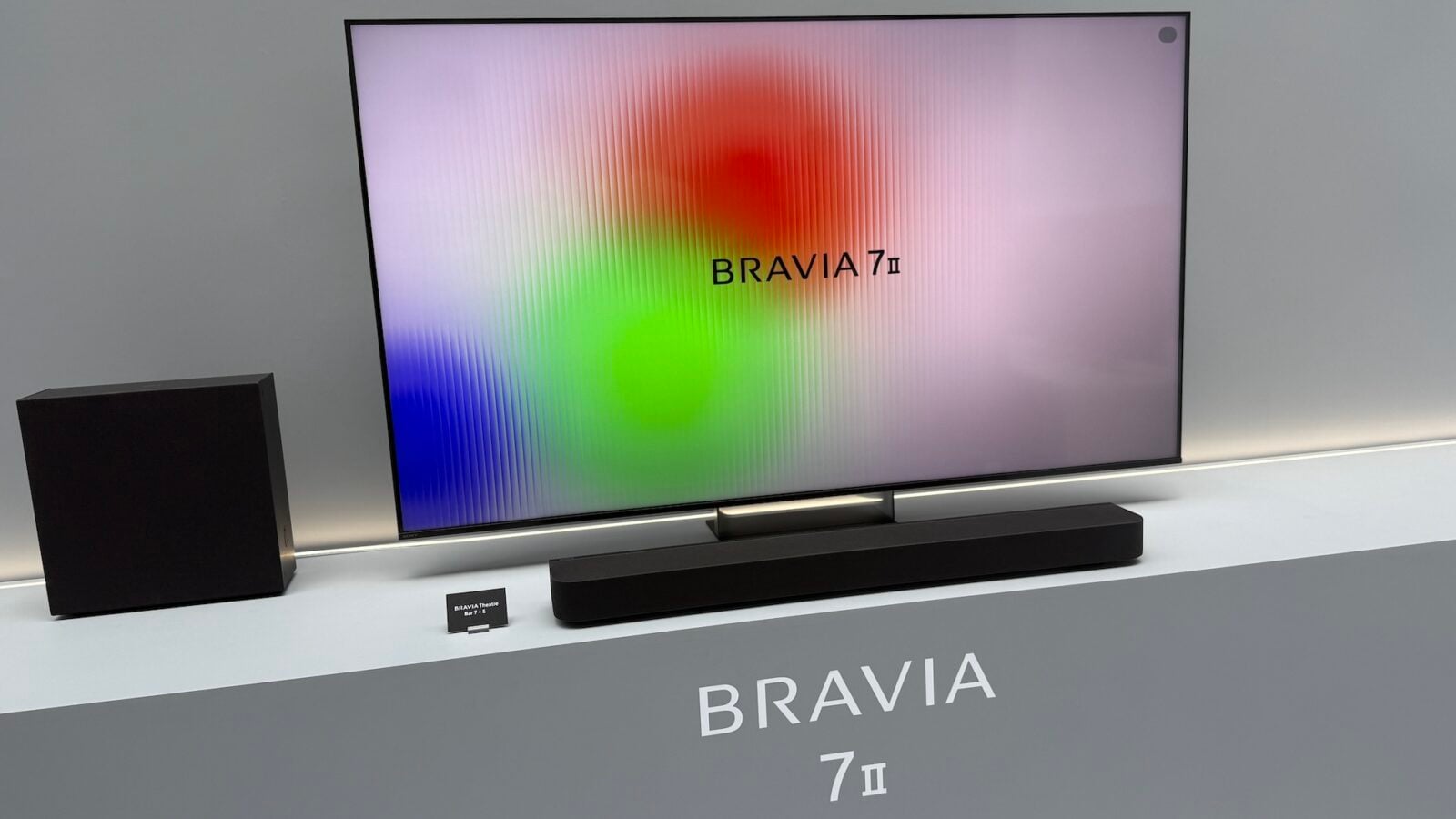
Sony’s Bravia 9 II and Bravia 7 II are official and they mark the Japanese manufacturer’s takeover of RGB LED technology. Before the test, here is an owner’s tour of Sony’s new televisions.
“Cinema comes to the home”: the promise is not new but this time Sony seems to really believe in it. The Japanese TV manufacturer does not intend to let the RGB bandwagon pass and announces the arrival of two models, the Bravia 9 II and its more accessible version, the Bravia 7 II. This formalization of RGB LED technology does not come out of nowhere, it is even a relatively old story at Sony which recalls that it had already taken the path of RGB LED in 2004 with a very atypical model, the Qualia 005.
Du LED RGB between 1,800 and 20,000 euros
More than twenty years later, we are no longer at the experimental stage and the new Bravia televisions are the perfect example. They fully enter the manufacturer’s catalog, alongside the Bravia 8 II and the Bravia 8, which remain in OLED, but they will embody the top of the range and will be available in many more diagonals.
Thus, the Bravia 9 II, the premium model will be available in 65, 75, 85 and 115 inches. If the price of the small diagonal remains at conventional heights (2,999 euros), the 115-inch version will undoubtedly require a call to your banker since it will be marketed at 19,999 euros.
As for the more “accessible” version, the Bravia 7 II, it will be available in 50, 55, 65, 75, 85 and 98 inches with prices ranging between 1,799 euros and 6,000 euros.
New technological standard
At this pricing level and in the face of OLED technology which continues to progress, it will obviously be necessary to demonstrate all its performances.
To achieve this, the Bravia 9 II and 7 II will therefore feature a True RGB LED panel made up of red, green and blue LEDs controlled independently. Consequence: the backlighting uses these LEDs instead of white light, which improves color accuracy.
To this substantial advantage, Sony adds its RGB Blacklight Master Drive Pro technology which allows the television to precisely control each LED, which improves brightness, but also contrast. In addition, this process makes it possible to considerably reduce the blooming effect. As for the viewing angles, they are also controlled even when you are not in the axis of the TV.
Up to 115 inches
But the last advantage, undoubtedly one of the most interesting compared to OLED and even mini-LED, is the possibility of obtaining much larger diagonals. Thus, while RGB LED technology in its commercial version is only in its infancy, the manufacturer is pushing the slider up to 115 inches, while guaranteeing unprecedented image precision and color fidelity.
A well-armed Bravia 7 II
Finally, the question that necessarily arises is that of the compromises of the Bravia 7 II compared to the best equipped model, the 9 II. These can be found on the image side of course with the absence of RGB Triluminos Max technologies and Luminance Booster Pro (understand: the light peak will be lower). Finally, the cheapest model will not include the surface treatment which allows it to compete with the anti-reflective filter of competing TVs, Samsung in the lead. Last compromise: it is on the sound, the Bravia 9 II embedding a much more ambitious audio system.
👉🏻 Follow tech news in real time: add 01net to your sources on Google, and subscribe to our WhatsApp channel.