By using this site, you agree to the Privacy Policy and Terms of Use.
Accept
World of SoftwareWorld of SoftwareWorld of Software
  • News
  • Software
  • Mobile
  • Computing
  • Gaming
  • Videos
  • More
    • Gadget
    • Web Stories
    • Trending
    • Press Release
Search
  • Privacy
  • Terms
  • Advertise
  • Contact
Copyright © All Rights Reserved. World of Software.
Reading: We had been ignoring the most “boring” stars for years. It turns out that they hide a treasure of nearby exoplanets
Share
Sign In
Notification Show More
Font ResizerAa
World of SoftwareWorld of Software
Font ResizerAa
  • Software
  • Mobile
  • Computing
  • Gadget
  • Gaming
  • Videos
Search
  • News
  • Software
  • Mobile
  • Computing
  • Gaming
  • Videos
  • More
    • Gadget
    • Web Stories
    • Trending
    • Press Release
Have an existing account? Sign In
Follow US
  • Privacy
  • Terms
  • Advertise
  • Contact
Copyright © All Rights Reserved. World of Software.
World of Software > Mobile > We had been ignoring the most “boring” stars for years. It turns out that they hide a treasure of nearby exoplanets
Mobile

We had been ignoring the most “boring” stars for years. It turns out that they hide a treasure of nearby exoplanets

News Room
Last updated: 2026/03/16 at 3:18 AM
News Room Published 16 March 2026
Share
We had been ignoring the most “boring” stars for years. It turns out that they hide a treasure of nearby exoplanets
SHARE

The hunt for exoplanets in the universe has always depended on our ability to observe the invisible. Until now we have mainly noticed the flickering of a star when it passes in front of one of these planets or the subtle gravitational wobble that it causes, but we have never seen them directly. Now a team of astronomers has perfected a much more ingenious method: searching for planets based on the “false” magnetic quiet of their stars.

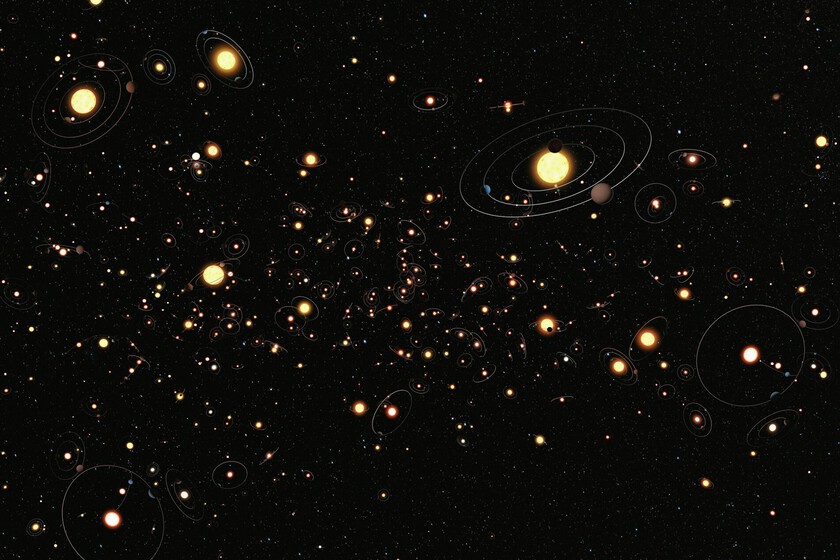
And now it works. The project known as the Dispersed Matter Planet Project (DMPP) has just confirmed the discovery of seven new planets spread across five star systems, and its projections indicate that there could be hundreds of rocky worlds hidden in our closest cosmic neighborhood. And we have not been able to ‘see’ all of these with our traditional systems.

How it works. The DMPP method is fascinating because it turns the traditional way of observing the universe on its head. Now, instead of looking for active stars, the team selects bright, very nearby stars that have anomalously low calcium emission. In fact, they show levels of magnetic activity below their basal level.

But these samples do not indicate that the star is without activity, but rather that it is hidden. Here astronomers have discovered that these systems host planets very close to the star, which due to the intense heat are evaporating. From this gas that is released from these worlds, a kind of ‘shield’ or orbital cloud is formed that absorbs radiation and hides the activity of the stellar chromosphere. That is, the star’s apparent inactivity is the gas “fingerprint” of a disintegrating planet.

Its precision. To confirm these suspicions, the team does not stop at observing the gas, since it uses extremely high-precision radial velocity spectrographs such as HARPS-N, which are capable of measuring minute variations in the movement of the star.

One of the project’s most intriguing case studies is the DMPP-4 system, located about 25 parsecs away. In this star, candidates for planets with sub-Neptunian masses have already been detected, on the order of between 8 and 12.2 times the mass of the Earth, orbiting at breakneck speeds, with “years” that last only between 2 and 5 days.

Where are they? These planets inhabit what astronomers know as the “Neptunian Desert,” a region very close to the star where planets the size of Neptune are rarely found. The leading theory is that these worlds are actually rocky cores of ancient Neptunes that migrated into the system and whose atmospheres were swept away by intense stellar radiation.
The origin of Saturn's rings has always been a mystery: a collision of moons 100 million ago wants to solve it

Many to discover. The implications of this study are massive for modern astrophysics, as data from the DMPP project suggests that between 10% and 20% of these low magnetic activity stars could host compact systems of rocky planets that we have not known about until now. This not only helps explain certain anomalies in the historical catalogs of the Kepler telescope, but gives us a treasure map.

Being such bright star systems close to Earth, these newly discovered exoplanets become the perfect candidates to be observed by the James Webb Space Telescope (JWST) and the future generation of Extremely Large Telescopes (ELT).

Images | NASA Hubble Space Telescope

In WorldOfSoftware | A new “solar system” has just been discovered. There’s just one problem: it shouldn’t exist.

Sign Up For Daily Newsletter

Be keep up! Get the latest breaking news delivered straight to your inbox.
By signing up, you agree to our Terms of Use and acknowledge the data practices in our Privacy Policy. You may unsubscribe at any time.
Share This Article
Facebook Twitter Email Print
Share
What do you think?
Love0
Sad0
Happy0
Sleepy0
Angry0
Dead0
Wink0
Previous Article This talking robot wants to escape the uncanny valley This talking robot wants to escape the uncanny valley
Next Article Xiaomi 17 Pro to Feature 50MP Leica Triple-Camera System and Rear Display · TechNode Xiaomi 17 Pro to Feature 50MP Leica Triple-Camera System and Rear Display · TechNode
Leave a comment

Leave a Reply Cancel reply

Your email address will not be published. Required fields are marked *

Stay Connected

248.1k Like
69.1k Follow
134k Pin
54.3k Follow

Latest News

Not a fan of Liquid Glass? This isn’t the news for you
Gadget
The classic Apple Macintosh mouse inspired Spigen’s retro AirPods case
News
If You Don’t Have One, I Recommend a Free Dark Web Monitoring Service
Gadget
ClickFix Campaigns Spread MacSync macOS Infostealer via Fake AI Tool Installers
Computing

You Might also Like

Agent Computer, AMD’s local AI platform
Mobile

Agent Computer, AMD’s local AI platform

4 Min Read
This talking robot wants to escape the uncanny valley
Mobile

This talking robot wants to escape the uncanny valley

3 Min Read
the exhibition ended with the plane in flames
Mobile

the exhibition ended with the plane in flames

7 Min Read
On paper they look very similar, but experience tells a different story
Mobile

On paper they look very similar, but experience tells a different story

4 Min Read
//

World of Software is your one-stop website for the latest tech news and updates, follow us now to get the news that matters to you.

Quick Link

  • Privacy Policy
  • Terms of use
  • Advertise
  • Contact

Topics

  • Computing
  • Software
  • Press Release
  • Trending

Sign Up for Our Newsletter

Subscribe to our newsletter to get our newest articles instantly!

World of SoftwareWorld of Software
Follow US
Copyright © All Rights Reserved. World of Software.
Welcome Back!

Sign in to your account

Lost your password?