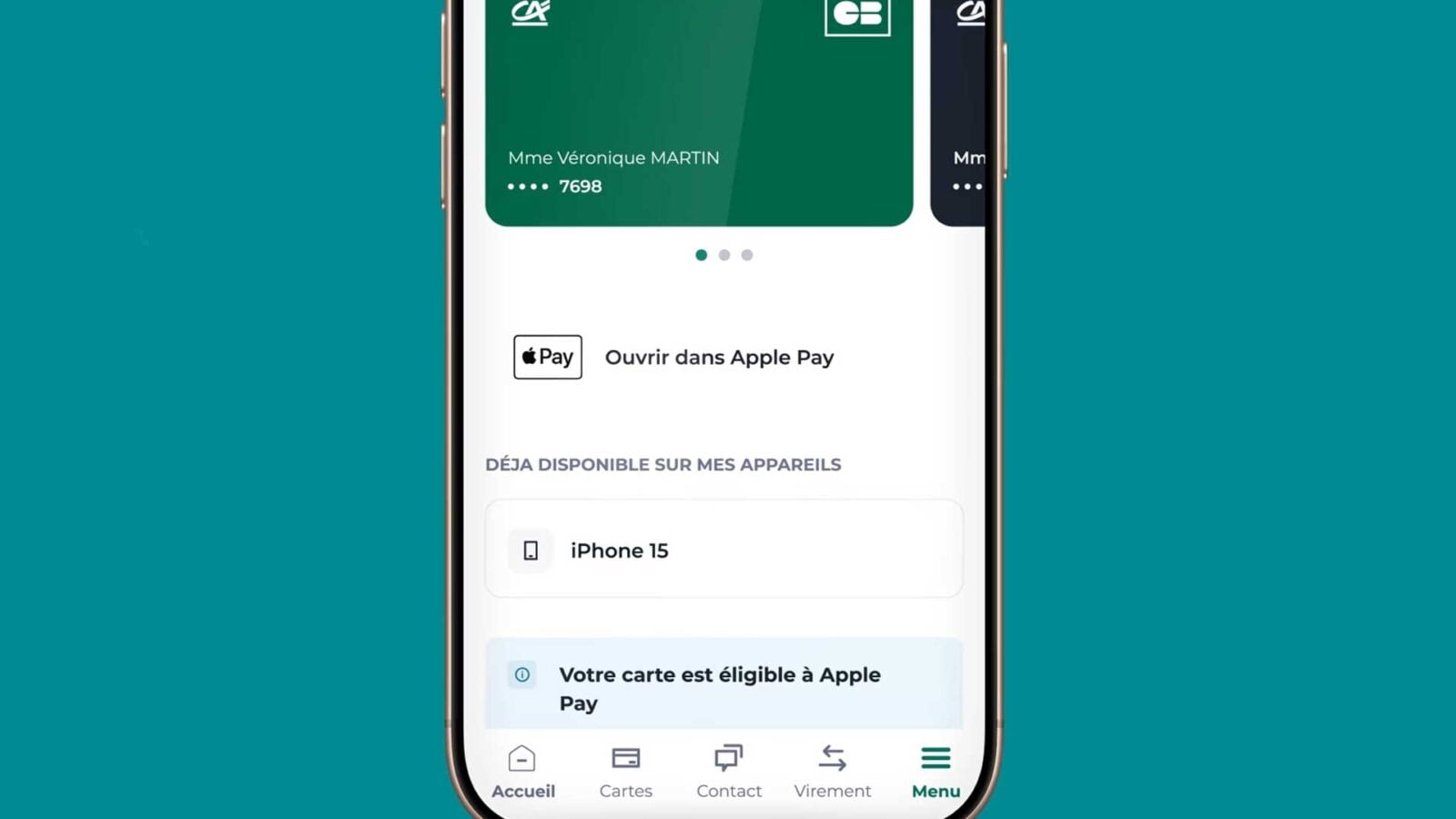
Crédit Agricole becomes the first French bank to do away with Apple Pay on iPhone by launching its own contactless payment application. A freedom permitted by Europe, but which hides heavy constraints.
It’s a huge problem that no one saw coming. Without any prior official communication, Crédit Agricole has just put a major update of its application online on iOS, entirely independent of Apple Pay. As noted by our colleagues at iGeneration, this software called Mobile Payment is now presented as a French alternative for paying for purchases in store. The banking establishment thus becomes the very first in France to attempt the adventure of software emancipation against the Cupertino giant. A technical and political maneuver which nevertheless promises to be complex for daily users.
How does the Crédit Agricole alternative work?
Concretely, the application functions as a substitute digital wallet. Once your Crédit Agricole bank cards have been registered in the interface and Face ID access has been configured, the application requests authorization to use the smartphone’s NFC chip. To simplify the lives of its customers, the bank is taking advantage of the new iOS options allowing the default contactless application to be modified via the iPhone settings. From then on, a double-click on the side button of the device will no longer open the Apple Cards (Wallet) application, but will directly launch the Crédit Agricole Mobile Payment application to validate the purchase on the merchant’s terminal.
This technical revolt is not by chance and is the result of a long regulatory standoff. In the summer of 2024, the European Commission obtained from Apple the opening of NFC access on iPhone for third-party services, in order to allow competition to exist in contactless payment. Since then, initiatives have remained timid in Europe, apart from a few major tests carried out by giants like PayPal in Germany. Crédit Agricole is the first to take the plunge in France, with the objective of offering an in-house alternative to its customers.
Why user experience may suffer
While the initiative is laudable in terms of competition, it comes up against heavy technical and ergonomic barriers. Apple has opened its NFC chip, but only via HCE software mode (Host Card Emulation). Unlike Apple Pay, Crédit Agricole does not have access to Secure Elementthis secure hardware component specific to the iPhone which validates transactions instantly. As a direct consequence, payments may be a little slower, and the number of transactions possible when the phone is offline and without a network is limited.
Bye bye Wallet. Crédit Agricole is launching its own mobile payment app on iPhone. pic.twitter.com/KLuYRvJBGI
— Stéphane Moussie (@stephmouss) June 23, 2026
Software fragmentation also promises to be painful on a daily basis. The Crédit Agricole application can only accommodate cards from its own network. A user with accounts in several establishments will therefore have to configure as many different applications and juggle them manually in the iPhone settings, where Wallet centralized absolutely everything. To make matters worse, the European agreement does not concern the Apple Watch. Finally, unlike Apple’s native solution, Mobile Payment does not integrate with the quick purchase buttons of merchant sites on the web.
Contacted, Crédit Agricole refused to specify whether it intended to maintain Apple Pay in parallel in the long term or to gradually push its customers towards its in-house solution, simply indicating that official communication would take place very soon. In the meantime, if Europe has won an ideological battle, customers risk finding this ergonomic step back particularly tedious.
👉🏻 Follow tech news in real time: add 01net to your sources on Google, and subscribe to our WhatsApp channel.

By: Opera