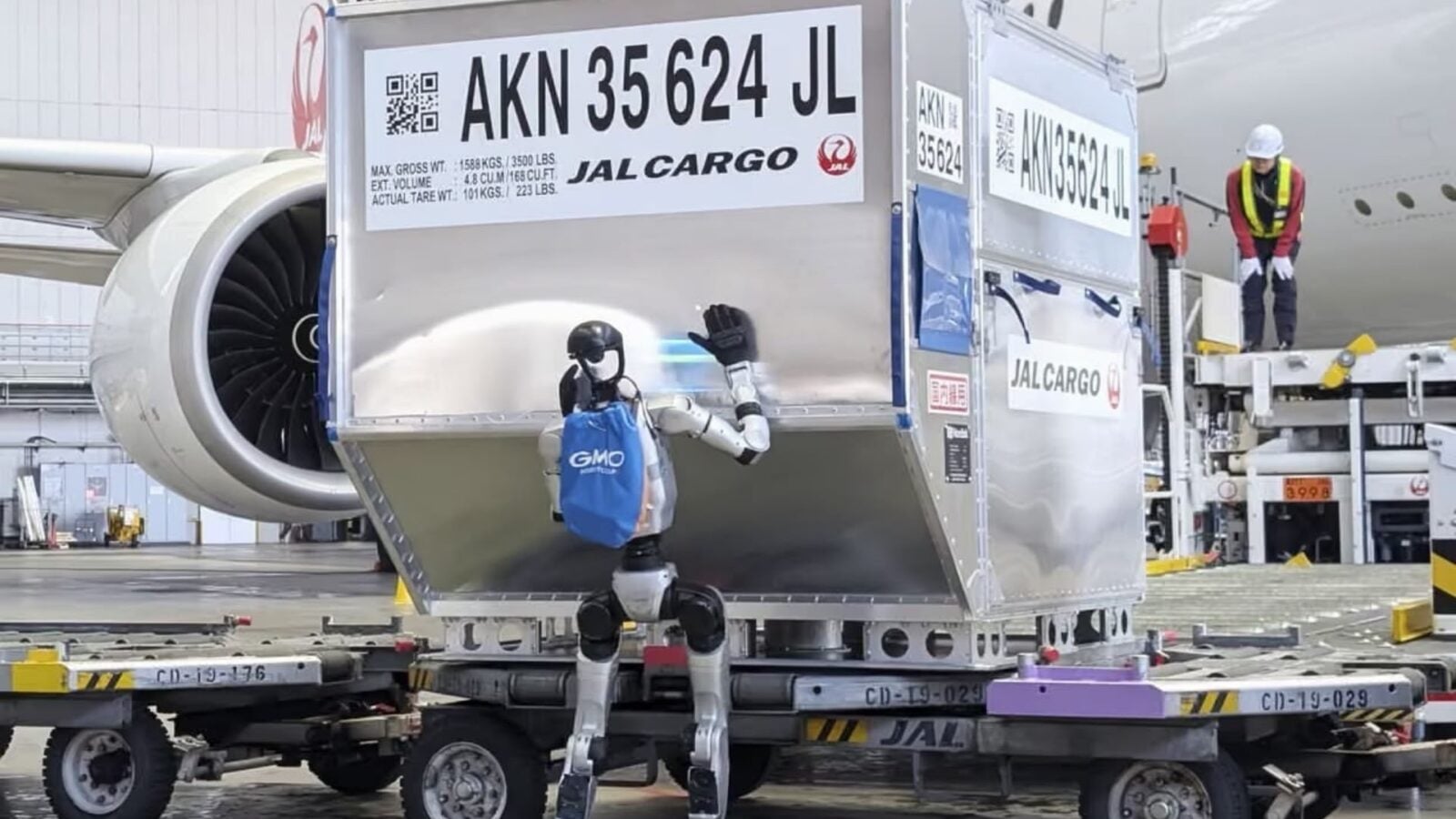
One meter thirty-two, thirty-five kilos and two hours of autonomy. The new baggage handler at Tokyo airport needs neither a break nor an employment contract.
The country that invented Asimo now outsources its humanoid robots to China. Japan Airlines will launch an experiment on the Haneda tarmac in Tokyo in May. Bipedal robots manufactured by Unitree Robotics (Hangzhou) will move luggage and freight to the loading belts. This is a first for a Japanese airport.
In a demonstration to the press, a robot pushed a package onto a conveyor, then shook the hand of an employee. All with the stature of an eight-year-old child: 1.32 meters tall, 35 kg on the scale. The Unitree G1, sold from 16 000 dollars the unit, features 3D LiDAR and depth cameras. Its three-fingered hands manipulate objects with reasonable precision. Its autonomy caps at two or three hours per charge (roughly the time of a Tokyo-Seoul flight, to give a scale).
A multi-phase trial, not an immediate replacement
The experiment will be spread over two years. The first phase will consist of mapping areas of the tarmac where robots can safely operate alongside humans. Next will come tests in a simulated environment, then progressive deployment to real operations. JAL plans to eventually expand their role to cleaning aircraft cabins. The president of JAL Ground Service, Yoshiteru Suzuki, told the Kyodo agency that security tasks would remain the responsibility of humans. The robots will be limited to handling on the tarmac.
Read also: A robot lasts 8 hours in the factory at Siemens – this is the real breakthrough in robotics
Project partner GMO Internet Group has named 2026 the “first year of humanoids” and inaugurated a dedicated research laboratory in Shibuya in April. The company will develop movement programs adapted to airport constraints (restricted spaces, heavy equipment, variable weather conditions). We are still far from a fully automated tarmac, but the ambition displayed goes far beyond the communication effort.
Why Japan is the first to take the plunge
The answer lies in two figures. Japan welcomed 42.7 million foreign tourists in 2025a historic record, and aims for 60 million by 2030. Haneda alone handles around 60 million passengers per year. At the same time, the working age population continues to shrink. The country may need 6.5 million foreign workers by 2040 to keep its economy afloat. The airline sector, physically demanding and poorly paid, is one of the first to drop out.
The use of humanoid robots rather than traditional automated systems (conveyors, autonomous vehicles) can be explained by the very nature of ground work. Handling operations take place in irregular spaces, around equipment designed for human bodies. A bipedal robot, even a modest one, adapts better than a cart programmed to drive in a straight line.
The problem is not only Japanese. French airports experienced comparable tensions after Covid: up to 4,000 vacant positions on the Orly and Roissy platforms, according to the unions. Cascading delays weighed on all European traffic. The question of ground services automation will eventually arise on this side of the globe. She will just pose with a different accent.
👉🏻 Follow tech news in real time: add 01net to your sources on Google, and subscribe to our WhatsApp channel.
Source :
Engadget