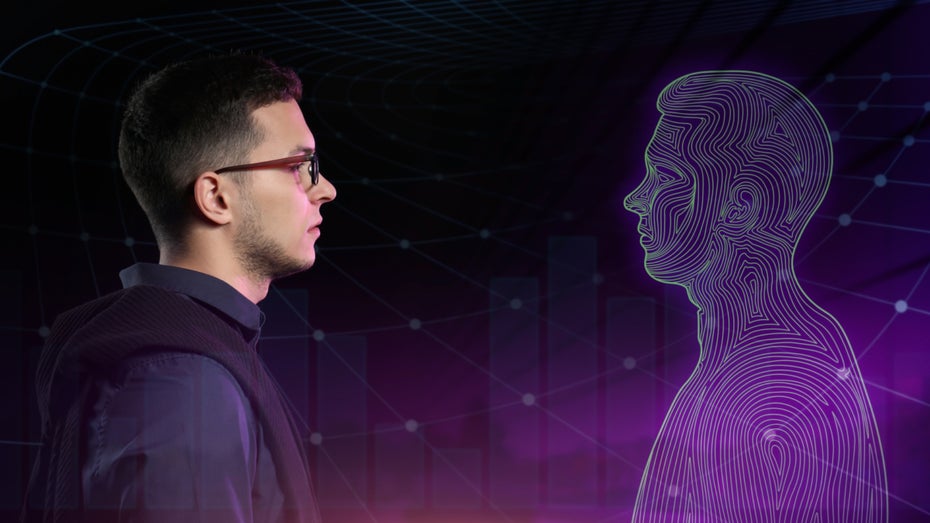
Conway’s Law is a Hermetic principle. It just wears a different costume in the cloud.
Every time we draw a boundary in software, we are making a claim about the nature of reality.
When engineers build large-scale applications today, we rarely build one massive, monolithic block of code. Instead, we break the problem apart. We define domains. We draw a line around a specific piece of the puzzle—say, Order Management or Inventory—and we give it a boundary. We give it its own local memory, a strict set of rules for how it talks to the outside world, and the authority to govern its own little corner of the universe.
We build a wall that mediates everything flowing in and out. Sensory inputs (requests) on one side, actions (responses) on the other, and internal states hidden safely away from everyone else.
Whether we realize it or not, we are building biology. We are making tiny, self-organizing universes and deploying them to servers.
The Holarchy We Already Built
In 1967, Arthur Koestler coined the term “holon” to describe something that is simultaneously a whole unto itself and a part of a larger whole.
A cell is a holon. It is complete, autonomous, and bounded. But it is also a component of an organ, which is a component of an organism, which is a component of an ecosystem. Each layer maintains its own boundary, its own internal logic, and its own rules for survival. Each layer is nested inside the one above it.
If you’ve ever looked at a modern software architecture diagram—with software containers running inside pods, grouped into namespaces, running across massive server clusters—you’ve mapped out a holarchy. The pattern recurs fractally, whether you’re looking at a cloud infrastructure dashboard or a histology slide.
The structural symmetry between cloud infrastructure and biological organisms. The same blueprint running on different substrates.
Karl Friston, a theoretical neuroscientist, popularized a concept called the Free Energy Principle, which argues that any system that persists over time does so by maintaining this exact kind of boundary (a Markov blanket). To stay alive, the system must constantly predict its environment and act to minimize the difference between what it expects and what it actually encounters.
It’s an elegant way of looking at biology. But if you’ve ever spent a weekend trying to keep a struggling software platform online, it’s also a perfect description of a distributed system.
How Systems Stay Alive
In software engineering, we have concepts like SLOs (Service Level Objectives). An SLO is basically a promise of what “normal” looks like—for instance, “this service will return an answer in under 200 milliseconds.”
In biological terms, an SLO is a generative model. It is the system’s baseline expectation for a healthy environment.
When traffic spikes and response times shoot up to 850 milliseconds, the system experiences prediction error. Reality is no longer matching the model. Friston calls this “surprise” or “free energy.” In an engineering control room, we just call it an incident.
What happens next is the interesting part. A well-designed system will reflexively act to protect itself, just like a biological organism.
- If a service is overwhelmed, it might trip a circuit breaker—a piece of code that temporarily stops sending traffic to a failing component, giving it time to recover. (Your body does this by withdrawing your hand from a hot stove).
- It might use exponential backoff, slowing down its attempts to talk to a broken system. (Your body does this by reducing your heart rate when you hold your breath).
- It might trigger an autoscaler, spinning up ten more servers to handle the load. (Your body does this by sweating to regulate temperature).
We aren’t just writing scripts. We are designing nervous systems. The main difference is that ours have runbooks.
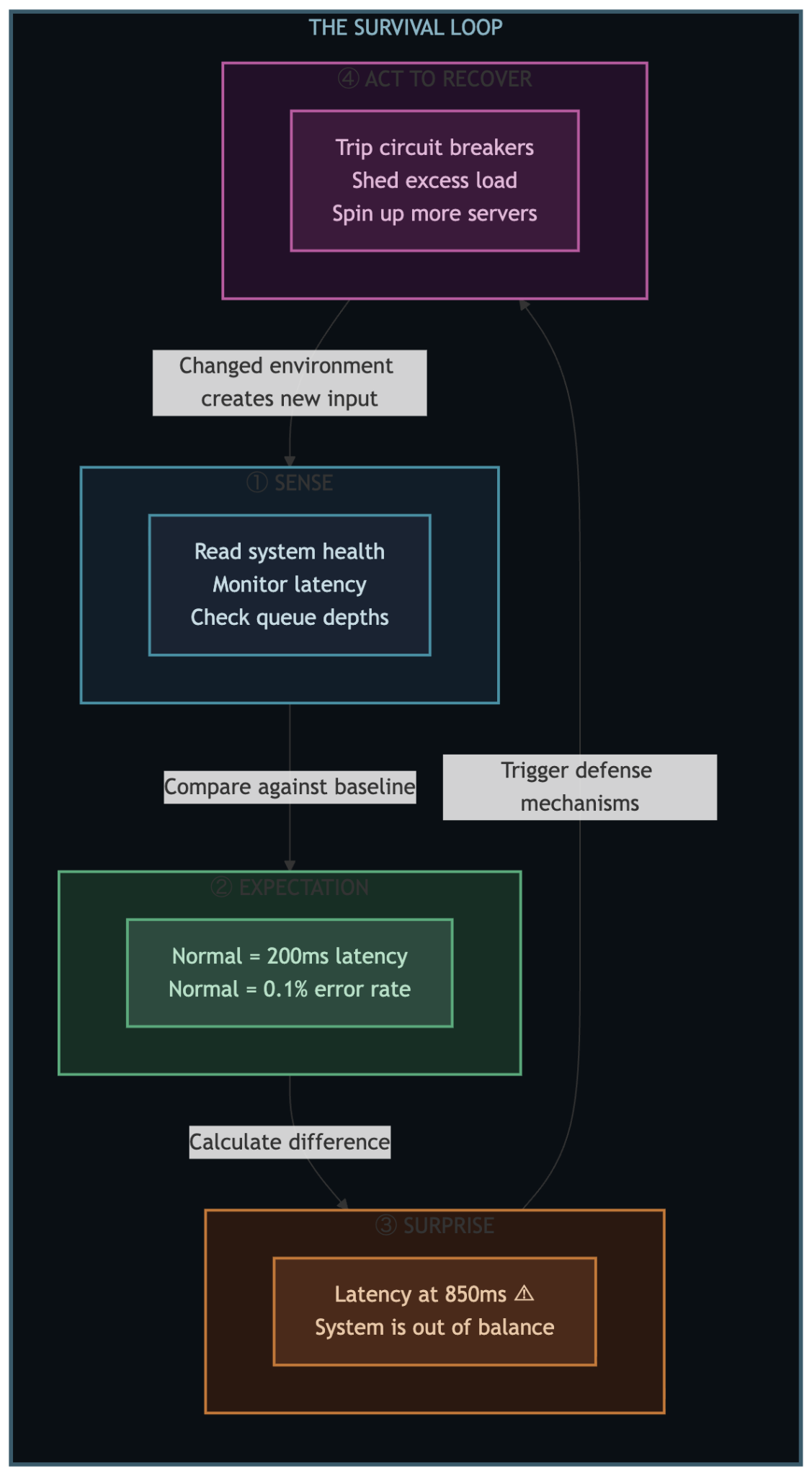
The survival loop. Engineering’s incident response maps directly to biology’s active inference cycle.
Figure 2: The survival loop. Engineering’s incident response mapping directly to biology’s active inference cycle.
The Membrane
In the tech industry, we constantly quote Conway’s Law: Organizations design systems that mirror their own communication structures.
But the implication runs deeper than corporate org charts. The structure of your software mirrors your assumptions about how information flows, where authority lives, and what happens at the edges where two different worlds collide.
Those edges—the API gateways where different services talk to each other—are the membranes of our digital cells.
When the Order Management system sends a message to the Inventory system, neither has access to the other’s internal brain. They can only interact through the boundary. And the friction at that boundary—data formats not matching, systems timing out, software versions colliding—is biological friction. It is the friction of two separate organisms trying to coordinate their models of the world.
Get those boundaries wrong—draw the lines in the wrong place—and you get a system at war with its own assumptions about where reality comes apart. Get them right, and the system almost breathes. It becomes resilient in ways you didn’t explicitly design, because the architecture has found the natural joints of the problem.
The Quiet Part
The Hermetic tradition—a philosophical lineage running quietly from late antiquity into the foundations of Western science—has a core axiom: as above, so below. The pattern at one scale recurs at every other.
Most engineers are materialists by default and mechanics by training. We don’t think of ourselves as making metaphysical commitments when we split a large database into smaller pieces. But every system design is a theory about where the seams of the world are.
The principles governing a well-designed piece of software are the same principles governing a forest ecosystem or a cellular membrane. The math doesn’t care whether it is running on meat, on wood, or on silicon.
Your architecture is a cosmology. Whether you meant it to be or not.
As Above is a reader-supported publication. To receive new posts and support my work, consider becoming a free or paid subscriber.