Dear Engineer,
Software should not evolve in the blink of an eye; it should be a careful, methodical beast that steadily improves and makes incremental progress, with fast shifts only when necessary to benefit the user. I say this not to justify bureaucratic procedure, nor to suggest that implementation should take longer than necessary, and certainly not to argue against adopting genuine advancements, but to argue for the importance of timelessness both in the solution and the problem being solved. Any project worth pursuing is valuable not just today, next week, or even next year; no, projects worth pursuing stand the test of time because they address deeply human needs with sustainable and sensible designs. Meaningful pursuits do not decay, for they are based on a simple truth: We are fundamentally the same people we have been since the dawn of the Neolithic era, and the day we traded spears for gardens was the day we stepped out of the rat race. We earned the right to deliberate and consider when we stopped chasing game and started building civilization.
To the discerning engineer, software need not constantly pivot towards new market opportunities and novel approaches; it can instead provide sustainable value and grow as needed. New technologies present opportunity for growth and improvement, certainly, and should be assessed for assimilation into a broader ecosystem, one which serves the core needs and desires of humanity, but they need not be pursued at all costs. It is simply a matter of designing and building in a way that puts the needs of the user first, allows change as the environment evolves, and is resilient to errors. It requires deep consideration, premeditation, and care for edge cases and divergent futures. All this is not to say we should design everything up front and plan for all eventualities in advance, but to suggest that we should build in a way that is ready for change, spend time being cautious, and tether our designs to the permanence of human nature. Prudence and conscientiousness are virtues, and engineers would do well to practice them.
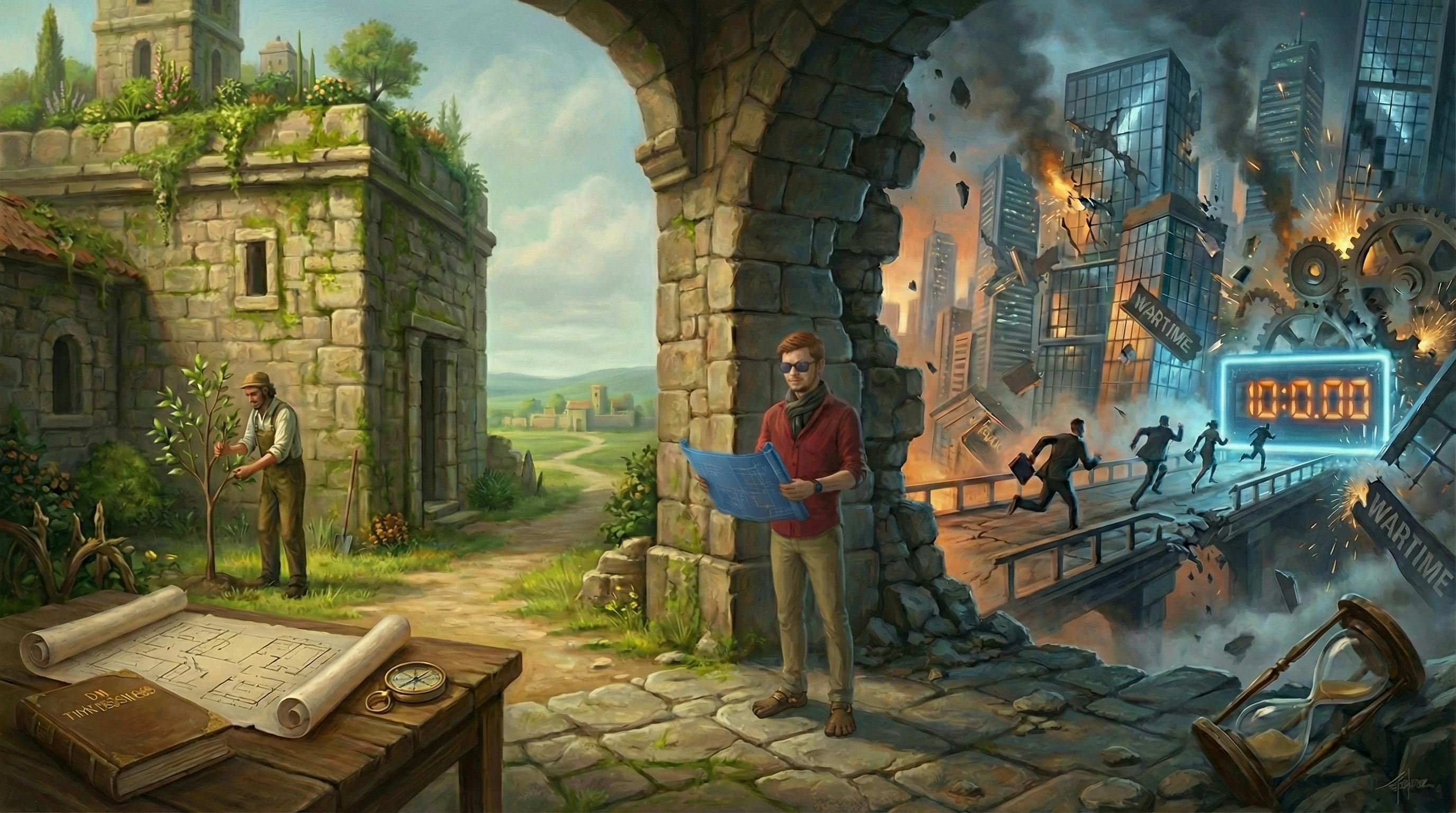
If building for a millennium is possible though, what drives the software industry towards short-term gains? The answer is multifaceted, but one answer can be found in rhetoric, for example, the appeal to narrative. Circa 2022, when AI was becoming popular, a term began appearing around me in software engineering circles: “wartime”. It was suggested that tech had entered into a period of war, and that “peacetime” was over. I heard people speak of it in various ways: some said Sundar Pichai and Tim Cook were excellent leaders in peacetime, but terrible leaders in wartime; while others described it as part of a cycle that never ends, with peace and war behaving like seasons; and a few said peacetime was never truly here, that the nature of business is to be at war with other companies. As the sentiment spread, the virtues of peaceful cooperation were quickly forgotten, and the spirit of conflict replaced the joy of collaboration. Years of investment were wasted as companies let go of skilled individuals and cancelled critical projects for no particular reason. As it continued for months, I grew to look at those espousing the virtue of war and wonder whether they had been playing too many video games, for there is very little about the modern world that requires war, and virtually nothing about the tech industry that mirrors it.
A real war is a terrible failure of morality, and none of the software engineers I have ever known would survive in one, which brings us to the question: why the obsession with violent conflict? I suppose a cynical answer is somewhat obvious: In true peacetime, detached from real protracted inter-state violence, people can easily romanticize war as a heroic adventure, yearn for victory over a worthy adversary, and desire the glory of conquest. It’s understandably human, for those who have never known pain have no reason to fear sharp objects, but the appeal of war and its comparison to business is pure fiction. War is not a time when profits are down and competition is fierce; no, war is nothing more than missing parents, dead children, and ruined dreams. It destroys decades of progress, sows wounds that take generations to heal, and leaves nothing but misery in its wake. It should not be taken lightly, and comparison with business should be avoided out of respect for the senseless victims of war. Virtue aside, businesses profit because peace permits innovation, and we have no need to be at war, ever, whether literal or figurative, so where does the delusion of the necessity of war come from?
When I hear people who have never seen the horrors of war longing for a conflict they would not survive, desperately seeking to make peacetime more exciting than it really is, I smell others using a flight of fancy as a means of control. I would encourage all those who enjoy peace and shared prosperity to hope they never see an actual war, to question the motivations of individuals who use such narratives to achieve their goals, and to ask: Who profits when people fight, and who wins when people suffer? My research suggests the sentiment of wartime traces back to various venture capitalists, all echoing the same message: Business is war, greed is good, and employees are disposable. It is those individuals (or “leaders”, as some call them) who we should examine: the ones who use psychology and manipulation to distort reality for their own short-term gain, regardless of the cost to society at large. They profit from conflict, but are they truly to blame, and what drives the culture of extreme competition?
It makes little sense to blame employees for following the rhetoric of self-motivated individuals, but it would be equally erroneous to blame those who espouse the narrative, for they too are simply downstream of the real source. Ultimately the zeal for conflict comes from excessive greed, unchecked and unmediated by patience, and it prospers in any culture where the acquisition of wealth is valued over sustainable growth and shared prosperity. It must be understood, because building systems tethered to the fundamental and unchanging laws of human nature requires also acknowledging and mitigating the greed that lives in that system. Without shame or judgement, greed must be examined, acknowledged, and transcended.
Both resistance and capitulation are failure, and the only path forward is detachment. We must move past greed and all those who espouse it, for we do not live in a world where urgency is physically necessary. We evolved from a system, nature, which makes steady progress over millennia, builds systems that change as needed, and recovers from all hardship in due time. Excessive urgency, in contrast, is manufactured, and reinforces itself until we are all chasing our own tails to satisfy an artificial deadline without care for the long-term consequences. It benefits the few now at the expense of the many later, leaves discarded husks of genius behind it, and does nothing but ruin the creative spirit that powers innovation. You have the ability to build something beautiful if you are not ruled by greed, so do not be led astray from your potential by those who have sold theirs, no matter how much green they promise you. Their dollars are not worth your future, and you have a bigger role to play in the world than profit above all else. Build for everyone, including people living 1000 years from now, and enjoy missing opportunities that others chase without purpose or end.
To relate this all back to the original point, that software should be sustainable, and that care and consideration are the tools of longevity, we must remain eternally aware of the cause of rushing. Artificial deadlines and pressure to perform are the antithesis of sustainable development, and the greed that powers them must be understood and mitigated. I urge software engineers to think critically about the narratives they are sold by others, to consider what will happen after they, and the purveyors of those narratives, have turned to dust and been forgotten. Ask yourself: Who will benefit from your life, who will suffer, and what will be left standing when you are gone?
Sincerely,
Patience
n n