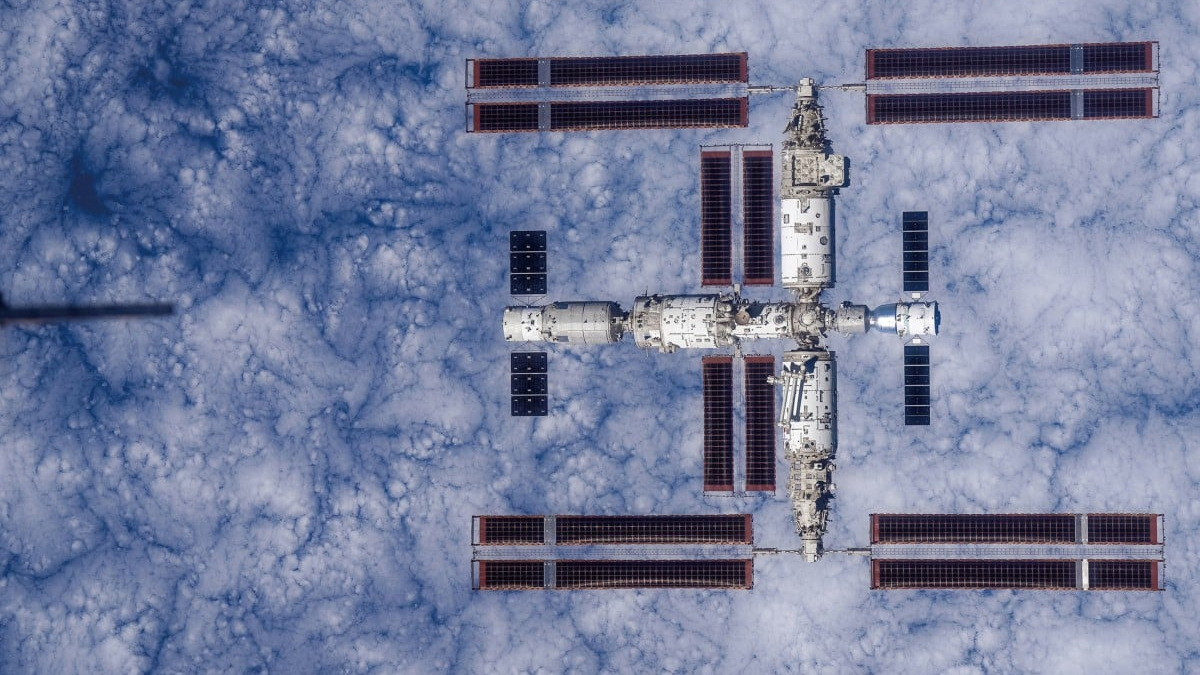
China has confirmed its plans to expand its Tiangong space station. Currently composed of three modules, the structure should increase to six modules, thus doubling its size to meet scientific demand and expand collaboration. A maneuver which comes at a time when the International Space Station (ISS) is approaching its end of life scheduled for 2031.
How will Tiangong Station be expanded?
The expansion will begin with the addition of a multifunctional module to the current heart of the station, the Tianhe module.
This fourth module, larger than the existing core, will transform the T-shaped configuration into a cross-shaped structure and have multiple docking ports, setting the stage for the addition of two future laboratory units.
The total mass of the station at six modules will then reach nearly 180 tons. To support this growth, improvements are planned, including a more powerful version of the Long March 5B rocket and refinement of the station’s robotic arms for more complex assembly tasks.
An already very active space laboratory
Completed in 2022, Tiangong station now offers a living space of approximately 110 m3. It is designed to accommodate three astronauts for long-term missions and up to six people during crew changes.
Since its commissioning, more than 260 scientific experiments were carried out there and the Chinese taikonauts have already broken a record with a spacewalk of 9 hours and 6 minutes.
International cooperation in low orbit?
With an expected lifespan of 15 years, Tiangong is positioned to become the only operational station in low orbit following SpaceX’s deorbiting of the ISS. Aware of this opportunity, China is opening its doors to international collaboration.
While an American law prohibits NASA from collaborating with China, Beijing is positioning Tiangong as a global laboratory. Astronauts from Pakistan, Hong Kong and Macau are expected to join missions this year.
N.B. : Source images : CMSA – South China Morning Post.