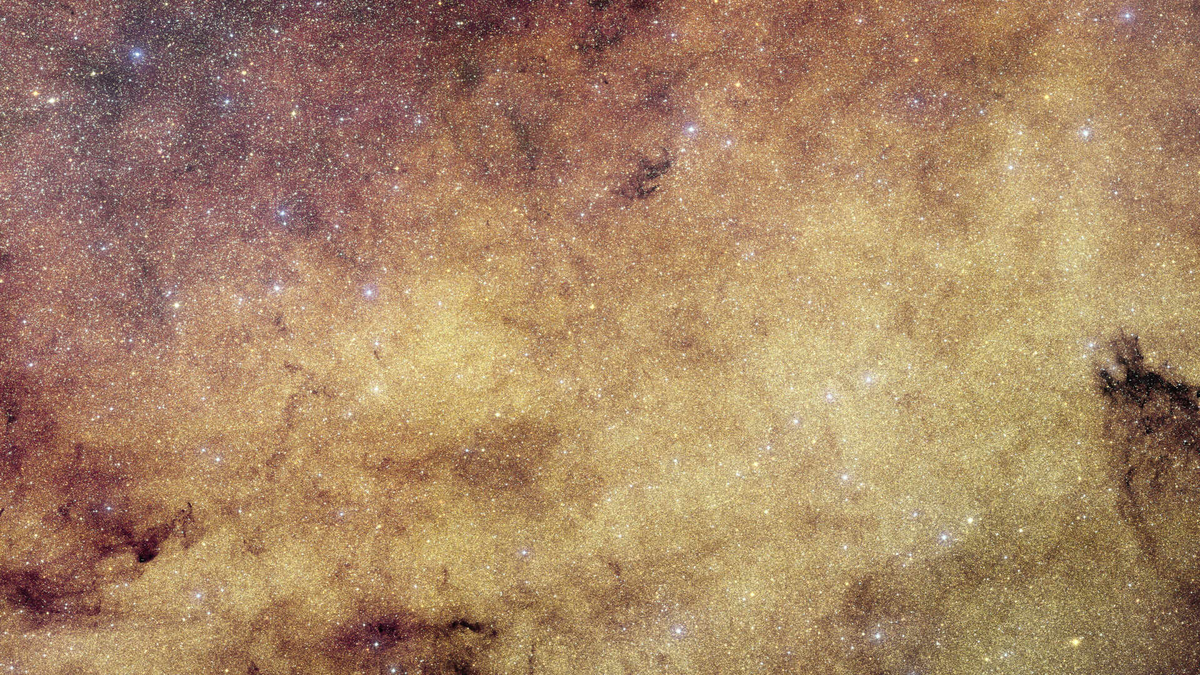
The space telescope Euclidflagship mission of the European Space Agency (ESA), delivered a spectacular image of our galactic bulbthe central and very dense region of the Milky Way.
Taken in just 26 hours on March 23, 2025, the mosaic of nine photos reveals more than 60 million stars with sharpness and sensitivity comparable to those of Hubble, but over an area 270 times larger.
An image for the hunt for exoplanets
A major advantage of such a cliché lies in its use for the method of gravitational microlensing.
This technique detects planets by observing how the nearest star acts like a cosmic magnifying glass, amplifying the light of a more distant star. The gravity of an orbiting planet causes an additional variation in this brightness, betraying its presence.
Jean-Philippe Beaulieu, of the Paris Institute of Astrophysics, points out that nearly 300 exoplanets have been discovered using this technique over the last twenty years. The Euclid snapshot already contains 51 known planetary systems and will be used to study many more.
In synergy with Nancy Grace Roman
The Euclid image is not intended to discover new microlensing events in real time, but to serve as a temporal reference point. It captured the state of the stars before they aligned.
So, when the future space telescope Nancy Grace Roman of NASA detects an event, astronomers will be able to compare the new data with those from Euclid.
Also from the Paris Institute of Astrophysics, Natalia Rektsini explains that this will make it possible to measure how quickly stars move, and therefore confirm the existence of a planet and determine its mass.
Broader scientific implications
The technique is particularly effective at finding cold exoplanets, a type of world that other methods struggle to detect. Beyond exoplanets, the data obtained can for example be used to study brown dwarfs or stellar movements within our galaxy.