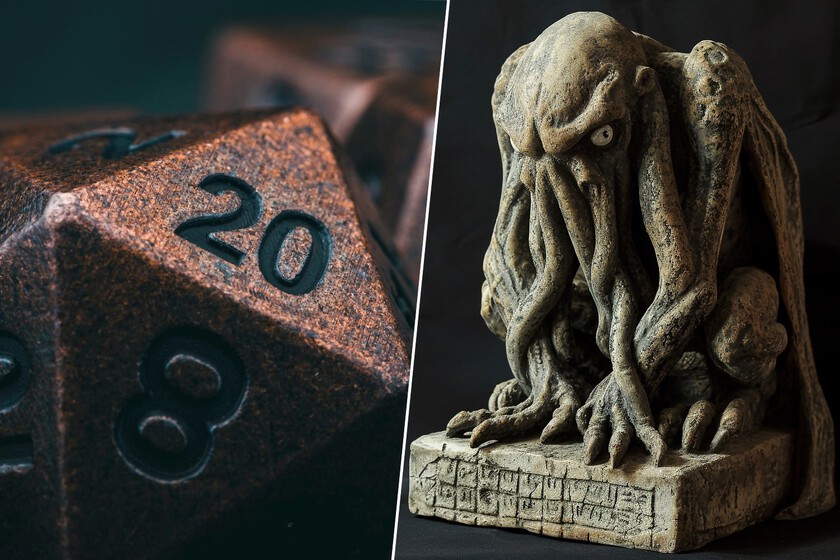
In ‘Dungeons & Dragons’ no one closes their eyes to a monster. Seeing it is synonymous with a confrontation (you can always run away, but without losing sight of it, just in case). But in the first test session of ‘The Call of Cthulhu’, in 1981, something unexpected happened: the players began to cover their eyes, hide in corners, run away up stairs. And that inspired him to reflect pure panic in his game.
The primal terror. When Sandy Petersen (zoologist by training, enthusiastic role-player, Lovecraft devotee since he was a teenager) was commissioned by Chaosium to develop a game based on the Cthulhu Mythos, horror role-playing games practically did not exist as their own genre. In 1981, the market was dominated by ‘D&D’ variants. There were terrifying monsters, undead, demons, but the mechanical framework was always the same: characters armed to the teeth who stoically absorbed the damage of their enemies. Fear had no representation in the rules.
The referent. The Lovecraft stories that inspired the game ‘The Call of Cthulhu’ demanded just the opposite. Its protagonists are not heroes: they are academics, journalists, doctors from the provinces who stumble upon a truth that the cosmos has been hiding for millions of years. The simple revelation of reality does not inject them with legendary courage to face these dangers, but rather destroys them. Translating that into a game system required new tools, new values to measure.
How it works. Whenever an investigator is faced with something his or her mind is not prepared to assimilate, the Game Master asks for a Sanity roll. The player rolls a percentile die (usually two 10-sided dice) and compares the result with his Sanity score: if he rolls equal or less, he passes the crash and loses a smaller number of points; If it fails, the loss is more severe. The Sanity score starts from a maximum value equivalent to the character’s Power characteristic multiplied by five and decreases throughout the game with each disturbing encounter.
When the loss in a single roll exceeds five points, the character suffers a crisis of temporary insanity: he may become paralyzed or develop erratic behavior that the Game Master dictates on the fly. If Sanity drops to zero, the character is permanently deranged and passes into the hands of the Director. There is a recovery mechanism (rest, therapy, certain successes in research) but the system is calibrated so that the trend is always downward.
How it was born. As Petersen explained, the direct inspiration for the Cordural mechanics was an article in the magazine ‘Sorcerer’s Apprentice’ in which the authors proposed a kind of mental stability statistic. If the character failed a roll, that statistic went down permanently. This idea of a statistic being reduced shocked him. He took the core idea, called it Sanity, made it the core of the game, and instead of lowering it only on rare occasions, decided that almost every encounter and event would lower it, until investigators could end up as mental ruins or even mindless monsters.
What happened. In the first game he led after developing the system, as he recounted in Petersen was taken aback: in ‘D&D’ no one would ever try to avoid looking at a monster, because seeing it implies information that could be useful.

At that moment he understood the true potential of the Sanity rules: they were not just another weapon in favor of monsters, but a mechanic that pushed players to behave in a way that fit this world they were building, a far cry from the fantasy in which ‘D&D’ monsters are almost everyday. Other systems could describe fear, but Sanity made players practice it.
Extreme sanity. Petersen’s initial version of Sanity was more extreme than the one that made it to the game: he initially decided that it could only decrease, never increase. It was those responsible for Chaosium who convinced him that this idea was too negative even in a game about Cthulhu. Petersen relented, but later discovered that the ability to regain Sanity makes the system more agonizing, not less, because it tricks players into believing they can save their characters. And we already know that that is very complicated.
The mansions of sanity. Since then, Sanity mechanics have influenced all subsequent role-playing horror. The first video game to explicitly pick up that heritage was ‘Eternal Darkness: Sanity’s Requiem’, whose crazy effects mechanic was patented by Nintendo in 2005. Eight years later, ‘Amnesia: The Dark Descent’ brought the mechanics to first-person horror for PC, where darkness and the sight of monsters drain mental stability with progressive visual and sound consequences.
Header | Photo by Timothy Dykes on Unsplash / Thomas Quine