What happens when your AI agent tries to buy a concert ticket, and 100,000 other AI agents, run by a single person, are attempting to do the same thing at the same moment?
That is not a hypothetical. It is the exact problem that World, the digital identity project co-founded by Sam Altman, is now building infrastructure to solve. On March 17, the company launched AgentKit in beta, a developer toolkit designed to let AI agents carry cryptographic proof that a real, unique human stands behind them. The product integrates with x402, an open payment protocol developed by Coinbase and Cloudflare, creating what World describes as a complete trust stack for the agentic web.
Why This Market Cannot Wait
The scale of what is being built around is significant. McKinsey estimates that agentic commerce could generate between $3 trillion and $5 trillion in global revenue by 2030, with the US B2C retail market alone representing up to $1 trillion of that figure. Bain projects that AI agents could account for 15 to 25 percent of all US e-commerce sales by the same year, a range of $300 to $500 billion in annual transactions.
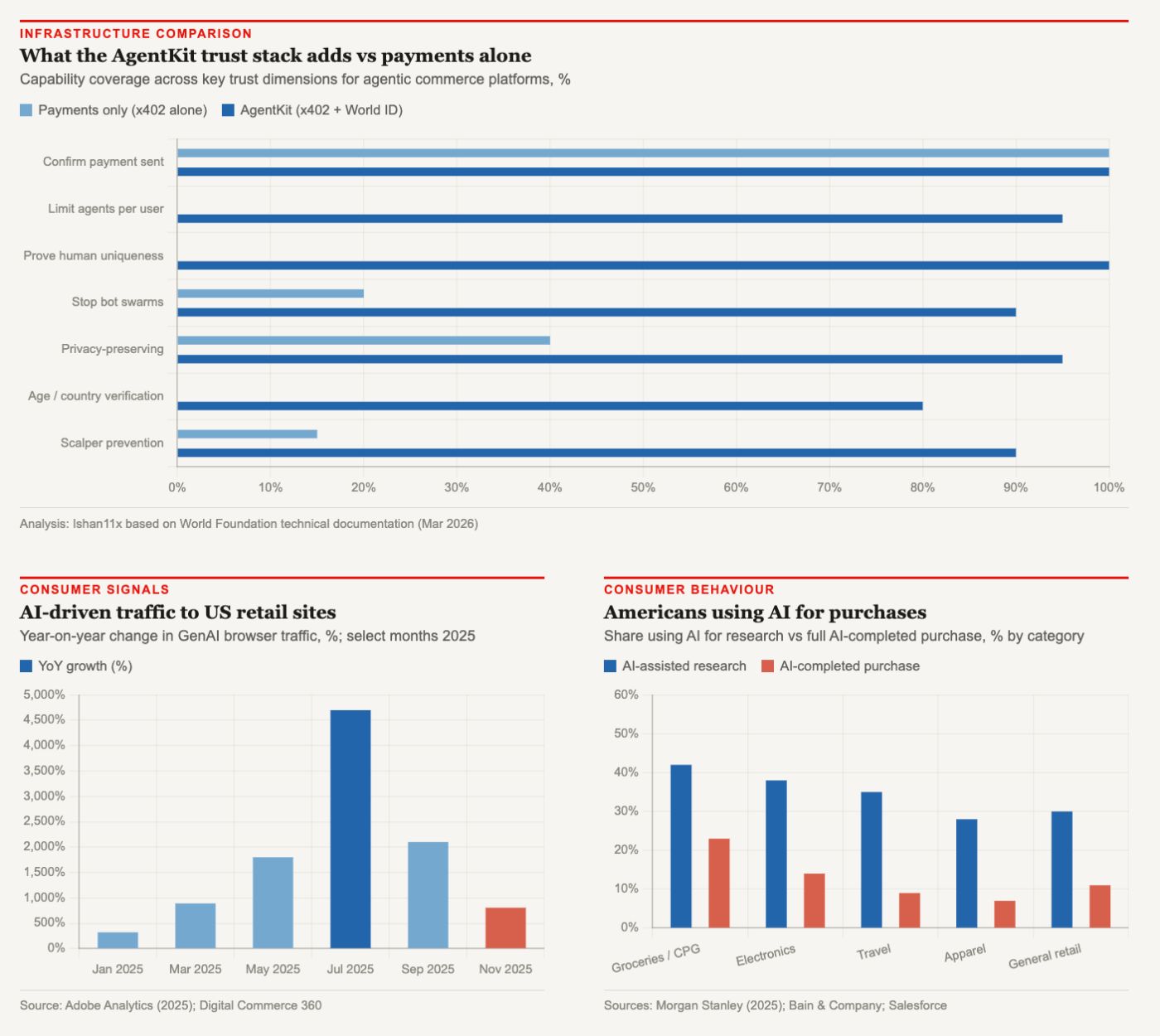
These numbers reflect a shift that is already underway. Adobe data shows that traffic to US retail sites from AI browsers and chat services increased 4,700 percent year-over-year in July 2025. Coinbase founder Brian Armstrong has said publicly he believes there will soon be more AI agents than humans making online transactions. Changpeng Zhao, founder of Binance, went further, predicting agents will make a million times more payments than people and that they will use crypto to do it.
The question of whether platforms will accept agent traffic at all, and on what terms, is one of the defining infrastructure decisions of the next three years. Federal courts have already entered the picture: earlier this year, a judge issued an order blocking AI developer Perplexity’s Comet browser from making purchases on Amazon on behalf of users, signaling that legal frameworks around agent-based commerce are forming in real time.
The Bot Problem That Payments Alone Cannot Fix
AI agents are already handling tasks once done by humans. They book restaurant tables, compare prices across retailers, pull data from APIs, and increasingly, initiate purchases. Platforms built for human traffic were not designed for this. Most websites treat automated requests as suspicious by default, and block them outright. Even when agents pay their way through, the identity question remains open.
DC Builder, Research Engineer at the World Foundation, explains,
One person could run thousands of agents that all pay small fees. Proof of Human addresses this gap by allowing websites to verify that an agent represents a unique person without revealing who that person is.
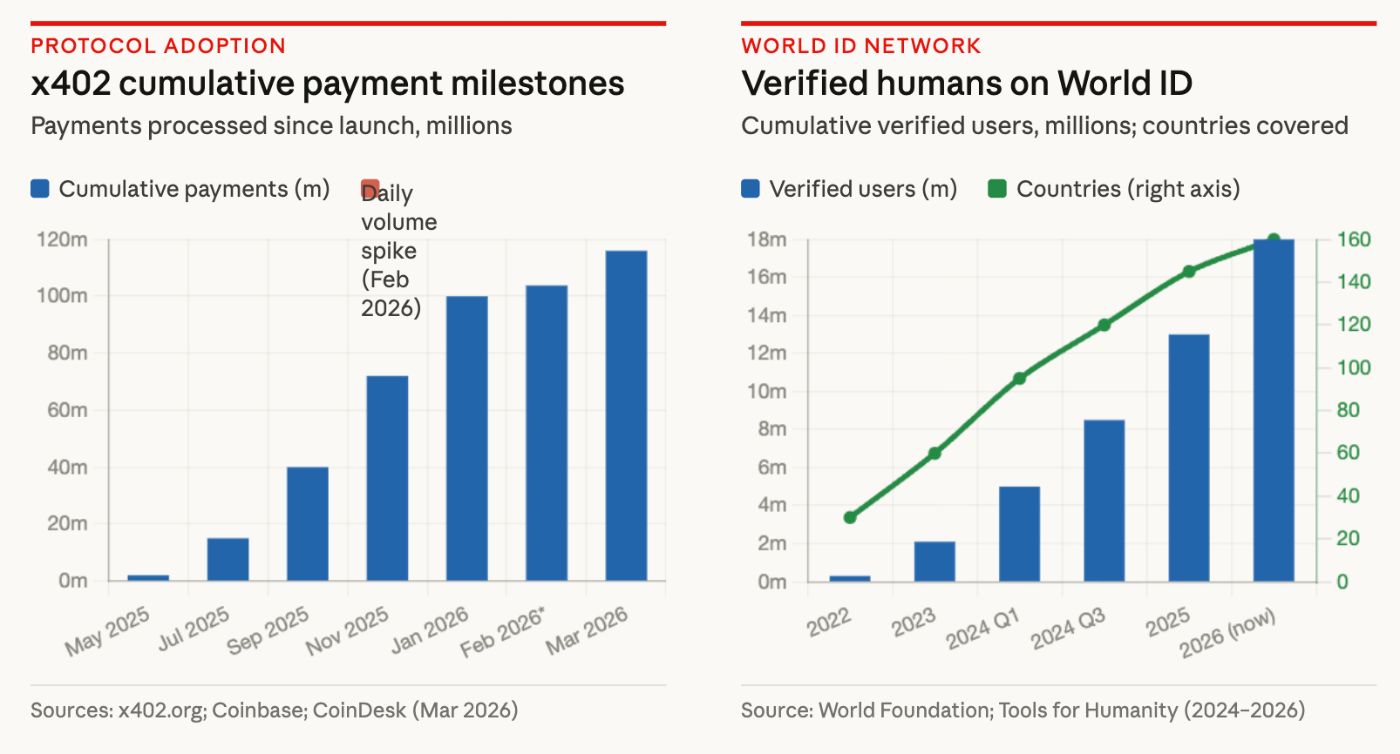
This is the core tension x402 addresses on the payment side. The protocol, which launched in May 2025, embeds stablecoin micropayments directly into the web’s standard HTTP communication layer, the same system your browser uses to load any website. When an AI agent requests a resource, the server responds with a 402 status code, the agent’s wallet pays automatically, and access is granted, all without a human approving each step. Since launching, x402 has processed over 100 million payments across APIs, applications, and autonomous agents.
But payment rails confirm that money moved. They do not confirm who sent it. A single person can spin up thousands of agents, each one paying small fees, and a platform has no way to distinguish that coordinated behavior from thousands of separate, legitimate users acting independently.
What Zero-Knowledge Proof of Personhood Actually Means
Zero-knowledge proofs sound abstract, but the practical function is direct. Imagine showing a bouncer that you are over 21 without handing over your ID, without the bouncer knowing your name, your address, or your date of birth. You prove the relevant fact without exposing any supporting information. That is the model World ID operates on.
Erik Reppel, Head of Engineering at Coinbase Developer Platform and Founder of x402, explains,
Payments are the ‘how’ of agentic commerce, but identity is the ‘who.’ By integrating World ID with the x402 protocol, developers now have a complete trust stack: a way for agents to pay for what they need and a way for platforms to verify there is a real human behind the wallet.
World uses iris-scanning hardware called Orbs to biometrically verify that a person is a unique human. The verification produces a cryptographic credential stored on the user’s device. When that user delegates their World ID to an AI agent, the agent can prove it represents a verified, unique human to any compatible platform, without transmitting any personal data. The platform learns only that a real, distinct person authorized this agent. It does not learn who.
What AgentKit adds is the ability to carry that proof into the x402 payment flow. Websites already using x402 can now request proof of unique human alongside, or instead of, a micropayment before granting access. A ticketing platform could require both payment and proof of human, then cap purchases per unique identity, not per wallet. A platform offering free trials could allocate access per verified person rather than per credit card. The architecture changes the unit of trust from money to people.
The Tension Between Vision and Current Reality
It would be inaccurate to describe the agentic payment ecosystem as a solved problem. CoinDesk reported this month that x402 currently processes roughly $28,000 in daily transaction volume, with onchain analysts at Artemis noting that a portion of that activity reflects infrastructure testing and self-dealing wallets rather than genuine commerce. The protocol processed a spike of 3.8 million transactions in a single February day, but analysts categorized much of that as wash trading.
This gap between narrative and adoption is real. The infrastructure is being built for a market that exists in projection more than in practice. AgentKit itself is still in beta, with World explicitly framing the launch as a feedback exercise for developers before the next generation of its World ID protocol releases.
World’s network spans nearly 18 million verified humans across more than 160 countries. That installed base gives developers a meaningful pool of verified identities to build against, which is more than most identity layers can offer at this stage. But translating that base into widespread adoption of agent-linked verification is a different problem from simply having the hardware in the field.
Final Thoughts
The framing World has chosen here is correct in the long run. Payments establish that value moved. Identity establishes accountability for who moved it. Any system that handles only one of these two signals is incomplete, and the internet, built for information exchange rather than commerce, has operated without a native solution to either problem for three decades.
What AgentKit is attempting is genuinely novel: using privacy-preserving cryptography to give autonomous software agents a social function, the ability to represent a person without impersonating them. The Ticketmaster example DC Builder used is not a corner case. It is the exact dynamic that breaks any system where access is priced but identity is anonymous. Concert tickets, restaurant reservations, free trials, API rate limits, all of these work on the assumption that the entity on the other side is a person with finite capacity and legitimate intent.
The gap between World’s ambition and today’s transaction volumes is not a reason to dismiss what is being built. Infrastructure for a $5 trillion market does not fill from the top down. It fills from the protocol layer up, and that is exactly where World and Coinbase are working. Whether the timing is right, and whether the orb-based verification model scales globally without becoming a centralization point of its own, are questions that will take years to answer. For now, the architecture is coherent, the problem is real, and the market has no better proposal on the table.
Don’t forget to like and share the story!