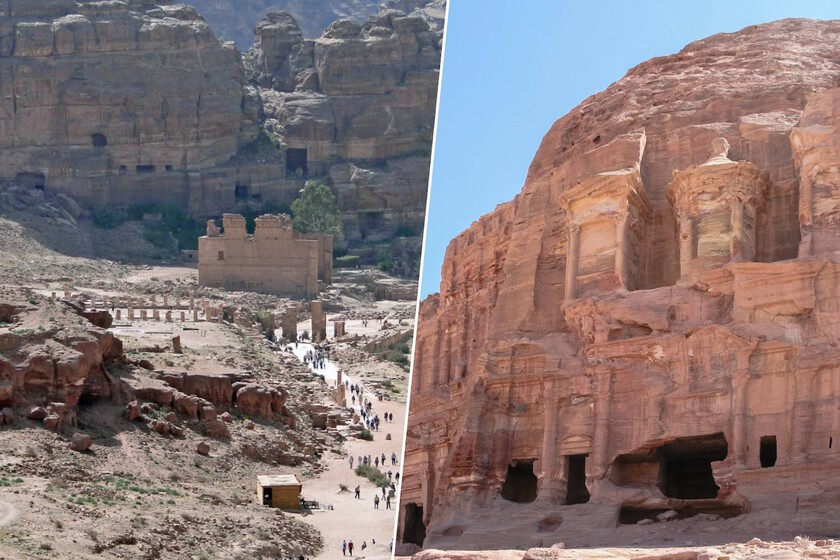
There are few monuments better known on the entire face of the Earth than Petra, the capital of the Nabataean Kingdom in the south of modern-day Jordan. That majestic façade sculpted in rock is a world heritage site. However, there is a dimension of the city that is equally impressive and that often goes unnoticed: its hydraulic engineering. In a semi-arid environment, control of water was not a mere matter of survival (as if that were not enough!) but also a symbol of power and prestige and strategic resource.
The capital of the kingdom required a stable and carefully managed water supply for drinking, bathing, agriculture, temple basins or gardens. To date, archeology believed it had a reasonably clear map of how its water network worked, but a research team from the Humboldt University of Berlin has just shown that the map was incomplete and partially wrong. Their research has been published in a paper in Levant.
The discovery. On the slopes of Jabal al-Madhbah the team has identified a 116 meter stretch of pressurized lead pipe preserved in situ in the ‘Ain Braq aqueduct, in a prospecting area of 2,500 square meters. This feature is poorly documented in open-air aqueduct corridors in the eastern Mediterranean.
Most importantly, it demonstrates that it was not a system built in a single phase. Because the investigation has documented nine conduits in total (including the aforementioned lead one), in addition to a large deposit sealed by a high dam, two cisterns and seven basins of different sizes and purposes. That is, two different technologies superimposed: first the pressurized lead pipe, which at some point was sealed, and on top of it a later terracotta network.
Why is it important. There are two levels where the discovery is relevant:
- From a technical point of view, the use of lead is rare beyond building interiors. Its presence in an outdoor channel shows that the Nabataeans had access to sufficient resources and technical knowledge to use it outdoors, rivaling the achievements of Rome. It should be remembered that lead requires mining, transportation and artisans.
- From a political point of view, it was a symbol of power and prosperity. The system fed the Az-Zantur reservoir, located on a high ridge. From there, water could be distributed under pressure to monuments such as the Great Temple and the Garden and Pool Complex. These structures require a continuous and reliable water supply, so as lead researcher Niklas Jungmann proposes, they demonstrate the luxury of running water in the desert. If you control the water, you control the city.
Context. The Siq, ‘Ain Braq and Wadi Mataha systems were the three main water supply systems of Petra and were fed by springs and reservoirs. Each of them were designed with different objectives to deal with the challenges of physics and the particular geology of the landscape, thus allowing them to supply the different sectors of the city. In a desert environment, it was an essential requirement to master water and boy did it do so: they had baths, ornamental gardens, sacred water installations and monuments that continually needed water.
Petra flourished as the capital of the Nabataean Kingdom before its incorporation into the Roman Empire and its subsequent decline following the earthquake of 363 AD. The chronological context places the lead phase probably at the height of the kingdom (1st century AD), under the reign of Aretas IV, when the city experienced an urban explosion. The transition to terracotta coincides with periods of economic restructuring or changes in administration after the Roman annexation in 106 AD, showing an adaptation towards materials that are easier to maintain.
How have they done it. Classic research approaches on Petra approached the entire city from a macro perspective and resorted to extrapolations, but Jungmann’s study focuses on a 2,500 square meter area of the Jabal al-Madhbah massif. This has allowed him to document every visible trace of hydraulic infrastructure with precision using photogrammetry and digital elevation models to understand how the terrain dictated water flow and where the use of pressure was necessary. Likewise, it did not focus on searching for objects through excavation, but rather on detailed reading of the stratigraphy and morphology of the infrastructure.
Yes, but. Although the discovery is revolutionary, unknowns remain and Jungmann himself is cautious with interpretations. To begin with, the lead pipe was abandoned and sealed to be replaced by a second network of open canals and terracotta pipes, a decision that was probably explained by costs. In addition, the study focuses on a small area and a first prospecting campaign (September 2023). That is, the connection with the reign of Aretas IV is plausible but not definitive when it comes to dating.
On the other hand, the use of lead raises the eternal question about toxicity. As a general context, in calcareous waters such as those in the region, calcium carbonate tends to form an internal layer that isolates the metal from drinking water, which would reduce the risk of contamination, although the paper does not address this issue. What is clear is that Nabataean water management was more advanced, experimental and adaptable than previously thought.
In | 2,600 years ago four Etruscans were buried in Rome. And today archaeologists have found a treasure thanks to them
In | 12,000 years ago a tribe in North America carved small dice with a single objective: to create bets.
Cover | Bernard Gagnon and Diego Delso