With summer almost (almost) around the corner, we Spaniards begin to think about where to spend our holidays. That has little new. What is curious is what the INE reveals about our behavior when planning these trips: we think less and less about national destinations, without leaving the country, and we look more abroad. The question is… Why?
Las low cost They make it easier for us, true, just as it is true that the tourism market is no stranger to generational change and changes in trends. There is, however, another key factor: the cost of spending the summer in Spain. It has risen so much and so quickly that sometimes it is more profitable to travel to the Caribbean or Indonesia.
Where do we Spaniards travel to? The question arises, but fortunately we have a valuable tool to answer it: the INE. Its technicians recently published a report on “resident tourism” that leaves a couple of curious conclusions. When we travel, we Spaniards do it above all through our own country. In fact, ‘domestic’ (national) trips accounted for 87% of the total in 2025, far from the 13% going abroad. That’s logical. The surprise comes when we go down to the detail, to the trend.
What does the data say? The INE estimates that in 2025 residents in Spain made 175.7 million trips, 4.7% less than in 2024. The ‘puncture’, however, did not affect all trips equally. The drop was concentrated in those that had a domestic destination, whose flow contracted by 6.1%.
Those made abroad experienced the opposite trend, with a growth of 5.2%. The trend was even more pronounced during the last quarter of the year: between October and December the flow of trips to destinations within the country itself fell by 7.1%. Those made abroad rose 7.2%.
|
Year |
Spanish trips without leaving the country |
Spanish trips abroad |
|---|---|---|
|
2020 |
96.45 million |
5.07 million |
|
2021 |
135.69 million |
7.20 million |
|
2022 |
155.25 million |
16.13 million |
|
2023 |
166.60 million |
19.29 million |
|
2024 |
162.81 million |
21.62 million |
|
2025 |
152.94 million (-6.1% year-on-year) |
22.75 million (+5.2% year-on-year) |
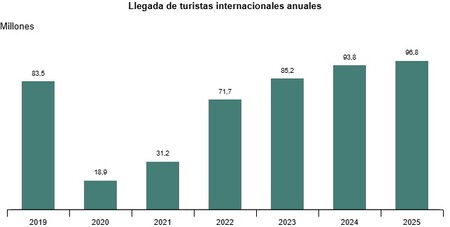
Is it the only indicator? Perhaps Spanish tourists think less about Spain when planning trips, but in return foreigners do so much more. In 2025, almost 97 million international tourists visited our country, a historical figure that maintains the growing trend registered since the health crisis. They increased over all visitors from the United Kingdom (19.1%), France (12.8%) and Germany (12%). As for the most popular destinations, Catalonia, the Balearic Islands, the Canary Islands, Andalusia and the Valencian Community stand out above all.
This flow was in turn reflected in the money billed by the sector. Last year, direct spending exceeded 175 billion euros, 5.2% more than in 2024, although the trend is again very different depending on whether we are talking about national or foreign tourists. While spending associated with foreign tourism grew at a rate of 7%, national spending stagnated, declining a slight 0.3%.
Is it something new? Yes. And no. The data itself is new and updates the ‘general picture’, but the trend comes from behind. If hotels in Spain have already managed to increase their flow of overnight stays by close to 5% in 2024, it was not due to the greater dynamism of domestic tourism, but rather due to the avalanche of foreign clients, whose demand skyrocketed by 7.5%. The same thing happened (although more cushioned) in 2025: Spaniards hired 0.2% fewer hotel rooms while travelers from other countries demanded 1.6% more.
They are not the only clues that tell us about a new reality: as tourist destinations in Spain become more expensive, driven in part by travelers from countries with greater purchasing power (in the case of the United Kingdom, France or Germany), more and more Spaniards choose to go abroad. It is not surprising at all if we take into account that sometimes spending a week in a country in Southeast Asia or the Caribbean costs the same as doing it in the Balearic Islands or the Canary Islands.
Are the prices that close? That’s how it is. At least if we go to the most extreme cases. In 2025 Mabrian carried out a study that demonstrates this with a specific case. After searching different options, their technicians concluded that the average Price of the plane ticket to visit the Balearic Islands amounted to 142.77 euros. Added to this was an average price per accommodation of 285.72. In the case of Bali the ticket rose to 238.97 euros, but in exchange the cost of the hotel remained at 99.26.
The agency made similar comparisons with Sicily, Algarve and Atalya. The conclusion was always the same: flights abroad were more expensive, but the difference with the Balearic Islands was compensated by including accommodation. Another similar analysis by Destinia, also published last year, showed that the 2,726 euros paid per couple in Menorca or 2,694 in Mojácar barely differed from the 2,883 in Punta Cana or 3,094 in the Riviera Maya.
Is there price data? Yes. And from different sources. One is the INE, which estimates that in 2025 the hotel price index increased on average by 5.1%, which raised the average daily billing of accommodation per occupied room to 127.7 euros. The other indicator is offered by the firm Cushman & Wakefield. According to their calculations, in 2025 the average price per night in a hotel in Spain amounted to 166.1, 4.8% more than in 2024 and (above all) “a new historical maximum.” In the Balearic Islands, Marbella and Benidorm the increase was around 10%.
It’s not just that hotels are becoming more expensive in Spain, it’s that they are doing so faster than those in the rest of Europe. “Spain’s 4.8% growth is well above that of Europe as a whole (1.2%) and is also higher than that of southern Europe (3.5%). In terms of revenue per available room, Spain continues to be one of the leading destinations, with an increase of 5.5%, surpassing European growth (2.1%) and southern Europe (3.9%)”, explains Elvira Arjona, from STR. In the Balearic Islands and Marvella the increase was double digits.
What are the forecasts? In February, Bruno Hallé, from Cushman & Walkefield Hospitality in Spain, issued a warning to sailors: “Hotel rates are at historic highs because demand remains strong and inflation is also driving prices up. The forecast is that the average daily rate could continue to increase in 2026, since Madrid and Barcelona are still below the rates of destinations such as London or Paris.”
Since then the panorama has changed. And in a direction that (a priori) benefits Spain. The war in Iran, the instability of the Persian Gulf, the complications that great hubs Airports such as Dubai or Doha and their impact on air traffic between Europe and Asia could cause some Europeans planning their vacations to pay (even more) attention to quieter destinations located in southern Europe, including Spain.
And how is 2026 going? There is still the unknown of how this scenario will affect national and international tourism. For now, ABC assures that Easter has left a preview of what could happen: “While Spaniards have chosen the national destination less than last year (reservations fell by 4%), choosing places like Salou, Benidorm, Barcelona, Madrid and Mojácar, mainly, those who have decided to go abroad are growing by double digits, opting mostly for cities like Lisbon, Rome, Venice, Milan and Oporto,” corroborates Beatriz Officialdegui, from the Destinia firm.
Images | Tomas Eidsvold (Unsplash) and INE
In WorldOfSoftware | Americans are the only way for Spain to reach 100 million tourists. And something is going wrong