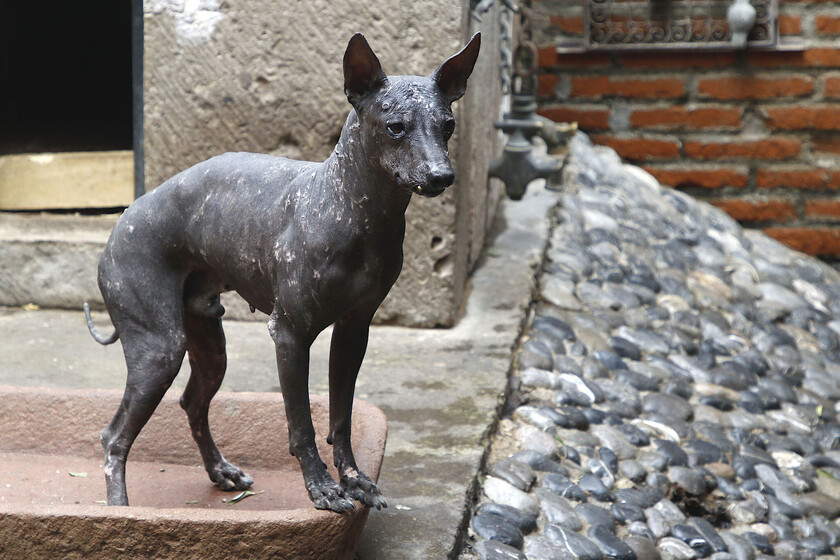
When, towards the 1930s, Mexican nationalism began to reclaim its pre-Hispanic past and rescue icons of the country, there was one in particular that stood out for its symbolism: the xoloitzcuintle. Its name may not mean much to you, but you’ve probably seen it in photos or movies like Pixar’s ‘Coco’. He sorryas it is usually known, is a breed of dog originally from Mexico that stands out for two great reasons. First, because of his appearance, bald and athletic. Second, because of its history, which dates back several millennia and is linked to the Aztecs.
For them the xoloitzcuintle was not only a pet, but a symbol associated with death and the last companion of the deceased on their journey to Mictlán, the Mexica underworld.
A name that says it all. It seems like a tongue twister, but “xoloitzcuintle” is not only the name of a breed of dog native to Mexico. The word, coming from Nahuatl, the language of the ancient Mexica, is in a way a description. There are those who believe that it is the combination of ‘Xólotl’, the god of fire and death, and ‘itzcuintli’, which means dog. Others consider that the first part of the word is more of a nod to the animal’s hairless appearance, which is why it would be translated as “strange or wrinkled dog.”
In either case, it is a fantastic business card for the ‘xolo’, a breed that has been linked to Mexico for millennia and stands out both for its exterior appearance and for its history and symbolic value. Hence, in the 1930s, the country’s nationalist movement “elevated it as a national symbol,” comments Raúl Valadez Azúa, from the Anthropological Research Institute (IIA) of the National Autonomous University of Mexico, UNAM.

No hair or premolars. Its symbolic value may not be obvious, but as a breed the Xoloitzcuintle is unmistakable. Although there are specimens of different sizes and varieties with and without hair, their specimens are usually distinguished by two characteristics: they are hairless and lack premolars. The reason must be sought in their genetic pool. During their first embryonic phase, three layers are formed in the xoloitzcuintle, as you remember from the UMAN: the endoderm, mesoderm and ectoderm. The latter, however, is affected by a mutation that affects the teeth and fur.
“It cannot be denied that a hairless dog is at a disadvantage. For example, when fighting with other dogs or in the face of climate changes. Despite this, after 2,000 years, it is still here,” reflects Valadez. Its peculiar condition also presents some advantages that have favored its bond with humans. Since it lacks hair, it is easy for us to feel its heat, which in the past led xolos to be used for therapeutic purposes to relieve rheumatism or muscle pain. Just like huge hot water bottles.
“A decision of the gods”. “The people of the region considered that, although the bald dog was a strange animal, its appearance responded to a decision of the gods and that therefore it was not up to them to kill it or decide its fate. Thus, they accepted it like other dogs and called it xoloitzcuintle,” adds the UNAM expert. The result is fascinating: a characteristic that a priori could have represented a disadvantage compared to other races, ended up becoming a sign of identity that strengthened its symbolic value and the bond with men.
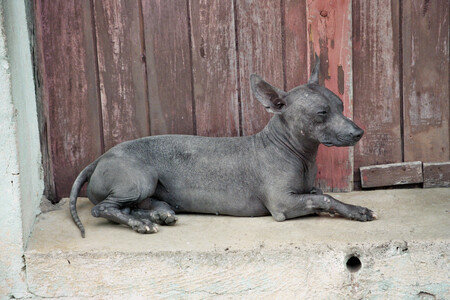
An ancient race. If the appearance of the xolo is peculiar, its history is no less so. Experts believe that the breed can date back to at least 2,000 years ago (some place it even further back, to 3,500 years ago), it emerged in western Mexico and after 500 years it began to disperse following two routes: one took it to South America, the other to Tula, Teotihuacán and Mayan territories.
Its link with humans is also very old. Researchers have found remains that date back to the 7th century and seem to associate it, even then, with funerary contexts. They even suggest that he was attributed a role as guardian of sacred spaces.
The Aztec dog. The remains of bones and ceramic fragments have allowed experts to better understand the role that dogs had in pre-Hispanic Mexico, where they were used for both eminently practical and symbolic purposes. Valadez recalls, for example, that there are testimonies that speak of ritual sacrifices of hairless dogs in times of drought or during mass ceremonies, as well as others that reveal how their scavenging habits ended up associating them with death.
“These animals were linked to the underworld because in some way what they ate in the underworld was converted into fecal matter, organic waste that was incorporated into the earth to pass to the underworld and, subsequently, returned to the earth as fertilizer that nourished the plants and, therefore, life,” reflects the expert. However, if the xolo stands out for something, if something has earned it the nickname ‘Aztec dog’, it is the spiritual role attributed to it.
The last companion. Its role in pre-Hispanic religiosity was so relevant that it is still highlighted today by Mexican authorities, who have even designated October 27 as ‘National Xoloitzcuintle Day’. Mythology claimed that when a person died, their essence undertook a journey to the underworld (Mictlán) that forced them, among other things, to cross the Chiconahuapan River. For that journey, however, he needed the help of the xolo, who would lend him a hand (or not) depending on how he had behaved in life.
Over the last few decades, researchers have found remains of dogs in graves, which has allowed them to confirm the belief that the deceased should have been buried accompanied by a dog. Of course, with an important nuance: although at first it was believed that xolos were the favorite breed for that rite, the really relevant factor was the color of the coat. It had to be toasted. Other meanings were attributed to white or black hair that made them invalid for the journey to the afterlife.
Images Milton Martínez / Secretariat of Culture of Mexico City (Flickr) 1, 2 and Octavio Cárdenas (Flickr)