Space travel is dangerous, and you need an escape plan when astronauts’ lives are threatened. It’s easy enough to vacate the ISS when someone has a medical emergency, but what if astronauts are in lunar orbit? The Moon is much further away. Still, NASA had plans in place to extract astronauts — sort of. It all boiled down to the Command and Service Modules (CSM) that got astronauts to the Moon in the first place.
According to Wired, the company that built and designed the CSMs for the Apollo Missions, North American Aviation (NAA), drew up plans for a “one-man CSM mission” that could rescue stranded astronauts. NAA provided a vague description about how one astronaut would sit in what was dubbed a “rescue CSM” and, in the event of an emergency, configure “modifications” that would let it dock with the Apollo Lunar Excursion Module (LEM). NAA’s designs also included additional room for rescued astronauts and umbilicals that would let them hook up their oxygen supplies to the CSM’s (no use rescuing them if they can’t breathe). The idea was that the rescue CSM would be on standby during each mission, perched atop a Saturn V rocket and ready to launch at a moment’s notice.
NAA proposed two “programs” to build the requisite rescue CSMs. One program involved converting two existing CSMs and having them ready by 1969, followed by building one every year; the other program would have NAA manufacture nine CSMs annually.
The best laid plans of mice and men often get denied
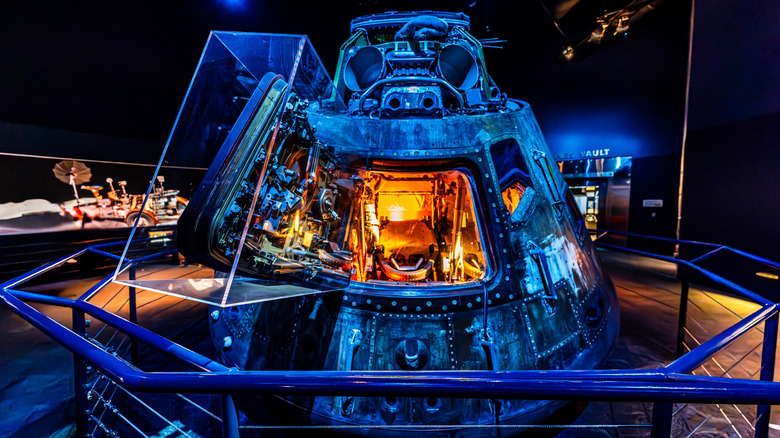
While NAA wasn’t too clear on how the rescue CSM would work and differ from a standard CSM, the organization had a pretty good idea how much it would cost to produce the modules. NAA estimated that the first plan — modifying two CSMs and then building another one every year — would cost $86 million. That would have been in addition to the $20.6 billion that was spent on the rest of the Apollo Mission, of course. However, NAA didn’t provide a budget for the second plan. While these additional costs seem like chump change, NAA also failed to account for the logistic problems built into the proposal.
One question that arose (one that NAA didn’t answer) was how stranded astronauts would survive while waiting for rescue. How would they limit their oxygen intake? How would they ration food? Could a rescue CSM even arrive in time? NASA took all of these into account and combined them with the “risks of a one-man lunar voyage” and decided to not go forward with NAA’s proposal.
Of course, this rescue plan was suggested during the 1960s. After 60 years of technological development, one might assume NASA would have a better, more feasible plan on how to rescue stranded astronauts. Well no, but even worse, according to a recent NASA report (PDF warning), the organization phased out the need for “in-space crew rescue capabilities.” According to the document, the additional resources needed for the trip and keeping a rocket on standby would be “prohibitively expensive.” Perhaps the recent Artemis III moon landing cancellation was a blessing in disguise.